They like me… they really like me!!
The Jewish and Israeli Blog Award nominations are out and Frume Sarah has been nominated for Best Personal Blog!!! How exciting! It sounds so cliched, but it really is an honour just to be nominated. The competition is going to be stiff and in fact, I am up against some of my favourite bloggers.
The first round of voting will take place from January 9-19 and I encourage you to vote and make your opinion count!
Eight crazy nights!!
This is an exhausting holiday! The kids are tired, PC is sick (as is Pepgiraffe), and I feel just plain nauseous as a result of the overabundance of fried foods.
Though Chanukah maintains a fairly low position on the hierarchy of Jewish holy days, we certainly make a point of celebrating with friends and family throughout this never-ending festival.
I love presents. I especially love getting presents from my family because they make a point of selecting things that are meaningful or fun or off my Amazon.com wishlist!! I actually love that we don’t go overboard on the gifts. I know that I really appreciate what I’ve gotten precisely because I’m not on gift-overload. Unlike my dear children — who have gotten so many wonderful things that they don’t know what to play with first.
It’s about the lights. And the food. And family. And friends. And it’s about our ability to maintain our unique relationship with God in this world.
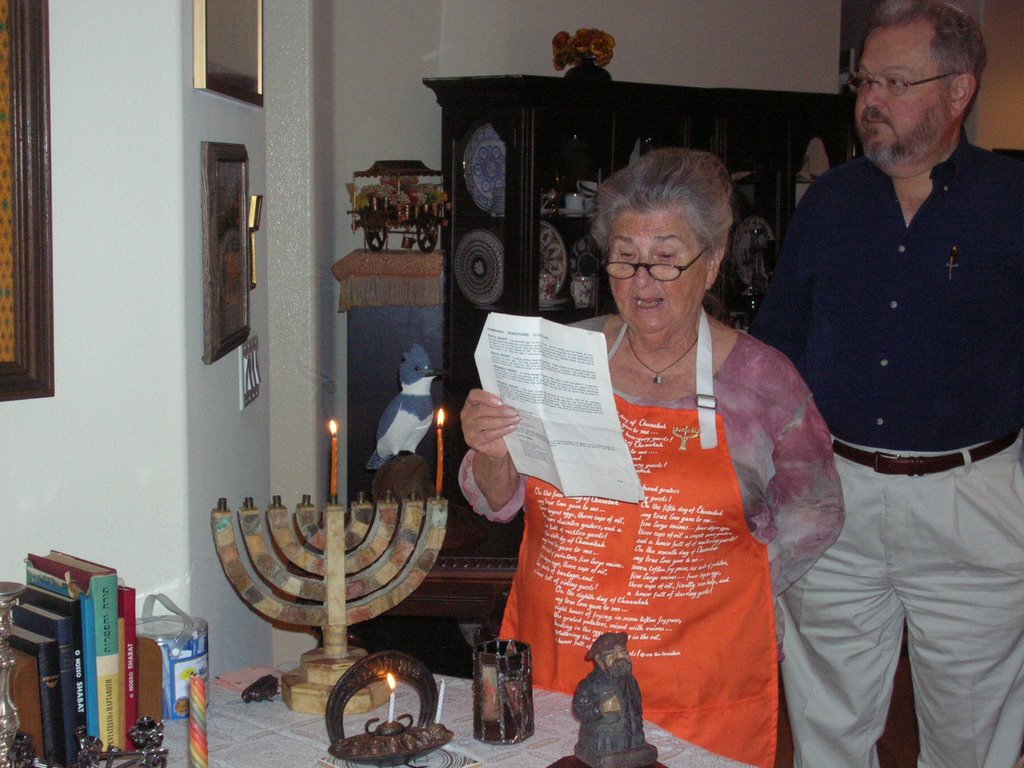
That’s what these eight crazy nights are all about.
Merry Christmas to all…
Not “Happy Holidays.” Not “Season’s Greetings.” If it walks like a duck, and it talks like a duck…
I have often said that my real talent is my lack-of-originality. What I mean by this is that I am of above-average intelligence with mostly average writing skills. My true brilliance can be seen in the ability to find quotes and writings by individuals who possess far greater talent than I could even hope to have.
This week’s missive by Danny Gordis [As I think I may have noted in an earlier posting, Rabbi Daniel Gordis (www.danielgordis.org) is Director of the Mandel Jerusalem Fellows, and the author, most recently, of If a Place Can Make You Cry: Dispatches from an Anxious State (Crown). If you ever have the chance to hear him speak, I highly recommend it!] is one of these gems. In Why Christmas is Good for the Jews, Rabbi Gordis articulates the true religious nature of our country and how it can strengthen American Judaism.
Today is not my holiday. Well, my holiday actually does start tonight…but you know what I mean. Christmas isn’t about me. Nor is it about asserting my rights as a minority to be included in the biggest event of the year. Today is about the belief, held by the majority of this country, that on this day, for one moment, perfection existed in the form of an innocent, beautiful baby. A gift, Christians believe, of eternal salvation given to them in love. It is not right for me to lessen that message. And acknowledging that the Christmas message is an essential part of the Christams holiday in no way detracts from my faith, legitimacy, or freedoms.
And so, out of genuine respect and love for my friends and family who celebrate today, I wish them a Christmas filled with peace, warmth, and faith.
What do Playboy, Ripe Cherries, and Mattisiyahu Have in Common?
I don’t know the answer to this perplexing question.
What I do know is that when I was at the check-out counter of the local record store last night, a fellow patron bought the aforementioned items.
As you might imagine, I was dying to ask.
I thought twice!
A shande far di goyim?
Today was Beernut’s “Holiday” party. The parents were asked to contribute candy or small toys that would be used to fill the children’s Christmas stockings. In a flash of brilliance, I decided that this might be a great opportunity to expose the other students to a little cultural diversity and chose to send in dreidels as our family’s contribution. I even included directions so that the kids could actually play with the compelling tops.
I thought about sending in gelt. After all, most of us use those delicious foil-enclosed chocolate coins in our dreidel game. Though come to think of it, I seem to recall hazel nuts and pennies being involved…and vodka too at some point. But I digress…
Anyhow, on the way to my favourite local Judaica store, I had a sobering thought: “What would the goyim think?” Hundreds of years of the Jew as a moneyloving, cheap banker. Would I be perpetuating this stereotype with the innocent act of including a mesh bag of gelt in the Christmas stockings of my son’s classmates?
Let’s take a look at the history of the dreidel:
The party-line that most of us learned in Sunday school is that the origins of the dreidel date back to the Chanukah story itself. Antiochus IV, the self-proclaimed divine ruler of the Greek-Syrians, prohibited the Jews from studying Torah. According to legend, the Jews needed a way to hide their Torah learning and so they used the dreidel as a decoy. When they saw the Greek-Syrians coming, the Jews would hide their books, take out their dreidels, and trick the Syrians into thinking they were just playing a game.
A perfect way to link the holiday’s history to its modern celebration, but probably not the actual genesis of this tradition. Like so many of our rituals, the dreidel game is more likely a reappropriation of a non-Jewish (or non-Israelite) practice.
A gambling game with a spinning top has been played for centuries by various people in various languages. In England and Ireland, the game of totum or teetotum, first mentioned in approximately 1500, was especially popular at Christmastime. The Germans also liked to play a gambling game with a spinning top.
It is believed that the Jewish game of dreidel is a Judaicized version of the German gambling game. The Yiddish word dreidel derived from the German word drehen, which means “to spin.” (Bet you didn’t know that!!!) The Hebrew word for dreidel is s’vivon. S’vivon comes from the word sovev which means “to turn.”
The letters on the faces of the gambling toy, which were mnemonic for the rules of the game, varied in each nation. The letters on the English spinning top were: T for Take, H for Half, P for Put, N for None. In the German game, the letters were: N for Nichts (nothing), G for Ganz (all), H for Halb (half), S for Stell (put). The German words would have been the same in Yiddish and so the Hebrew letters on the dreidel correspond to the Yiddish: Nun for Nichts (nothing), Gimel for Ganz (all), Hay for Halb (half), Shin for Stell (put).
In an effort to link the game to the celebration of Hanukkah, the Hebrew letters nun, gimel, hay and shin were said to stand for the phrase Nes Gadol Haya Sham, which means “a great miracle happened there.”
In Israel, the letter shin on the dreidel is replaced with the letter pay. Thus, the letters nun, gimel, hay and pay would stand for the phrase Nes Gadol Haya Po, which means “a great miracle happened here.”
In other words, this game is about money! Or at the very least, it is about gambling. And we didn’t even invent it. And some people are going to think that we are money-grubbing, cheap bankers whether or not I include the chocolate coins in the stocking.
End result: I opted not to include the chocolate. Figured the parents might be worried about the amount of junk their kids are going to be eating this week.
Oy, it’s a crazy world!
Rabbis in Skirts??

I kid you not — this was actually the title of an article that our local Jewish magazine ran during the summer.
And for those of you who know me, you won’t be surprised to learn that I thought it was a cute title 🙂
Beernut’s December Dilemma
“Mom, I don’t want to be Jewish anymore.”
Not an uncommon feeling for any of us to have at some point or another. I suppose I always knew that my children might express this sentiment as they made their ways through childhood or adolescence. I just didn’t expect to hear it from a five-year old.
“Why not, sweetheart,” I replied, as calmly as I could be — given the fact that I am a rabbi and this might not really be good for business.
“Because I want to have snow.”
Snow. That’s right. My poor, confused kid doesn’t want to be Jewish because he wants to have snow. Oy vey — you see where political correctedness has gotten us?? We no longer have Christmas Break but Winter Break. We don’t have Christmas concerts with Christmas songs but Holiday concerts filled with “seasonal” music. When used in a predominantly secular setting, the Christmas tree, according to the United States Supreme Court [County of Allegheny v. American Civil Liberties Union, 492 U.S. 573, 602, 616 (1989)], is a seasonal symbol. So is a menorah for that matter [Id. at 613-14, 618]. So it’s no wonder that this little Jewish kid is confused. Heck, I find this pretty confusing!
What do we say to our children who are growing up in a distinctly Christian culture? How can we help our kids avoid feelings of exclusion or, worse, resent being Jewish?
In Becoming a Jewish Parent, Rabbi Danny Gordis reminds us that “if we have brought Judaism to life all year round, then December will not be a problem.” In other words, it’s a bit late to be addressing this issue! All we can do at this point, if we haven’t been making Judaism an exciting and engaging presence in our homes, is be reactive rather than proactive. Building a sukkah for Sukkot, planting trees for Tu Bish’vat, sending Shalach Manos at Purim, attending a seder at Pesach are just some of the ways to bring Judaism alive. We don’t even have to wait for a holiday — Shabbos gives us FIFTY-TWO opportunities to do Jewish.
And with all that said, “part of what we as parents have to recognize is that raising our kids as Jews in a Christian culture is going to mean feeling left out at times.” (ibid.) How can this not be the case when Christmas completely invades our cultural at this season? And to be honest, much of this season is rather lovely. The twinkling lights brightening our neighbourhoods, the beautiful music on the airwaves, and the general sense of friendliness and kindness — warm-fuzzy stuff, if you ask me. And we, as Jews, can appreciate not just the secular nature of this holiday but truly sense its sacredness as well. For as a religious people, we understand awe and holiness, and can recognize the sanctity and beauty of our friends’ and/or extended families’ celebrations.
As for our children – they’ll be OK. Since they’ll follow our lead, it is up to us to show them how wonderful Judaism can be throughout the year. And to explain that snow really is seasonal…in places other than Orange County!
Chag Ha-Hoda-ah
The Thanksgiving Feast is almost upon us. Turkey, stuffing, cranberries, and pumpkin pie – mmmmm! You can almost taste it, can’t you??
Thanksgiving is a uniquely American family holiday that can have a special Jewish twist to it. (Of course I’m going to look for the Jewish slant…)
Most families get together for the traditional turkey dinner. Though the story of the pilgrims and their plentiful harvest that was followed by a celebratory feast with their Indian neighbours is part of American folklore, we tend to leave the story behind once we’ve graduated elementary school. It is not recalled year-after-year at the dinner table the way we retell the story of the Exodus during the Passover seder.
We have the model of storytelling with which generations of our people have taught and renewed our values and commitments. Maybe we could duplicate that model during our annual Thanksgiving meal. Many of us probably take a moment to recognize those things for which we are thankful. Why not take some time and recall the good and bad in American history? We can remember the suffering and displacement of the indigenous people as well as highlight the refuge that our country has offered to so many people.
Thanksgiving Day provides a wonderful opportunity for a living Haggadah (‘telling’), an opportunity to take stock of our country and give thanks for its many blessings and for the opportunity to work for and create change.
As we celebrate and give thanks for the freedom granted to all who have reached these shores, we think of the beautiful words written many years ago by the young Jewish poetess, Emma Lazarus. These words can be found on the base of the Statue of Liberty:
“The New Colossus” (1883)
Not like the brazen giant of Greek fame;
With conquering limbs astride from land to land,
Here at our sea-washed sunset gates shall stand
A mighty woman with a torch, whose flame
Is the imprisoned lightning, and her name
Mother of Exiles. From her beacon-hand
Glows world-wide welcome; her mild eyes command
The air-bridged harbor that twin cities frame.
“Keep ancient lands, your storied pomp!” cries she
With silent lips.
“Give me your tired, your poor,
Your huddles masses yearning to breath free,
The wretched refuse of your teeming shore.
Send these, the homeless, tempest-tost to me,
I lift my lamp beside the golden door!”
May your Thanksgiving be filled with meaning, warmth, and gratitude!
It’s Raining on Sukkah-night…
We haven’t put it up yet. It has been raining since Sunday — the day we had planned to build the sukkah.
Now my life is, at best, a hectic yet delightful mess! I often feel as though I am just one step ahead of things. Sometimes, I do try to get my act together and plan ahead. So I asked Beernut if he’d given any thought to what costume he might like for Halloween. His response: “I can’t think about that now. All I can think about is when we can get the sukkah ready.”
That was two days ago…
When we got home from school yesterday, Beernut wanted to know what would happen if we couldn’t get the sukkah up before Sukkot began.
And when he woke up this morning, dismayed to find that it was still grey and pouring, he exclaimed, “Now we’ll never have a sukkah!”
So, what to do?
I suppose I could wait for a respite from the rain, dash outside, and put up the darn thing as rapidly as possible. But what is the point here? We’ve always taken time to build and beautify the sukkah together as a family. Our decorations will surely get ruined in the rain.
Perhaps this is the year to just eat at my folks every night…
Someone Else’s Story
Some months ago, our family went to dinner at a local restaurant and had a most amazing experience. It was a Saturday night and though we had intended to get out of the house in time to avoid the Saturday evening rush, somehow it took a bit longer than we had hoped. When we arrived at our location, the wait was about 25 minutes, there was no where even to sit while waiting, and both children were close to the brink of hysteria. As PC went in search of crackers, a young couple seated at a nearby booth motioned to me.
I went over and the woman said, “we want to give you our table. Your family is so beautiful and as a mother, I don’t want your kids to have to wait for dinner.” I was taken aback. I had never met this woman and she had no obligation to relinquish her table to our family. I thanked her, and made it clear that while we truly appreciated her kindness, it was not necessary. She insisted, and so we were able to be seated and calm the kids.
There are two lessons that I took from this experience. The first lesson is that the actions of a stranger can have a significant impact. We all have a tendency to view society with a hardened eye. Small gestures of kindness, such as this one, have the ability to renew our faith in the human spirit. The rest of our meal had a special overtone to it. Though we would have eventually been seated, this act of g’milut chasadim brought a sense of holiness to our dinner.
I initially had refused the woman’s offer because I couldn’t imagine displacing anyone in order to be seated more quickly. And then the second lesson dawned on me; by accepting the table, I was allowing this woman to perform a mitzvah. Sometimes we are so focused on being independent that we overlook the importance of giving another person the opportunity to do good. When I put the stranger’s kindness into this perspective, I felt as though I had an active role in her performance of a mitzvah rather than being a passive recipient.
Beernut and Poppyseed are too young to have noticed the look of appreciation that passed between the eyes of this thankful and relieved mother and the eyes of a knowing and kind stranger. But this experience will become part of our family story, as I recall the night that an act of kindness touched our lives. And it will become an example from which I pray they will learn.
How will you become part of a stranger’s family story?

 Frume Sarah is Shabbos-observant -- in a Reform way, that is. Please note that from Friday afternoons until one hour after sundown on Saturday evenings, Frume Sarah will be unavailable, in observance of the Jewish Sabbath.
Comments made during this time will be held in a queue, to be moderated afterwards.
Thank you for your understanding...and gut Shabbos!!!
Frume Sarah is Shabbos-observant -- in a Reform way, that is. Please note that from Friday afternoons until one hour after sundown on Saturday evenings, Frume Sarah will be unavailable, in observance of the Jewish Sabbath.
Comments made during this time will be held in a queue, to be moderated afterwards.
Thank you for your understanding...and gut Shabbos!!! 


 Frume Sarah's World