Unlikely Association
Hot dogs, Andes Crème de Menthe, and ding-dong-ditch remind me of Purim.
An unlikely association. Yet, connected just the same.
When I was a girl, my parents gave shalach manos baskets to each and every household in our shul. Shalach manos, also know as mishloach manot, is the traditional gift shared with family and friends during the holiday of Purim. For days on end, our home would be filled with sweet scent of hamentashen as RebbetzinGiraffe baked dozens and dozens of batches of this Ashkenazic treat. It will surprise no one that the fillings were “traditional” — lekvar (prune), apricot, cherry.
But these triangle-shaped cookies, meant to recall Haman‘s hat, are merely the first step in the process of constructing mishloach manot. For our Sages teach (Shulchan Aruch, Orech Chayim 695:4, if you are interested) that we must include at least two different food-stuffs. In order to prepare baskets for over three hundred families, BossGiraffe enlisted the (free) help of the youth group. Assembly lines were the most efficient means for getting the job done swiftly. And with a house full of teens, there was much gaiety in the air. Styrofoam bowls filled with peanuts, chocolates, hamentashen, a card with the appropriate Talmudic quote, and — the pièce de résistance — an Andes Crème de Menthe. Wrapped in coloured cellophane and secured with curling ribbon.
Teenagers get hungry. Lunch = hot dogs (boiled…blech!), Heinz vegetarian beans (the green label), potato chips (Laura Scudder’s, perhaps?). Après avoir mangé? Purim shpiel rehearsal. Though in those days, it was less of a shpiel and more of a pantomime. And less of a rehearsal than a one-shot run-through.
But…who cares? It’s Purim, not Broadway.
And then?
BossGiraffe, who I suspect could have had a successful career as a navigator, map reader, or surveyor, took the synagogue roster, divided it into precincts, and plotted them out for the drivers. Pre-GPS, drivers routinely kept maps in the glove compartment. Especially since no one was wearing gloves at that point…
The drivers? Why, the loyal men of the Brotherhood, of course. With two or three youth groupers acting as accomplices, the driver would guide his car to the house and slow down. Out jumped a kid who would drop gingerly set down the basket at the front door, ring the doorbell and……RUNNNNNNNNNNNNNNNNNNNN!!!! Back to the car and away they’d go.
Good times.
More than once, I caught myself thinking about my parents’ massive undertaking as I baked and wrapped over the weekend; my efforts not nearly as ambitious. And in each basket, an Andes Crème de Menthe. As a tribute to those who, by their generous example, taught me this mitzvah.

Homework Tribulations

In anticipation of National Grammar Day (March 4), I share with you the following grammar exercise assigned to Poppyseed’s third grade class just this week:
Spelling Words
soarsore- wore
- form
- story
- warn
- bore
- sport
- glory
- force
- course
Sort the spelling words. Write them where they belong. Some words will fit in more than one group.
Common Nouns
1.
2.
3.
4.
5.
6.
7.
Action Verbs
8.
9.
10.
11.
12.
Anyone else see a problem here?
Just Do It!

It’s a gift, the day of rest. It really is.
Start small. Don’t let the sanctity of the day scare you away.
If you’ve never observed Shabbat, that’s OK. Because it’s never too late.
Looking for ideas?
Don’t know what to do? How to start? Where to go?
You’re in luck. This week is Shabbat Across America. Click on the link and let them guide you to a Shabbat project that is right for you.
And…early Shabbat Shalom!
Visiting the Sins of the Parents
We. were. relentless.
For weeks — nay, months — we asked, begged, cajoled, negotiated, and pleaded. And I imagine that DadGiraffe believed there was no other choice than to grant our wish.
It was not without provisos, however. If we insisted that he bring home a cereal that he warned would be foul-tasting, we had to finish it. All of it. The entire box. It would be one of the two open boxes that were permitted at any given time. [Although, I do recall that at a certain point, perhaps after Ace was old enough to eat cereal, that there was a temporary three open-box amendment to the rule.] Should we fail to consume the entirety of the cereal in question, a sugar-cereal moratorium would go into effect. Immediately. And eternally.

Source: Wikimedia Commons
You don’t need me to tell you the rest of the story, as Paul Harvey was wont to say. DadGiraffe bought Cookie Crisp and it was, in fact, vile. Just vile. And try as I might, I could not bring myself to finish the box.
I am amazed, these many years later, that I never thought to siphon off a bowl-sized amount each day. It might have saved us from the sugar-cereal hiatus that befell our home. And while it wasn’t eternal, it was several years in length. Long enough to drive home the point.
So when my own children recently asked, begged, cajoled, negotiated, and pleaded, I shared my own woeful tale. Hoping that we could avoid the mistake and associated consequence. It is the rare child who is willing to make decisions based on his or her parent’s life experience.
And that rare child is not to be found among the frummies.
I bought, they tasted.
And now they are trying to consume the vile, foul-tasted cereal in their attempt to have a different ending to their story.
Chodesh Tov — Happy New Month
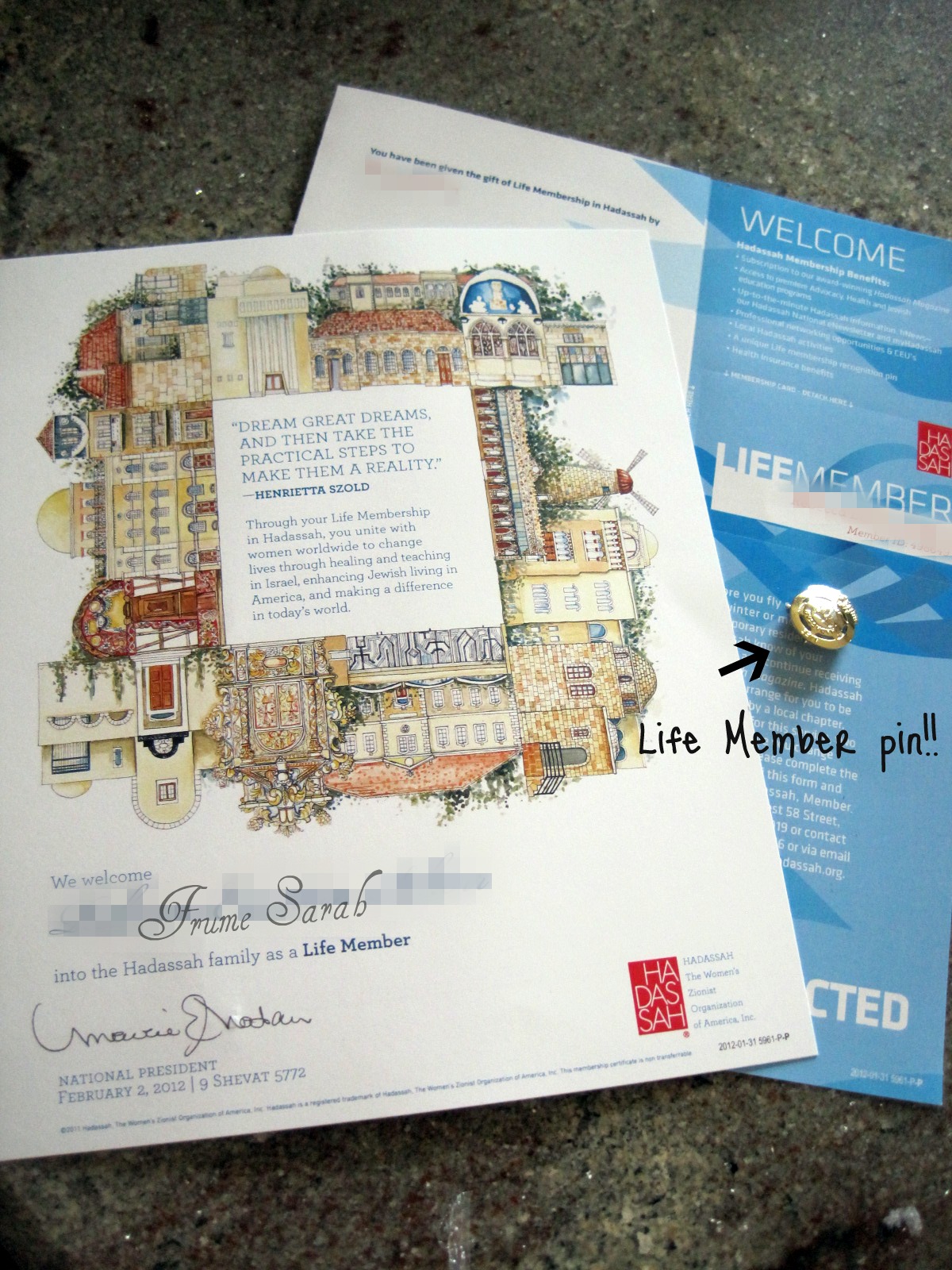
Guess who's finally a Hadassah lady???
It seems only fitting that Poppyseed and I received our Hadassah welcome packets on the first day of Adar for I have always associated the month with this American Jewish women’s volunteer organization, founded by Henrietta Szold in 1912.
It all stems from Megillat Esther Chapter 2, verse 7:
ז וַיְהִי אֹמֵן אֶת-הֲדַסָּה, הִיא אֶסְתֵּר בַּת-דֹּדוֹ–כִּי אֵין לָהּ, אָב וָאֵם; וְהַנַּעֲרָה יְפַת-תֹּאַר, וְטוֹבַת מַרְאֶה, וּבְמוֹת אָבִיהָ וְאִמָּהּ, לְקָחָהּ מָרְדֳּכַי לוֹ לְבַת
7 And he brought up Hadassah, that is, Esther, his uncle’s daughter; for she had neither father nor mother, and the maiden was of beautiful form and fair to look on; and when her father and mother were dead, Mordecai took her for his own daughter.
During the annual Megillah reading, BossGiraffe would tease the congregation: “And he brought up…Jewish Women International, formerly known as B’nai Brith Women…National Council of Jewish Women…Women of Reform Judaism, formerly known as the National Federation of Temple Sisterhoods…And he brought up Ha-DAAAAAAA-ssah.”
Even before I understood the particular missions of each of these women’s organizations, I knew that they had a place in our larger American Jewish story. And now, thanks to BubbeGiraffe, Poppyseed and I are life members of this worthwhile organization.
Finally…I’m a Hadassah lady!!
Ash Wednesday Repeat
 As I wrote last year, I always recall my Theory professor on Ash Wednesday. Here’s why: Meaningful Schmutz
Mystery Solved

A week away from home meant a week’s worth of mail! And, as I’ve mentioned, Frume Sarah loves mail. Especially packages.
SO I was particularly thrilled to be handed a box upon my return. I opened this by mistake, confessed PC, I think it’s for you. And out came this =====>
I didn’t order this, said I.
Are you sure? asked he.
I’m sure, said I, perhaps you ordered it for me as a surprise?
Nope, confirmed he.
But here’s the weird thing; I’d pinned it on Pinterest. I meant to buy it…just hadn’t gotten around to it.
Are you sure you didn’t buy it as a surprise? pressed I.
Nope, insisted he.
It turns out that Syl, who follows me on Pinterest, saw that I wanted this and had it sent for my birthday. Somehow, the gift note never made it inside the package.
How much fun it is to receive something you wanted from someone without knowing that they knew what you wanted!
Lesson Learned: One at a Time
I treated myself to a birthday gift.
Now, that’s not so out-of-character. What better way to make certain that one receives what one wants??
What is really shocking is what I purchased for myself.

Happy birthday to me!
That’s right. A cookbook.
I bought myself a new cookbook.
Admittedly, it is the first time that I ever received a cookbook as a gift outside of our engagement and wedding. Of course, it’s also the only time that I received a cookbook as a gift that I knew I’d use. Right away. In fact, I tried a tomato crisp that very day as part of my birthday dinner.
Ah-ha — I was reminded that I recently received a no-occasion gift from Mom-&-DadGiraffe that would fall into the general category of ‘cooking.’ Inside the Jewish Bakery: Recipes and Memories from the Golden Age of Jewish Baking is about baking and not cooking. I know so little about such things that I don’t even know if one can correctly refer to a book about baking as a cookbook. One day, please God, I’ll have enough skill confidence to attempt the delicacies in it.
Over last Shabbat, I poured over the pages in order to determine what I wanted to try in the upcoming week. A new dish on Tuesday. One on Thursday. But it was Shabbos dinner that captured my fancy.
- challah
- Za’atar Chicken with prunes, dried apricots, and Spanish olives
- Tzimmes Puffs
- Citrus-Hazelnut Green Beans
- Basmati Rice (white and brown, combined)
- Zebra cookies
A few things to note:
Before we moved to the middle of a corn field, we lived in an area with a considerable Arab (Muslim, Christian, AND Jewish) population and a sizable Israeli population. Za’atar is widely available. Here? Not so much. The za’atar I did {{finally}} locate turned out to be a very anemic version. [And it went directly down the drain upon receipt of a care package from the Ima.]
Tzimmes. We were not a tzimmes family when I was a kid. Or kugel. Sure, they made their seasonally-appropriate, cameo appearances, but were not regulars on the Shabbos rotation. Also, I don’t like sweet unless it’s a dessert. Or during breakfast. Otherwise, I’ve never been a fan of sweet potatoes, candied yams, etc.
And did I mention that for about two months when I was a kid, we had a dog named Tzimmes? A blog post for another time…
Just as I was about to start the green beans, I had what turned out to be a perfectly-timed change-of-heart. And replaced the fancy-shmancy green beans with simple, rather unoriginal, canned French-cut green beans. And it was a very, very smart move.
Because PC and I were the only ones who enjoyed my culinary efforts.
The kids were unimpressed. The chicken looked weird. The tzimmes tasted weird. The basmati rice wasn’t sticky enough.
Later that night, Beernut did the math for me:
For Shabbos, Mom, you can only make one new thing. We look forward to Shabbat dinner all week. And it needs to be stuff we like or else it’s ruined. So three old things and one new thing would be good.
Sydney Taylor Book Award Blog Tour 2012: Interview with author, illustrator, Durga Yael Bernhard
I have a secret.
The secret is that this post was so much fun to craft. Interviewing Durga Yael Bernhard, who goes by Yael, was like having a chat with a friend. Her expertise, creativity, and passion are engaging. I read Around the World in One Shabbat: Jewish People Celebrate the Sabbath Together, in advance of the interview. Afterwards, I ran right back to it, with newfound knowledge, to better appreciate the story and the artistic renderings. It was like reading a page of text on its own and then reading it with the commentary; a whole new world of understanding.
Yael, I really loved the book! Before we get into the artwork, I’d like to step back and ask, first, where did the idea first originate? What was the initial spark that made you think, “a book about Shabbat observance around the world?”
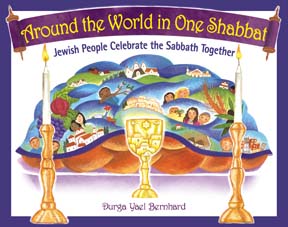
I’ve always loved the thought that on every Shabbat, Jews all over the world are doing the same things: cooking a special meal, setting the Sabbath table, lighting candles, reciting blessings, going to synagogue, reading the weekly Torah portion, eating great food and relaxing. It’s easy to imagine children everywhere who are just like my own daughter growing up with this tradition. I want all children to have an inside peek at what the Sabbath is really like; and I want parents to know how much it supports family life to have a sanctified day of rest.
I’ve written and/or illustrated a number of books that explore the commonality of children all over the world. A Ride on Mother’s Back (1997, written by Emery Bernhard, still in print) shows how babies in many cultures are still carried through daily activities, and what they learn from that unique perspective. While You Are Sleeping: A Lift-the-Flap Book of Time Around the World (2011, just named as a Children’s Book Council Notable Book) shows one moment in time in the lives of children all over the world. These books explore the universality of children’s internal experience as they move through the daily rhythms of their lives. Similarly, Around the World in One Shabbat: Jewish People Celebrate the Sabbath Together invites readers to share in a tradition that marks the cycle of each week. What better window on the Jewish Diaspora and the world?
Which comes first to you: the text or the images? And at what point did the notion of weaving the appropriate blessings through the primary text come to you?
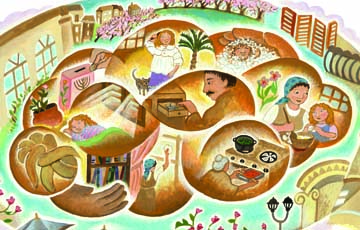
What came to me first was the core concept of the book. Since I am first and foremost a visual artist, images always come next. In this case, the first sketch I did was a challah as a weaving of many household scenes “braided” together. From the oval shape of this drawing came the idea that each illustration would occupy the basic shape of a horizontal oval, symbolizing the world and the cyclical and inclusive nature of Shabbat. Other drawings grew from there. The blessings seemed only natural, as they are the verbal consecration of Shabbat – and children’s knowledge of language and music are indelibly interwoven with their memories and experience.
I really like how you use the different time periods of the Shabbat as a framework. Did that idea come first or did you just write the vignettes and then realize that the framework was inherent in the text itself?
The framework came first. Like the spokes of a wheel, the various stages of the cycle of Shabbat give us opportunities to participate. I began by asking: when does the Sabbath really begin each week? Since observant Jews do not cook during Shabbat, the cycle begins with food shopping and preparation. One visit to the Machane Yehudah in Jerusalem confirms that by Friday morning, something is already different. Torah study for the weekly parshah begins even earlier than that. The benefits and effects of the Sabbath extend beyond the 25-hour cycle of the actual day of rest. Each stop along the way involves children in one way or another.
How did you arrive at the particular locations? I know that you have a passion for African culture and Eastern religions. Did that love influence your choices?
No. My goal in choosing locations was not to show what attracts me personally (which is always changing), but to create a well-rounded portrait of the Diaspora. My editor and I wanted to portray a diverse selection of Jewish cultures. We decided to include some of the largest Jewish communities in the world (France, Germany); some that may be lesser known to American readers (Argentina, Australia, and Morocco); some that are waning (Ethiopia, Russia); some that are growing (Mumbai); and some that are not indigenous at all but composed of international travelers (Thailand). We wanted to include rural scenes (Ethiopia, New England) and city scenes (Montreal, Istanbul); older synagogues (France) and a brand new synagogue that is based on a real one (Germany). Anchoring all this are scenes from Israel which are the “bookends” of the story – and the soil in which the Sabbath tradition finds its roots.
Are there any stories in the book that particularly resonate with you? What about the illustrations? Any favourites?
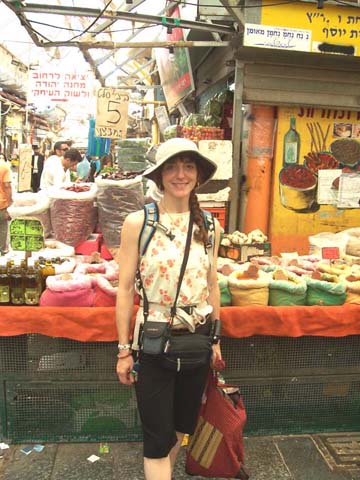
Yael at the shuk
The scene from New England resonates because I have been to that synagogue, and watched my own daughter reaching for the challah during the Hamotzi blessing there. But the opening scene from the Machane Yehudah is my personal favorite, because I took all my own photographs there specifically for this book. 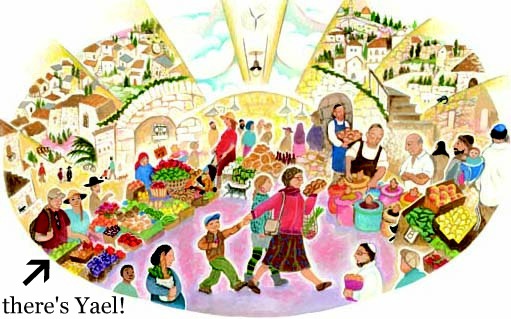 In fact, I have painted myself into that scene, wearing a blue shirt and straw hat while shopping with a friend. The little boy, Avi, in the scene is based on a photo from that friend’s childhood. The teenager, Rachel, is based on an Israeli friend’s daughter. And the grandmother carrying the challah is based on a woman in Jerusalem who became my friend on that trip.
Because you have characters from around the globe, what type of research is involved in making certain that you are portraying them accurately, as far as the illustration goes? And the scenery? And the overall timbre of each scene?
A great deal of research is involved. I use everything from personal photos and notes taken on my own travels, to interviews, library research, images found on the internet, newspapers, websites such as JewishEncyclopedia.com, and museums such as Beit Hatfutsot (the Museum of the Diaspora) in Tel Aviv. Researching contemporary first names in other cultures was especially tricky, as children’s names gain and lose popularity with each generation. I wrote a blog post “What’s In a Name?” just on this subject.
In your YouTube clip, I recognized snippets from all different pages in the book on one page. What motivates you to tackle them in either a particular or random order? Do you wake up and think…”aha! I dreamed the perfect texture and design for the rug in the India scene and I must sketch it immediately”…and then think…”and I am in the mood to work on the hut over in Ethiopia as well?”
I only grouped those illustrations together because they are all “spots” (small, free-floating images) that would be placed later on each page amongst the text. I did not paint these spots at the same time, but rather worked on each one simultaneous with the main scene to which each one belongs. This way, skin coloring, clothing, and details such as fabric, furnishings and architecture in each scene are done all at the same time for consistency.
I normally begin working on each scene by gathering books and photos, then making a desktop collage out of many images from that culture. The collage covers my whole computer screen. This allows me to view many things at once in an effort to establish the overall look or “timbre” of each culture.
How did you arrive at Hinei Mah Tov as the song? Was there something about this particular song? For that matter, does music play any role in your act of creating?
I often listen to the music of a particular culture while working on a illustration from that culture, in order to evoke the right feeling. Somehow, it puts me in the right mood. I chose Hinei Mah Tov because it is so well-known, and represents well one of the main themes of Shabbat. While I was working on that illustration of the little boy singing zemirot in his grandfather’s lap, what came to mind most of all were memories of the sounds of singing coming from residential windows as I walked with a friend through the streets of Jerusalem one Erev Shabbat – mingled with the sounds of clinking silverware and babbling babies – all clearly audible in the striking absence of city traffic. This was a real treat for me. I live in a rural area of the Catskill Mountains of New York, and am more likely to hear an owl hooting or a coyote howling on Erev Shabbat than the sound of human voices.
Thanks so much, Yael, and mazal tov on this achievement!
Around the World in One Shabbat: Jewish People Celebrate the Sabbath Together is available at Jewish Lights. And, like all quality children’s lit, isn’t just for kids.

*The Sydney Taylor Book Award is presented annually to outstanding books for children and teens that authentically portray the Jewish experience. Presented by the Association of Jewish Libraries (AJL) since 1968, the Award encourages the publication and widespread use of quality Judaic literature. Gold medals are presented in three categories: Younger Readers, Older Readers, and Teen Readers. Honor Books are awarded silver medals, and Notable Books are named in each category. Thirty-three outstanding books were selected from among the over one hundred and twenty titles evaluated by the Sydney Taylor Book Award Committee during 2011. The Committee recommends them for library, classroom, and home use. A complete list of all 2012 Award, Honor, and Notable Books can be found here.
Chag Ha-Ilanot Sameach — Happy Festival of the Trees

It was hard to create the kind of vibrant Jewish home I wanted for my children when I was so busy bringing Judaism to others.
I couldn’t find the time. I lacked the energy.
So I see it as a blessing that my new “career” affords me the time (actual, mental, emotional) to infuse our home with the Yiddishe ta’am, best translated as ‘Jewish flavour,’ that surrounded me as a child.
Today is Tu BiShvat – the birthday of the trees. A beautiful explanation, written by one of my Rabbis Without Borders colleagues AND a fellow IC alumna, can be found here. Taking inspiration from some of my rebbes (Ima on the Bima and Homeshuling, I’m looking at you!), we enjoyed a Tu BiShvat feast last night. An aromatic meal with herbs and seasonings from the land of Israel, rounded off with a fruity fondue.
Will this one moment be THE ONE that they recall when they are parents themselves? Who knows. For now, PC and I enjoyed watching them discover how yummy fondue can be. And which fruits they liked the most when dipped in chocolate. And catching one of them (any guesses??) eating forkfulls of just chocolate. A sweet way to begin the holiday.
Conversations about the importance of trees and what we can do to protect God’s gifts. Acknowledging the many, many ways our lives are enhanced by nature.
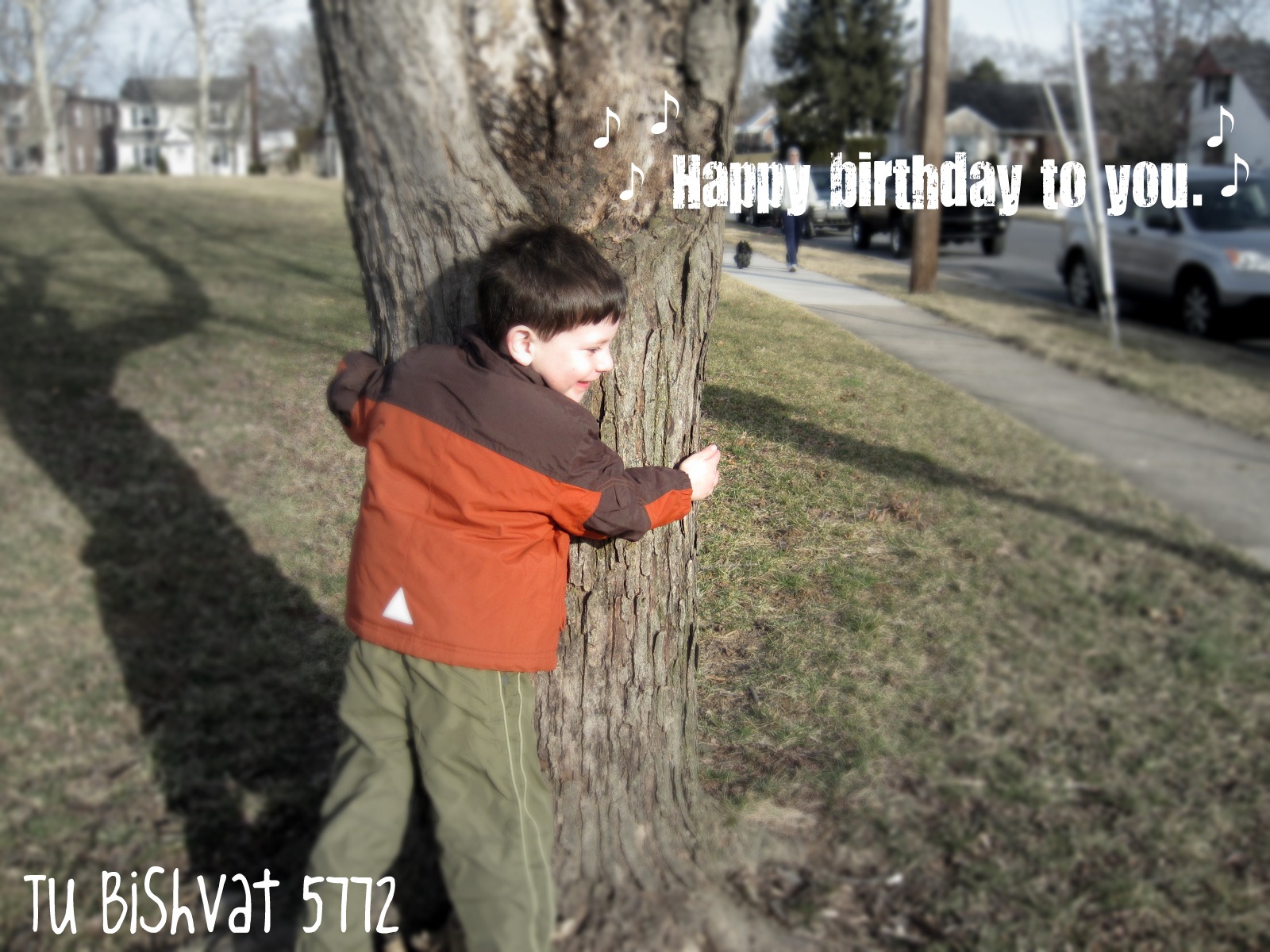
And before school began, a song and hug for a dear friend.
Related articles
- Tu Bishvat 2012: Environmental Jewish Holiday Celebrates Mystical Fruit (huffingtonpost.com)
- Happy Tu Bishvat, the new year for trees (mnn.com)
- Rabbi Yonah Bookstein: Tu Bishvat Seder: A Kabbalistic Celebration Of Trees (huffingtonpost.com)

 Frume Sarah is Shabbos-observant -- in a Reform way, that is. Please note that from Friday afternoons until one hour after sundown on Saturday evenings, Frume Sarah will be unavailable, in observance of the Jewish Sabbath.
Comments made during this time will be held in a queue, to be moderated afterwards.
Thank you for your understanding...and gut Shabbos!!!
Frume Sarah is Shabbos-observant -- in a Reform way, that is. Please note that from Friday afternoons until one hour after sundown on Saturday evenings, Frume Sarah will be unavailable, in observance of the Jewish Sabbath.
Comments made during this time will be held in a queue, to be moderated afterwards.
Thank you for your understanding...and gut Shabbos!!! 


 Frume Sarah's World