Purim Like You’ve Never Seen It

What do you get when you take a bunch of Jewish comedy writers and ask them to reimagine Purim with a bit of pop culture, satirical levity, and respectful irreverance?
You get The Shushan Channel.
For the 8th consecutive year, the NYC Purim scene will be taken by storm by this creative endeavour. Directed by Mike Shapiro, and headlined by Lizz Winstead, (co-creator of The Daily Show and creator of Shoot the Messenger), this year’s cast includes actors and writers from The Daily Show, The Tonight Show With Conan O’Brien and 30 Rock. Special appearance by 30 Rock’s Scott Adsit (10pm show only), a video presentation by Joel McHale, AND a surprise message from a star of The Tonight Show.
This year’s skits include Persia Shore. Flight of the Conquereds. Glee-vey! Glenn Beck, Harry Potter & Facebook – ancient Persian style! Want the inside scoop?
Still not convinced?
Tickets are available exclusively at the 92nd St. Y. They WILL go fast…so don’t delay.
Making Memories
I’m a hamantaschen expert, you know.
And what makes one a hamantaschen expert, Poppyseed??

- You have to learn from another hamantaschen expert
- You have to practice. A lot.
Bubbe taught me how to make hamantaschen. She’s an expert, you know. And she always lets me do the pinching. That’s my specialty. The pinching part.
For the record, Bubbe really is a hamantaschen expert. Though she has scaled back her hamantaschen operation, there was a time that she made enough of these delicacies for the entire congregation.
Frume Sarah, on the hand, is not an expert. Every year, I attempt to make hamantaschen that NEVER taste as good as Bubbe’s. So this year, a new tactic.
I’m not using Bubbe’s recipe.
Since I can’t make them as good as Bubbe using her recipe, I decided that I would seek out a new recipe. I had planned to try out new recipes in the weeks leading up to Purim. With the recent events in our family, I had to go with Plan B; choose just one new recipe for this year and hope for the best.
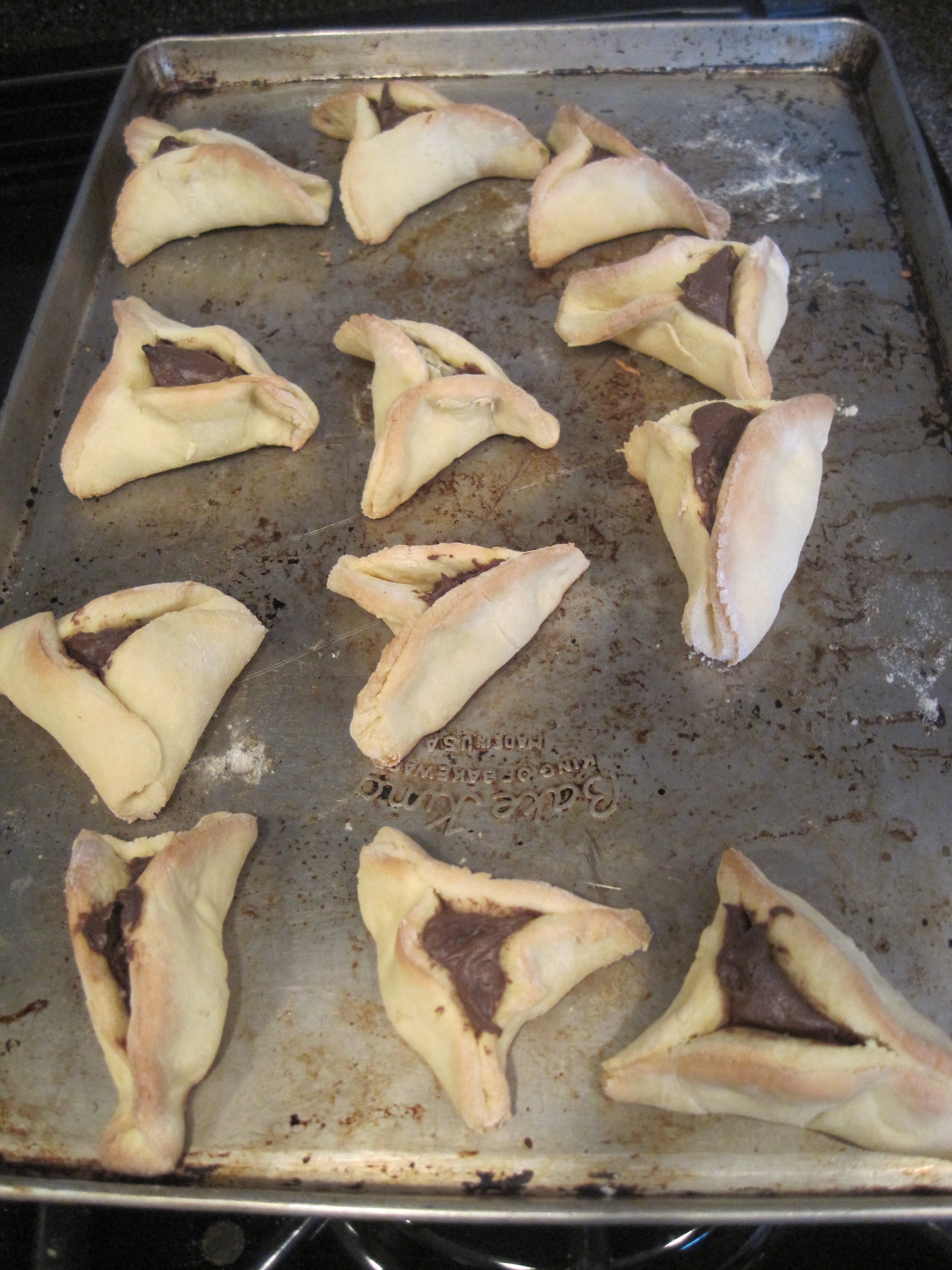
[This one was recommended by my friend, and classmate, Rabbi Susan Lippe. I adapted the filling suggestions.]
- Ingrediants
- 1 (18.25 ounce) package moist yellow cake mix
- 1 cup all-purpose flour
- 2 eggs
- 2 tablespoons water
- 1 cup Solo cake and pastry filling (any flavour), chocolate spread, Nutella, etc.
Directions

- Preheat the oven to 375 degrees F (190 degrees C). Grease cookie sheets.
- In a large bowl, mix together the cake mix and flour. Stir in the eggs and water to form a stiff dough. On a lightly floured surface, roll the dough out to 1/8 inch thickness. Cut into 3 inch round circles and place 2 inches apart onto the prepared cookie sheets. Place a teaspoon of filling into the center of each cookie and pinch the sides to form three corners. Moisten with water if necessary.
- Bake for 6 to 8 minutes in the preheated oven, or until lightly browned. Allow cookies to cool for 1 minute on the cookie sheets before removing to wire racks to cool completely.
[There was a request for peanut butter. Now, it will come as no surprise that I am a traditionalist. I never thought that I would veer from lekvar, apricot, etc. Chocolate was a compromise that I made early on in order meet the needs of the kidlets. But peanut butter?

Tasted good…but with hamantaschen, one must not discount presentation. Chocolate, however, prevents the peanut butter from escaping!!! And tastes delicious.]
The Verdict??
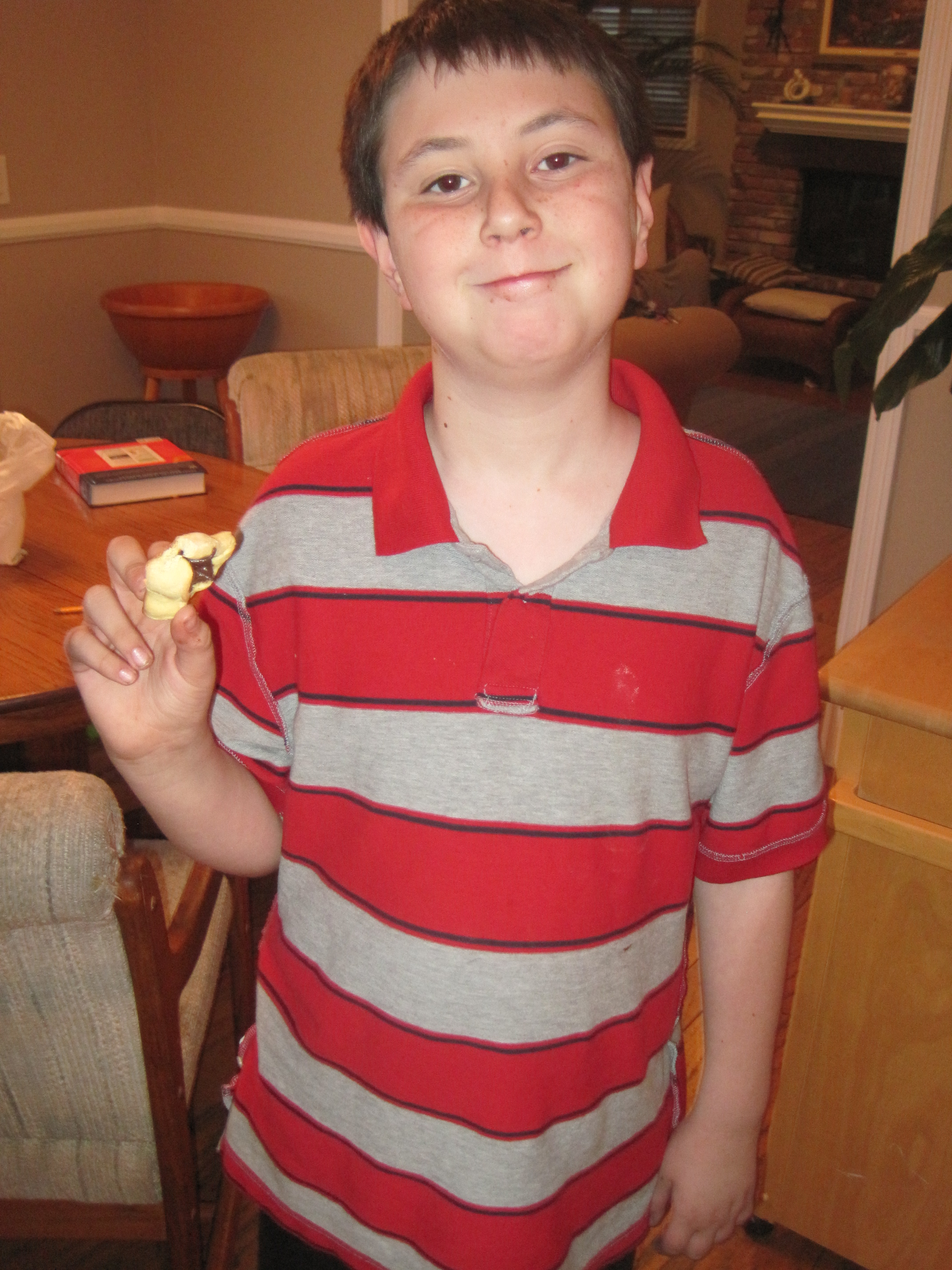
Awesome!

Delicious!
The Gift of Life
 Imagine if you had the ability to save a life. Can there be a greater feeling of satisfaction than knowing that because of you, someone will live to see a lifetime of sunrises?
Imagine, now, being in a situation where your very life depends on the gift of a stranger. What is it like to live each day, not knowing if that gift will ever be forthcoming?
Joe Antanoff is waiting. Diagnosed this past November with Acute Lymphoblastic Leukemia, this father-of-two needs a bone marrow transplant. Though family members have the best odds, neither of Joe’s siblings is a match. Now it is time to widen the familial circle to include all Ashkenazic Jews. Statistics suggest that Joe’s chances of finding a match are higher within our ethnic group.
Registration with the National Bone Marrow Registry is simple. All it requires is a simple blood test OR cheek swab. During the rest of this month, the $60.00 registration fee is waved if you enter “Joseph” as the promo code.
Please consider registering. It might be the first step to gifting life.
As we are taught in Sanhedrin 37a, to save a life it is as though one has saved a world.
Attitude Adjustment Required

Four years ago, I was intrigued with the number of Frozen Chosen who were participating in the Turino games. As I then mentioned, I love the Olympics. I get completely caught up in the human interest aspect and enjoy watching the high caliber of athleticism and determination. As a citizen of the world, I get a thrill watching each team enter the arena during the Parade of Nations. As an American, it does give me satisfaction when an compatriot medals. However, I truly rejoice when the ones who executed the most flawless routine or played the best match are rewarded. Even when that athlete is from a country other than my own.
Perhaps it is for that reason that I have no tolerance for bad sportsmanship. After the race has been run (or the routine has been skated, in this case) and the judges have rendered a decision, accept it or don’t. But keep your thoughts to yourself.
There were many amazing moments in last night’s Mens Figure Skating Long Program. Extraordinary artistry and incredible power. Both are required. And both are rewarded. If it was just about the jumps, it would be a jumping contest.
Evgeny Plushenko is the best jumper in the world. For him, it really is all about the quad, as evidenced by this statement:
Still, he and his coach, Aleksei Mishin, continued to say that male skaters who did not try the quad were basically wimps. Their theory is that no-quad performances are setting the sport back at least a decade. Mishin said “a real champion should execute quadruple jumps.” Plushenko hinted that Lysacek’s performance was subpar.
“If the Olympic champion doesn’t know how to jump a quad, I don’t know,” Plushenko said. “Now it’s not men’s figure skating. It’s dancing. Maybe figure skating needs a new name.”
[For the record, Evan Lysacek, “the Olympic Champion”, does “know how to jump a quad.” having successfully executed them in the past, Lysacek was forced to abandon the quad due to a stress fracture that he sustained earlier this season. Though that fact did not stop Plushenko from getting in his digs during the week leading up to the competition.]
Like all bad sports, the responsibility lies elsewhere. Plushenko cites a flaw in the judging system as the reason for his second place finish. At least, that was the reason after a good night’s sleep. His original thought?
“I was positive that I won,” Plushenko said. “But I saw that Evan needs a medal more than I do. Maybe because I already have one.”
A Slow Return
Bagels. Rolls. Hard-boiled Eggs. Nahit . Served at the Seudat Havra’ah, the round shapes are to remind us of the cyclical nature of life. Furthermore, eggs are a reminder of life and hope (Orakh Chayim 552:3). All that lives must die and these symbolic representations remind us of this inevitability.
The most intense period of mourning is known as shiva. It is commonly thought to last for seven days after the burial, but that is not an accurate understanding. In counting the days, our Tradition follows the principle of considering a fraction of a day as a complete day. The day of the burial counts as the first full day even though burial may have been later in the day. Also, the seventh, and final, day is not an entire day. Observing shiva for sixty minutes on the morning of that final day is sufficient.
The process of emerging from the intensity of this seven-day period is just that. It is a process. Having withdrawn from life to mourn a loved one, the time comes when one must be gently guided back towards a new normal. Tradition has the mourner cross the threshold, walk around the block, and return home. Home to what was once the house of mourning.
Our home was not the house of mourning. And Frume Sarah is too superstitious to engage in behaviours that might catch the attention of the Malakh HaMavet. So no morning shpatzir for the Frummies. Yet we had to mark the end of this sadness in some meaningful way.
I explained to the children that we were having a special treat for breakfast to signify our attempt to reenter life without GGma. A treat loved by GGma. And one that symbolized the circle of life.
Peach shared this with his beloved teacher.
My GGma died. I got a chocolate doughnut.
I wonder if this is what the prophet meant when he comforted:
Your sun will not go down again,
your moon will not depart;
for the Eternal One will be your Light forever,
and your days of mourning will be ended.
(Isaiah 60:20)
Theory of Relativity

I am not one of the seven.
I am not her brother or sister. I am not her son or daughter. I am not her mother or father. And I am not her spouse.
Therefore, Jewish law does not regard me as an obligatory mourner.
Obligatory mourners have certain restrictions placed on them in order to allow them the space to mourn. They are to refrain from all social pleasantries and major positive religious requirements during the initial days. The mourners must remain in their homes during the week of shiva — with certain exceptions. They are to wear their rent garment (or torn back ribbon) throughout the week, sit on lowered seats, wear slippers or stockinged feet, abstain from shaving, the wearing of cosmetics, Torah study, and sexual relations. The mirrors in a house of mourning are covered. The list goes on…
I am not bound to the restrictions. Nor are these behaviours required of me.
My grandmother died. Jewish law does not obligate me to behave in any way. And yet, by not binding me to the prescribed mourning rites, it is as though my relationship has somehow been deemed “less than.”
Is this what the rabbis had in mind?
In seeking an answer across the ages, it is often useful to look at a similar circumstance in order to arrive at a reasonable explanation. Consider the minimum lifespan required to establish a human being as a viable person. An infant less than thirty days is not considered a viable person and is not mourned should, God-forbid, death occur before the thirty-first day of life.
When first confronted by this text from the Shulkhan Arukh (Yoreh Deah 374:8), the decision by the Rabbis to forbid mourning rite seems heartless and cruel. I came to learn that the Rabbis arrived at this conclusion at a time when infant mortality was high. In order to spare the feelings of the bereft parents, they established a minimum age of thirty complete days. Living until thirty-first day increased, though did not guarantee, the odds that this was a viable life.
Application of the Rabbis’ protective intent in the case of an infant to the definition of “who is a mourner?” leads to one possible conclusion; by limiting the categories, the Rabbis limit the opportunities to thrust an individual into the restrictions of mourning.
Whereas in the case of an infant death I concur with the current liberal approach that encourages parents to observe mourning rites, I am too much of a traditionalist (not to mention a superstitionalist) to argue for a change.
Our Sages did acknowledge that some relationships stand outside the traditional seven and may warrent some fashion of ritual mourning. A glance at the Kitzur Shulkhan Arukh (203:2) shows that partial mourning may be observed for a cousin, grandson, mother-in-law, father-in-law, and grandfather. [Later commentaries instruct an individual with living parents to obtain permission prior to observing rites for a mother-or-father-in-law.] Surely, in our egalitarian community, we might expand this list to include a granddaugter and a grandmother.
Relationship titles can be misleading. Though they accurately describe the familial relationship between two people, they do little to define the actual relationship. I suppose that people have no way of knowing that a chasm remains in the place once filled by my grandmother. I wore no ribbon. My mirrors remained uncovered. No outward sign of the mind-numbing grief.
Guilty Pleasures

We all have them. Since 1907, something pleasurable that induces a usually minor amount of guilt has been known as a guilty pleasure.
When asked to name their own guilty pleasure, many people will offer a type of junk food, a pricey line of handbags, or a massage or mani/pedi.
I have the following thoughts —
junk food — eat it or don’t eat it. but don’t ruin it by feeling guilty about it.
handbags — ditto. buy it…don’t buy it. but it you buy it…enjoy it!
massage or mani/pedi — it’s maintenance. promotes relaxation. NOTHING about which to feel guilty.
So here’s my weekly guilty pleasure:
The New York Times wedding announcements.
Every week, I eagerly await the end of Shabbat so that I can log onto the New York Times website and check out the statistics.
Was it a good week for us??? How do we know?
-
- Names
- Look at the names. Names can often, though not always, be a good starting point. So if a Miss Sharon Kastenbaum and Mr. Daniel Schwartz are the couple in question, it’s a pretty good supposition that two MsOT (the grammatically-correct pluralization of MOT) have found one another in this crazy, lonely world.
-
- Time of Day
- If that same Miss Sharon Kastenbaum and Mr. Daniel Schwartz are to be married this Saturday evening or Sunday afternoon, again, the odds are in our favour that this is a Jewish couple.
-
- Officiant
- Finally, if the name of the ceremony officiant begins with “R,” as in rabbi, then it would be a safe assumption that the House of Israel is being built up.
We are a religious, cultural, and ethnic minority. And we are a minority that has suffered losses so numerous that we will never be able to compensate for the future generations who are forever lost to us and to humanity. So when two Jews meet, fall in love, and decide to sanctify their marriage at the chuppah through the sacred rites of kiddushin, it is a reason for the entire community to rejoice.
Perhaps not such a guilty pleasure, after all.
L’shanah Tovah?

In the spirit of cultural diversity, the kidlets’ school has decided to celebrate the Lunar New Year for the first time. Not Peach, of course, who attends a Jewish preschool…where they do Nouruz (Persian New Year) in addition to Rosh HaShannah.
Given that our school community is comprised of 36.5% Asian families, it makes sense. And since one of the reasons we endorsed public school was to educate them in an environment that is reflective of the world in which we live, being exposed to the New Year of other cultures is a very good thing.
[Plus, I can’t help but think that exposing the other scholars to this overall concept will make them more understanding of our New Year in Elul.]
I admit that I know NOTHING about the Lunar New Year. Absolutely nothing. I learned this very day that the Lunar New Year is misnamed.. A fact that occurred to me just last night because unlike the lunar-based Ramadan, which moves all around the year, the Lunar New Year seems always to fall around my birthday…give or take a week or two in either direction. (Hey, now that sounds kind of familiar.)
The Lunar New Year is, in fact, based on a lunisolar calendar. Not unlike our calendar. This calendar is often referred to as the Chinese calendar for it was the Chinese who perfected in around the year 500 BCE. The Lunar New Year, called Chinese New Year in English, is celebrated by many other Asian countries such as Korea, Vietnam, Thailand, and Tibet.
In order for our celebration to be successful, we will accept any Chinese, Vietnamese, or Korean store bought food donations so the children can share the joy of the festival with their friends at school.
Well, I certainly hope that there are little placards by each dish in order to distinguish between the different cultural cuisines. After all, isn’t it just like a group of Anglos to bunch all the Asians together??

Please encourage your children to wear their traditional outfit to school on Friday, February 19, 2010.
Glaring grammatical problem aside, I find this request problematic. This was sent to every kid in the school. How ought we interpret it? I’m thinking peyos and a tallit katan for Beernut and maybe a long pleated skirt and woven Oxford blouse for Poppyseed. You??
Due to the complex rules of the Chinese language, I shall not attempt to use Chinese characters lest I make a major cultural faux pas. Instead, I extend the translation of the traditional greeting — Congratulations and Be Prosperous!
*************************

The Sydney Taylor Book Award is presented annually to outstanding books for children and teens that authentically portray the Jewish experience. Presented by the Association of Jewish Libraries (AJL) since 1968, the Award encourages the publication and widespread use of quality Judaic literature. Gold medals are presented in three categories: Younger Readers, Older Readers, and Teen Readers. Honor Books are awarded silver medals, and Notable Books are named in each category. Thirty-three outstanding books were selected from among the over one hundred and twenty titles evaluated by the Sydney Taylor Book Award Committee during 2009. The Committee recommends them for library, classroom, and home use. List of all 2010 Award, Honor, and Notable Books.
You won’t want to miss one moment of the Sydney Taylor Book Award Blog Tour 2010! Check out the Association of Jewish Libraries for up-to-date tour info.
FRIDAY, FEBRUARY 5, 2010
Friday, February 5, 2010
Annika Thor, author of A Faraway Island
Sydney Taylor Honor Award winner in the Older Readers Category
at Teen Reads
Friday, February 5, 2010
Ellen Frankel, author of The JPS Illustrated Bible for Children
Sydney Taylor Notable Book for All Ages
at Deo Writer

 Frume Sarah is Shabbos-observant -- in a Reform way, that is. Please note that from Friday afternoons until one hour after sundown on Saturday evenings, Frume Sarah will be unavailable, in observance of the Jewish Sabbath.
Comments made during this time will be held in a queue, to be moderated afterwards.
Thank you for your understanding...and gut Shabbos!!!
Frume Sarah is Shabbos-observant -- in a Reform way, that is. Please note that from Friday afternoons until one hour after sundown on Saturday evenings, Frume Sarah will be unavailable, in observance of the Jewish Sabbath.
Comments made during this time will be held in a queue, to be moderated afterwards.
Thank you for your understanding...and gut Shabbos!!! 


 Frume Sarah's World