In Celebration

So my birthday has come and gone. Thirty-nine years old.
I was thinking of listing thirty-nine blessings in my life for which I am thankful. But so darn superstitious is Frume Sarah that simply could not bring herself to write them down lest the Ayin HaRa be regular FS reader.
[I can see you cringing, Mr. BossGiraffe. But remember that though he did not subscribe to superstitious behaviour, even Yehuda HaNasi once said that it was better to err on the side of caution.]
Then I thought about doing a whole survey of Hebrew words that had the numeric equivalent to thirty-nine.
The first word that popped up??

אאזל meaning “to be exhausted”
Well, it is certainly an apt description of Frume Sarah these days. What else adds up to thirty-nine??
אגלה meaning “to reveal; expose; be banished; expell”
Wait a minute…I’m not sure I like where this survey is headed. However, after looking through word-after-word, I discovered that there are both positive and negative words that add up to the number thirty-nine and one could really be driven insane by attempting to find deeper meaning in a number.
Of course, the number thirty-nine has special Shabbat significance as it is the same number of categories used to define work, according to the Rabbis. And any activity that falls within one of these categories is, therefore, prohibited on the Sabbath.

So what can I write as a recap of what is my final Thirtysomething year?? Was there a grand celebration? A fancy trip? A day at the spa?
None of the above. It was a quiet day. A day spent with my Grandmother. And a day that was marked with the generosity of family and friends who contributed $276.00 to MAZON: A Jewish Response to Hunger in my honour.
It was a perfect day.
*************************

The Sydney Taylor Book Award is presented annually to outstanding books for children and teens that authentically portray the Jewish experience. Presented by the Association of Jewish Libraries (AJL) since 1968, the Award encourages the publication and widespread use of quality Judaic literature. Gold medals are presented in three categories: Younger Readers, Older Readers, and Teen Readers. Honor Books are awarded silver medals, and Notable Books are named in each category. Thirty-three outstanding books were selected from among the over one hundred and twenty titles evaluated by the Sydney Taylor Book Award Committee during 2009. The Committee recommends them for library, classroom, and home use. List of all 2010 Award, Honor, and Notable Books.
You won’t want to miss one moment of the Sydney Taylor Book Award Blog Tour 2010! Check out the Association of Jewish Libraries for up-to-date tour info.
THURSDAY, FEBRUARY 4, 2010
Thursday, February 4, 2010
Jacqueline Jules, author of Benjamin and the Silver Goblet
Sydney Taylor Honor Award winner in the Younger Readers Category
at ASHarmony
Thursday, February 4, 2010
Natascia Ugliano, illustrator of Benjamin and the Silver Goblet
Sydney Taylor Honor Award winner in the Younger Readers Category
at The Book of Life
Thursday, February 4, 2010
Deborah Bodin Cohen, author of Nachshon, Who Was Afraid to Swim
Sydney Taylor Honor Award winner in the Younger Readers Category
at Ima On and Off the Bima
Thursday, February 4, 2010
Jago, illustrator of Nachshon, Who Was Afraid to Swim
Sydney Taylor Honor Award winner in the Younger Readers Category
at Jewish Books for Children
Suggestions…Guidelines…Expectations…
*guest post by BossGiraffe
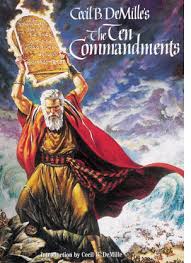
I’m not a fan of The Ten Commandments!
There…I’ve gotten your attention. This week’s Torah portion, Yitro, contains what is arguably the most famous section of the entire Bible. It is commonly called The Ten Commandments, though this is actually a misnomer. In Jewish Tradition, it is known as Aseret Ha-Dibrot—The Ten Statements, which is a more apt description, considering that the First “Commandment” is “I am the Eternal your God who brought you out of the land of Egypt, from the house of bondage.” Wouldn’t you agree that’s more of a statement than a commandment?
So, what’s my problem with The Ten Commandments? Well, let me put it this way: I can’t count the number of times I’ve heard people say, “I’m not very religious, but at least I try to live my life by The Ten Commandments.” I question that statement because I’ve done the following experiment dozens of times: I’ve asked a class of adults to list The Ten Commandments. The group typically comes up with 8 or 9 or 11 or 12. If they come up with 10, some of the 10 are not actually part of The Ten Commandments. So, how can people live by The Ten Commandments if they don’t even know what they are?
Further, we are all aware that one of The Ten Commandments reads “Remember (Exodus version)/Observe (Deuteronomy version) the Sabbath day to keep it holy.” How many of these folks who claim to live by The Ten Commandments can be found in shul on Friday night? If they’re not at services, have they lit candles and made kiddush at home? You know the answer!
Another concern: There is more to Judaism than following just 10 commandments. How about “Love your neighbor as yourself?” What about “Justice, justice shall you pursue?” And then we have the whole round of annual festivals listed in Leviticus, Chapter 23. Can you imagine Judaism without Pesach or Yom Kippur, for instance? Just how many commandments are there in the Torah? (Hint: the number is somewhere between 612 and 614.) The Ten Commandments? Not enough to live a meaningful Jewish life.
Should we do our best to follow The Ten Commandments? Sure. But, let’s not stop there!
*************************
The Sydney Taylor Book Award is presented annually to outstanding books for children and teens that authentically portray the Jewish experience. Presented by the Association of Jewish Libraries (AJL) since 1968, the Award encourages the publication and widespread use of quality Judaic literature. Gold medals are presented in three categories: Younger Readers, Older Readers, and Teen Readers. Honor Books are awarded silver medals, and Notable Books are named in each category. Thirty-three outstanding books were selected from among the over one hundred and twenty titles evaluated by the Sydney Taylor Book Award Committee during 2009. The Committee recommends them for library, classroom, and home use. List of all 2010 Award, Honor, and Notable Books.
You won’t want to miss one moment of the Sydney Taylor Book Award Blog Tour 2010! Check out the Association of Jewish Libraries for up-to-date tour info.
WEDNESDAY, FEBRUARY 3, 2010
Wednesday, February 3, 2010
Elka Weber, author of The Yankee at the Seder
Sydney Taylor Honor Award winner in the Younger Readers Category
at BewilderBlog
Wednesday, February 3, 2010
Adam Gustavson, illustrator of The Yankee at the Seder
Sydney Taylor Honor Award winner in the Younger Readers Category
at Great Kids Books
Wednesday, February 3, 2010
Judy Vida, daughter of the late Selma Kritzer Silverberg, author of Naomi’s Song
Sydney Taylor Honor Award winner in the Teen Readers Category
at The Book Nosher
What’s Treifer than Treif?
There’s treif and then there is treif.
You know what I mean.
The Torah, and later interpretations and clarifications by the Rabbis, lay down the Law when it comes to what is kosher and what is not kosher.
Horse? Not kosher. Does not possess a cloven hoof. Nor does it chew its cud. (See Lev. 11:3 or Deut. 14:6)
Horseraddish? Kosher. And necessary to chase down the gefilte fish.
Oysters? Not kosher. Possesses neither the requisite fins nor scales. (See Lev. 11:9 or Deut. 14:9)
Oyster Mushrooms? Kosher. But a rather confusing name, don’t you think?
Calves? Kosher. Technically. Though there are some who regard veal as unkosher on ethical grounds.
Calf’s Foot Jelly? You bet. Strange as though it may sound, jellied calves feet was a common Ashkenazic food. Great source of protein without all the fat!
Mayonnaise? Kosher. In-and-of-itself, there is nothing unkosher about a condiment made of eggs, oil, and vinegar.
Mayonnaise in the relative proximity of anything other than egg salad or tuna salad? Still kosher. But it shouldn’t be.
Matzo balls? What could be more kosher than matzo balls…

Matzo balls wrapped in bacon?
What???
Yep. It is the gastronomical invention of one Ilan Hall. You may remember him as the winner of the second season of Top Chef. Where he certainly cooked his share of treif.
Now I certainly know that not all Jews keep kosher. And not all Jewish chefs keep kosher. What really galls me is his irreverent, and very public, approach to Jewish food. As though he is purposefully flaunting the forbidden mixture of foods. Not to mention the baggage he is still shlepping from his bad Hebrew school experience.
His restaurant, and “global” approach to cooking, was recently highlighted in the Los Angeles Times. Where the journalist, after acknowledging the lack of kashrut, made the following declaration:
and when he does use bacon, it makes sense, as in his fluffy matzo balls wrapped in bacon
Um…on what planet does this combination make sense???
**************************
The Sydney Taylor Book Award is presented annually to outstanding books for children and teens that authentically portray the Jewish experience. Presented by the Association of Jewish Libraries (AJL) since 1968, the Award encourages the publication and widespread use of quality Judaic literature. Gold medals are presented in three categories: Younger Readers, Older Readers, and Teen Readers. Honor Books are awarded silver medals, and Notable Books are named in each category. Thirty-three outstanding books were selected from among the over one hundred and twenty titles evaluated by the Sydney Taylor Book Award Committee during 2009. The Committee recommends them for library, classroom, and home use. List of all 2010 Award, Honor, and Notable Books.
You won’t want to miss one moment of the Sydney Taylor Book Award Blog Tour 2010! Check out the Association of Jewish Libraries for up-to-date tour info.
TUESDAY, FEBRUARY 2, 2010
Tuesday, February 2, 2010
Robin Friedman, author of The Importance of Wings
Sydney Taylor Book Award winner in the Older Readers Category
at Little Willow’s Bildungsroman
Tuesday, February 2, 2010
Jacqueline Davies, author of Lost
Sydney Taylor Honor Award winner in the Teen Readers Category
at Biblio File
Tuesday, February 2, 2010
Jonah Winter, author of You Never Heard of Sandy Koufax?
Sydney Taylor Honor Award winner in the Younger Readers Category
at Get in the Game: Read! and cross-posted at Examiner.com
Bringing Words to Life

What interests me most are people and their environment. I love drawing people ~ big, small or weird ~ and creating the worlds they live in.
And creating a world for Izzy, his family, and friends is exactly what Stéphane Jorisch has done with his artistic rendering of April Halprin Wayland‘s New Year at the Pier. Using both watercolour and gouache, Stéphane fashions a quiet, yet vibrant, world in which young Izzy discovers the power of a genuine apology and the healing nature of the ritual of Tashlich.

Influenced greatly by his illustrator father, drawing came naturally to Stéphane Jorisch. Born in Brussels, Stéphane grew up in Lachine, Quebec. Nestled on the St. Lawrence River, Stéphane spent the majority of his youth on the water which, as he recalls, was “a great place to dream.” Since childhood, he has put images onto paper, filling the margins of his notebooks with sketches. Ultimately, he chose to make illustrating his career “because,” he says, “he could not do much else besides draw—images for museums, magazines, and books. All sorts of books.”

I have often wondered how an artist takes an image, real or imagined, and recreates it. Is it necessary, for example, to refer often to a photograph in order to capture every finite detail? Once he starts to draw, Stéphane’s approach is to rely on his memory rather than reference materials. This freedom enables a more fluid hand. And his inspiration? His inspiration comes from everyday things, daydreams, and time spent delayed in traffic.
Each artist approaches a project with his or her unique method. I asked Stéphane to walk us through his process for creating:
I try not to begin with any preconceived idea when I’m starting a project. In the past, when I’ve done that, it doesn’t work. I avoid trying to determine what the end product will look like till I get to the end. I get the best results if I let things happen spontaneously and gradually.
So the first step [when beginning a project such as this one] is to let it sit. Images and ideas start coming together as you start associating everyday events, magazine arcticles and pictures, books you are reading, stuff you notice as you drive about, people and kids you meet. As for the locations I illustrate, they are usually inspired from pictures in magazines or books. However, the garden scene was inspired by my own back yard.
I usually start by sketching the main characters. If the characters don’t work in a sketch session I put it away and wait a day or two to work on them later. The failure to arrive at something makes me mull over things without getting frustrated because in a few days, in a new sketch session, the characters just pop off the page.
Intuition is the sum of experience, talent and knowledge and this is what usually gets the work done.
I then break up the text in key places and make a layout with the text in place. I use this to make rough action sketches that the editors don’t see. I then make a final layout in the computer onto which I place the final sketches that are scanned and fitted in place in Photoshop.On this project I worked with watercolour. I love watercolour because I can’t spend too long on an image. I have to finish quickly with watercolour because it dries so quickly. The images are traced onto the watercolour paper with the help of a lightbox. The sketch being backlit makes it possible to see through the watercolour paper. The images are then carefully packed and sent off the to the editor for approval.
Given his beautiful and creative renderings, it is difficult to believe that Stéphane began his career in the very structured world of architecture. A place, as he came to realize, that left little room for imagination. And it is imagination, combined with curiosity and a keen sense of observation, that Stéphane believes feed the soul of the artist.
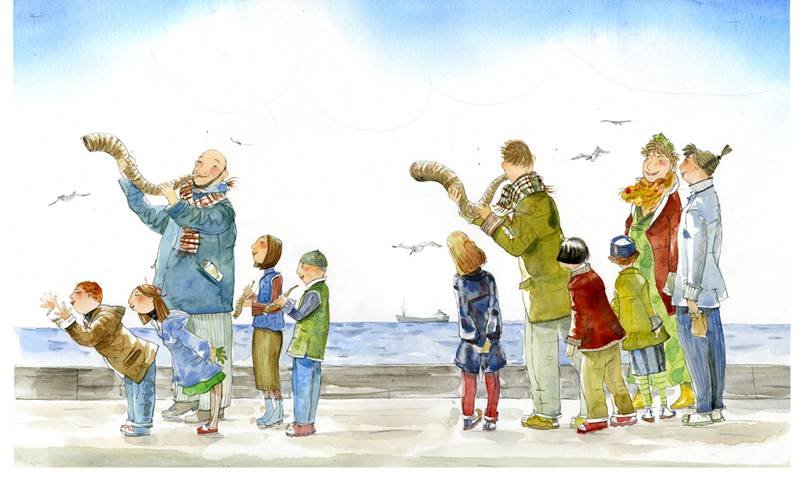
Stéphane has received several prestigious honors for previous books, including the 2008 TD Canadian Children’s
Literature Award, the Governor General’s Award (2008, 2004, 1999, and 1993), nominations for Governor General’s Awards in 1995, 1997 and 1998, and nominations for the 1997 and 1999 Mr. Christie Book Awards. And he is now, along with author, April Halprin Wayland [see Practically Paradise, who is hosting April’s stop on the Blog Tour], the 2010 Sydney Taylor Book Award winner in the Younger Readers Category.
Mazal tov, Stéphane! May you go from strength to strength.
************************
The Sydney Taylor Book Award is presented annually to outstanding books for children and teens that authentically portray the Jewish experience. Presented by the Association of Jewish Libraries (AJL) since 1968, the Award encourages the publication and widespread use of quality Judaic literature. Gold medals are presented in three categories: Younger Readers, Older Readers, and Teen Readers. Honor Books are awarded silver medals, and Notable Books are named in each category. Thirty-three outstanding books were selected from among the over one hundred and twenty titles evaluated by the Sydney Taylor Book Award Committee during 2009. The Committee recommends them for library, classroom, and home use. List of all 2010 Award, Honor, and Notable Books.
You won’t want to miss one moment of the Sydney Taylor Book Award Blog Tour 2010! Check out the Association of Jewish Libraries for up-to-date tour info.
Say What You Mean…

I’m starving.
How many times a day do you say this? How many times a day do your children say this.
I’m starving.
I admit it. I used to say this when I hadn’t eaten in a few hours. When the noises in my tummy were audible to a classmate. Or sometimes just for effect.
But, like all words, those words have meaning. And thank God, I have never had to mean them. I have never known true starvation. The only reason I have ever had for going to bed hungry was my own refusal to eat something put in front of me.
I’m starving.
Becoming a mother radically altered my sensitivity to this phrase. The idea that there are mothers who must put their hungry children to bed nightly without knowing if their hunger will be satiated the next day horrifies me. I cannot imagine the pain felt by those women. Or by their children.
In advance of my birthday, I received a lovely email from Facebook, asking me to give people the opportunity to do a mitzvah in honour of my birthday. OK — it was phrased a little differently, but that was the essence of the email.
I figured that a few relatives or close friends might take me up on this crazy idea. What I didn’t expect is that within a few hours of posting my Birthday Wish, people who are not related to me (and are, therefore, NOT obligated to get me anything) chose to mark my birthday with a gift of tzedakah to Mazon: A Jewish Response to Hunger.
I am touched by their thoughtfulness. And hopeful that with such acts of justice, that awful phrase will be eradicated along with hunger.
Keyn y’hi ratzon — may this be God’s Will
Literary Love

I recently came across a copy of the 1993 obituary for Ralph Taylor.
“Who is Ralph Taylor?” you might ask. Apparently the co-owner of Caswell-Massey (who knew??). More impressively (to me, at any rate), Ralph Taylor was the husband of Sydney Taylor, who remains known for introducing generations of Jewish kids to the Lower East Side. Ella, Henny, Sarah, Charlotte and Gertie. With a baby brother, Charlie, arriving at the end of the first of the five-book series and introducing this Reform school girl to a Pidyon ha-Ben (Benny the Pigeon, anyone?). It was Ralph Taylor who slyly entered his wife’s manuscript for consideration of the Charles W. Follett award for writing. Which she won.
I wish I could remember who introduced me to these books. I wish that I could remember so that I could express my gratitude for inserting me into a world not unlike that known to my grandparents. Through Taylor’s vivid storytelling, I searched for buttons in the front room alongside Mama’s girls. When I got my ears pierced at the mall, I was surprised to find that I did not have loops made of candle wicks in my lobes like Sarah. And I was introduced to a new colour (ecru) after Henny frantically tried to cover-up the tea stain on Ella’s white linen dress. I have loved these girls and their stories for nearly three decades. I loved that their stories and experiences mirrored the ones of my family and me.
The importance of providing a literary portal for Jewish children and teens cannot be emphasized enough. As a religious, ethnic, and cultural minority, Jewish kids can feel marginalized without seeing their own experiences refracted through the stories of others. The Association of Jewish Libraries has been recognizing outstanding Jewish children’s literature since 1968. As a tribute to his wife, Ralph Taylor helped to continue this tradition by supporting the creation of the Sydney Taylor Book Award. Each year, books, their authors, and, in some cases, their illustrators are honoured for their outstanding contribution to Jewish literature.
New this year is a blog tour. Based on the idea of a book tour, this virtual tour will be located on various blogs throughout the blogosphere. And I am so excited that the blog tour’s 2nd stop will be right here at Frume Sarah’s World on Monday, February 1, 2010.
You are cordially invited!
Heed the Advice
Without a doubt, Southern California, with its predictably sunny disposition, has a habit of elevating the slightest inclement weather to a squall of historic proportions. Thanks to the meteorologists and their fancy-shmancy equipment (eg. the Live Mega Doppler 7000), each year we are greeted with warnings of “Storm Watch 2000-whatever” — much to the ridicule of the rest of the country.
So it is no wonder that many of the comments I have seen on Facebook this week are in this vein.
…thinks it’s a little bit funny when bad weather in California equals a crisis.
…Were [sic] are a tornado watch today? Really? Oh, the media hype…
…only in Orange County would a principal call and remind all the students to go to school because its raining.
However, this weather situation really does merit the warnings as it is creating serious problems and some very difficult conditions. We really did have a tornado touch down in a nearby coastal town. The superintendent of our school district called each household and let us know that emergency protocols were in place and that should parents choose to keep their children home due to weather concerns, to inform the school. Roads near our home were closed due to flooding. And over 1,000 homes have been evacuated ahead of potential mud slides.
These mudslides are a very real possibility. According to Sue Cannon, USGS Research Geologist, “the forecast rainfall for the next 48 hours is comparable with that which occurred during a 1969 storm that triggered landslides, debris flows and floods throughout Southern California, resulting in the deaths of 34 people.” Those areas particularly hard hit during the 1969 storm had been scorched in the fall leading up to the storm as well. This parallelism is providing the experts with the ability to predict, and potentially prevent, tragedy.
What is most amazing to me is the chutzpah (read: audacious stupidity) that some people have in the face of authority-mandated evacuations. They were told to leave and, believing that they know better, are choosing to stay.
Deputy Fire Chief Mike Metro urged “If we do get significant debris flows in those areas, those people are going to be isolated…They’re not going to be able to get out. They’re going to be trapped in their homes. And equally as important, maybe more important, is if they have a critical medical need, we may not be able to get to them. So that’s very important.”
Not only does such stubbornness put the individual at risk, but it also has the potential of putting safety officers at risk should the need of rescue arise.
Perhaps people are downplaying the risks out of ignorance. Perhaps they simply do not understand what a debris flow is or how swiftly it can overtake everything in its path.
Debris flows are one of the most dangerous of geologic phenomena. Debris flows can occur with little warning and rivers of mud, rocks, and debris from the fire can cascade down mountainsides and through channels. As these flows move through channels they pick up sediment and can grow to be tens of feet deep, traveling as much as 35 miles per hour.
“In Southern California, debris flows and floods have over history killed a comparable number of people as earthquakes,” said Dr. Lucy Jones, chief of the USGS multi-hazards project. “These past deadly debris flows highlight that residents should not be complacent, and those with evacuation orders need to leave.”
So…for what are you waiting….an engraved invitation???
Tu Necca Necca
 It really should have been a tip-off. Who has to take Spanish I two times?
In my defense, Spanish I was offered to eighth grade students who wished to get a head-start on the foreign language requirement. Repeating it in the ninth grade did not in any way delay my plan to take four years of Spanish. It was my lack of ability in Spanish that delayed my plan to take four years of Spanish.
I had a language requirement in college as well. I took Hebrew, but as a music major, Hebrew did not fulfill my language requirement. But I figured that it would be an effective and rewarding expenditure of six of my precious few elective credits. Ithaca College, at that time, offered first year Hebrew only. And it was taught not by a Hebrew professor but by the Jewish chaplain. Arrangements for further Hebraic study theoretically could be made at the school on the other hill, but such pursuits were logistically improbable. And, to be quite honest, Ithaca’s language classes met thrice-weekly. I did not think that I could handle the daily rigor expected at that other school. I earned high marks in both the first and the second term. Given my actual proficiency at the end of that year, the instructor should have been fired.
I fared no better in Italian. Earned high marks in Italian with little comprehension. Moments after submitting my Italian 102 exam, I had the misfortunate, and somewhat disconcerting, experience of running into mio professore in the student quad and found that I could muster no more than “Ciao, Professore!” The entire body of my Italian knowledge had been regurgitated onto a scantron in Muller Hall, never to return.
German? French? Not only did neither of these stick, between my many linguistic attempts, I now had several related Romance languages swirling about my head.
Hebrew and Aramaic were front and center during my HUC-JIR years. We had a Bible professor who tried to convince us that Ugaritic would be an easy elective, but strangely enough, not one of us believed that “easy” and “Ugaritic” ought to intersect in the same sentence.
American Sign Language proved to be the one exception. A six-week crash course left me eager to communicate with the members of my student pulpit at Temple Beth Solomon for the Deaf. They were very forgiving of my mistakes and I was fearless. Signing as much and as often as I could. Grateful that I was finally becoming comfortable in another language and realizing only later that ASL relies less upon the language center and more on the movement center.
But that has all changed, thanks to nine-and-a-half years of Ulpan Toddler. How else does one explain that when Peach said “doze cars are racin tu necca necca” that I instantaneously, and correctly, translated it as “those cars are racing neck-to-neck”?
Taking Your Time
Think about the best meal that you have ever eaten. Chances are pretty good that you enjoyed that meal with others.
There is much to be said about eating in community. Friendships and family bonds can be strengthened when we sit down together at the table. Our Tradition encourages this behaviour. For example, when three people eat together, the Birkat HaMazon(Grace After Meals) is preceded with zimun. Zimun is the term used for both the group of three or more as well as for the introductory invitation prior to the core blessings of the Birkat HaMazon. In fact, if two people eat together, we are taught (Mishnah Berurah 193:7) that it is great mitzvah to find a third to join the meal! The Talmud bases the teaching of eating in community on a line from Proverbs (14:28) which states “In a greater number of people there is glory of the Sovereign”. Should ten or more individuals eat together, the word Eloheinu (“our God”) is added to several of the lines of the zimun.
In his book, The Omnivore’s Dilemma, Michael Pollan describes the beauty of slow and storied meals. One cannot have a storied meal alone. It requires other individuals. By lingering over a meal, savouring the tastes and textures while sharing histories, memories, and stories, we deepen the experience. Much in the way we do yearly at the Pesach Seder. [A comparison drawn by Pollan himself!]
And much in the way we do weekly at the Shabbat table. Or, rather, much in the way we ought to do weekly at the Shabbat table. How rapidly the week slips past us. Friday rolls around again only to find us unprepared to relax. For relaxation does take preparation. And for many of our families, making Shabbat can seem like just one more item on a never-ending to-do list.
Like many shul communities, we get together for a monthly Shabbat dinner. We hope that it will allow more and more people to experience Shabbat. To enjoy the company of old friends and new as we eat together, sing together, and share Torah together. As it is written, “But if three have eaten at one table and have spoken over it words of Torah, it is as if they had eaten from the table of God.” (Pirkei Avot 3:4).
What are you doing to enjoy food in the company of others?
Don’t Know Much About…
 So how does a meat-loving, fast-food devouring, non-granola/fish/healthy food of any type-eating Jewess end up at a food conference?
Ba-da-bump.
Seriously…unlike some folks who can link the origins of their commitment to vegetarianism to the documentary they saw on slaughterhouses, there was no watershed moment that started me on this unlikely path.
A little background. I am a very picky eater. I have always been a picky eater. Fish is too fishy. Veggies are too bitter. A lot of fruit has a weird texture. On top of it all, I don’t eat pork (or pork by-products), shellfish (or shellfish by-products), or combine dairy and meat.
That’s not to say that I cannot find anything to suit my palate. If its fried, sweet, crunchy, processed, or white (think bread, pasta, potatoes) — chances are likely that it will score points in my book.
So it shouldn’t come as a surprise that between my eating habits (and a genetic predisposition that seems to have skipped a generation), I have struggled with weight and eating issues since my preteen years. Or what is now known as the ‘tween years. I don’t want my children to be saddled with my meshugas. I want them to enjoy food. I want eating to be a pleasurable experience for them. I want them to feel comfortable in their own skin. I want their bodies to be strong and fit and healthy. And I don’t know how to do this.
A trip to the neighbourhood grocery store uncovers a cornucopia of choices. “Natural.” “Organic.” “Free-Range.” “Grass-fed.” “Hormone-Free.” But what do these labels really mean? A closer examination reveals that some of them are utterly meaningless. For example, there is no legal definition for “natural” or “free-range.” How am I, the consumer, supposed to make heads-or-tails of it all?
Be a clearing house for ideas:
Inspire and motivate participants to think more deeply and broadly about their food choices and food systems.
Remember this?? The first goal of the Hazon Conference. Just one hour after my arrival at the breathtaking Asilomar Conference Center, I was confronted with the first of many very difficult decisions; which session should I attend?? Given that this would be my first food conference, I figured that I ought to start with something that would give me a good foundation for the rest of the sessions.
The Greenwashing of Food: Be an Informed Consumer seemed like a good introduction to food issues. And it turned out to be a wise choice. Led by Denise Garbinski, participants were given clear ideas on what constitutes organic as well as how agribusinesses are using the current food trends to their advantage. It was eye-opening.
There was no expectation that everyone at the conference be on the same page when it comes to food issues. The expectation was that all participants would be open to new information and willing to consider all sides of an issue before formulating an opinion. Always with respect for those who were not in agreement. From the very first session I attended, I felt inspired and challenged to consider and reconsider how I think about food.
Goal: exceeded expectation!
[Incidentally, the picture at the top of this post is the logo for the Beverage Institute for Health and Wellness. A division of the COCA-COLA COMPANY!!!!]

 Frume Sarah is Shabbos-observant -- in a Reform way, that is. Please note that from Friday afternoons until one hour after sundown on Saturday evenings, Frume Sarah will be unavailable, in observance of the Jewish Sabbath.
Comments made during this time will be held in a queue, to be moderated afterwards.
Thank you for your understanding...and gut Shabbos!!!
Frume Sarah is Shabbos-observant -- in a Reform way, that is. Please note that from Friday afternoons until one hour after sundown on Saturday evenings, Frume Sarah will be unavailable, in observance of the Jewish Sabbath.
Comments made during this time will be held in a queue, to be moderated afterwards.
Thank you for your understanding...and gut Shabbos!!! 


 Frume Sarah's World