Fiduciary Math
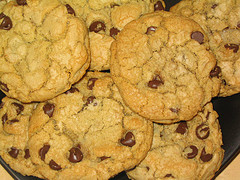
Poppyseed: Mommy, our holiday party is on Friday and I signed up to bring cookies.
FrumeSarah: No problem, sweetheart. (This was on Wednesday so I figured I had a bit of lead time) How many cookies do you need to bring?
Poppyseed: A million.
FS: A million? That’s an awful lot of cookies.
Poppyseed: Well, due to budget cuts, we have a very big class. So we need a lot of cookies. And could they be your famous chocolate-chip ones??
It turns out that there are only 30 kids in the class so that’s a bit more manageable. Poppyseed asked for my famous cookies in that hyperbolic fashion utilized by kids who want something from their parents. They aren’t famous. And it’s not even my recipe. It comes from an amazing site called Nosh with Me.
Here is the recipe:
4 1/2 cups all-purpose flour
2 teaspoons baking soda
2 cups butter, softened
1 1/2 cups brown sugar, packed
1/2 cup white sugar
2 (3.4 oz) packages instant vanilla pudding mix
4 eggs
2 teaspoons vanilla extract
4 cups semi-sweet chocolate chips
2 cups chopped walnuts (optional)
Preheat oven to 350 degrees F (175 degrees C).
Sift together the flour and baking soda, set aside.
In a large bowl, cream together the butter, brown sugar, and white sugar.
Beat in the instant pudding mix until blended.
Stir in the eggs and vanilla.
Blend in the flour mixture.
Finally, stir in the chocolate chips and nuts.
Drop cookies by rounded spoonfuls onto ungreased cookie sheets.
Bake for 10 to 12 minutes in the preheated oven. Edges should be golden brown.
Makes six dozen cookies.
That should be enough, Poppyseed. Even with budget cuts.
Best Discussed Amongst Ourselves

Another guest post by RebGiraffe. Feel free to share your thoughts. It makes him smile 🙂
David Brooks is a highly respected op-ed columnist for The New York Times, which many regard as THE newspaper of record for our entire nation. Before my friends on the Right get upset, you should know that Mr. Brooks presents articulate conservative views, both in the newspaper and on Public Television’s The News Hour with Jim Lehrer.
A few days ago, The New York Times published a David Brooks column, headlined The Hanukkah Story. It was very-well written,–as his articles typically are–and historically accurate. In a number of points, the article paralleled the email I composed and sent to you last week.
Here are the final five paragraphs of the piece:
The Maccabees are best understood as moderate fanatics. They were not in total revolt against Greek culture. They used constitutional language to explain themselves. They created a festival to commemorate their triumph (which is part of Greek, not Jewish culture). Before long, they were electing their priests [Ed. note: also not the traditional Jewish mode of priestly succession].
On the other hand, they were fighting heroically for their traditions and the survival of their faith. If they found uncircumcised Jews, they performed forced circumcisions. They had no interest in religious liberty within the Jewish community and believed religion was a collective regimen, not an individual choice.
They were not the last bunch of angry, bearded religious guys to win an insurgency campaign against a great power in the Middle East, but they may have been among the first. They retook Jerusalem in 164 B.C. [E.] and rededicated the temple. Their regime quickly became corrupt, brutal and reactionary. The concept of reform had been discredited by the Hellenizing extremists. Practice stagnated. Scholarship withered. The Maccabees became religious oppressors themselves, fatefully inviting the Romans into Jerusalem.
Generations of Sunday school teachers have turned Hanukkah into the story of unified Jewish bravery against an anti-Semitic Hellenic empire. Settlers in the West Bank tell it as a story of how the Jewish hard-core defeated the corrupt, assimilated Jewish masses. Rabbis later added the lamp miracle to give God at least a bit part in the proceedings.
But there is no erasing the complex ironies of the events, the way progress, heroism and brutality weave through all sides. The Maccabees heroically preserved the Jewish faith. But there is not honest way to tell their story as a self-congratulatory morality tale. The lesson of Hanukkah is that even the struggles that saved a people are dappled with tragic irony, complexity, and unattractive choices.
So, if Mr. Brooks’ article reflects history as it really was, why am I so uncomfortable reading it? Probably because the persistent question raised by our immigrant parents or grandparents keeps running through my head:
Is this good or bad for the Jews?
Well, I don’t think it’s good for the Jews! If it had appeared in one of the leading Jewish newspapers, such as The Forward or The Jewish Week, I honestly wouldn’t have a problem with the article. It would likely be one of several takes in the newspaper on the significance of Chanukah, and Jewish readers could decide which take suits them best.
But, The New York Times is read by the whole world, not just by Jews. Just as we are celebrating Chanukah, here comes an article that debunks the holiday. Readers will remember the warts of the heroes herein described far longer than any of their acts of bravery.
Anti-Semitism is alive and well in our world. In polite society, it often masquerades as anti-Zionism. Let me quickly add that I do not believe that the Israeli government–like the American government–is above criticism. However, I do believe that questioning Israel’s right to exist is tantamount to questioning the right of Jews to live in this world.
I am most assuredly NOT saying that David Brooks is an anti-Semite. He is NOT. However, I do fear that this article can contribute to negative feelings about Jews, and that is what makes me uncomfortable.
In spite of the excesses of the Maccabees, particularly when they took control of the country following the revolt, we should recognize that without their rebellion, Judaism would likely have ceased to exist. For that alone, this holiday is worthy of celebration.
Beyond the Dreidel
Feeling as though the mainstream radio stations aren’t being very inclusive this time of year? Hoping to create a sense of Chanukah?
Take a look at some of my favourite Chanukah offerings:
If swing is your thing, check out Hanukkah Swings.

Try Chanukah music..Israeli-style with Hanukkah Songs by Matan Ariel.

Craig Taubman takes Chanukah standards and gives them a chill, lounge sound. Go hang in the Hanukkah Lounge.

An eclectic collection of melodies and artists come together on Festival of Light 2.

Totally irreverent and sometimes inappropriate, but always funny! Hanukkah Rocks, thanks to The LeeVees.

Chanukah NEVER sounded like this before! World-fushion musician Erran Baron Cohen provides a whole new beat with Songs in the Key of Hanukkah.

And for those of you who subscribe to satellite radio, you can find Radio Hanukkah on Channel 28 (XM) of Channel 76 (SIRIUS). And some satellite television companies carry it as well.
There’s nothing wrong with singing about a dreidel. But it’s hard to get excited about Chanukah music if that’s the extent of your Chanukah repertoire.
Going Viral
What is it that makes certain links go viral?
As of this writing, a Chanukah song by Senator Orrin Hatch has gotten over 135,000 hits. One hundred, thirty-five THOUSAND. And it’s not even that good of a song.
In recent days, I have received a link to this insipid, parody-like ditty from more than two dozen folk. (The video clip reminded me of an SNL short.) With one exception, all of the senders are members of the baby-boomer or greatest generation. Not an insignificant observation.
That the overwhelming majority of those who have gleefully forwarded this atrocious Chanukah song by Senator Hatch are of a certain age points to an underlying, and probably unarticulated, sense of discomfort. For several generations, we Jews have done everything possible to fit in with our non-Jewish neighbours. Often to the detriment of our Judaism. No matter how hard we try, we still sense that on some level we don’t really belong.
So when some like Johnny Mathis covers Kol Nidre or the Temptations record If I Were A Rich Man?, we feel validated.
“See? We really do belong. Non-Jews want to record OUR songs!”
Or
“See? We really do belong. A non-Jewish (Mormon, no less) senator has written a Chanukah song.”
And then we forward it to every single Jew on our buddy list as if this is proof that we have been fully accepted into American society.
You want to send around a link that will make you feel good…REALLY good…about being a Jew? Send this one. This story has the power to bring healing to our world. This story illustrates who we are. And what life is like in a place where we truly belong.
Check it out
Haveil Havalim is ready for viewing over at The Israel Situation.
Frume Sarah is delighted to be hosting the next edition of Haveil Havalim. So make certain to send your entires my way!!
Happy reading…and Chag Urim Sameach!!!
Parental Perogative
To Peach’s delight, his dessert this evening contained a message.

You see…every morning, Peach insists on staying in his jammies and wearing them to school. And every morning I ask “is today ‘Jammie Day?’ I don’t think today is ”
‘Jammie Day’ because Ms. Brooke didn’t say ‘Tomorrow is “Jammie Day,” friends’ when I picked you up yesterday.”
Peach bit into his fortune cookie tonight only to discover that there was a slip of paper concealed inside. He asked me to read it and I made the decision to tell a lie. Not a white lie, but a complete and utter falsehood.
When I read the lie message to him, Peach’s eyes lit up. Followed by a quick inhalation of air.
There is no “Jammie Day” tomorrow! Dat’s what it says on my message.
Yes, Love, that is what is says on your message.
Did I do something awful by lying to Peach?? Does Frume Sarah advocate dishonesty?
What do you think??
What’s It All About?
guest author: RebGiraffe (aka BossGiraffe)
Chanukah is often presented as a black-and-white story. Like the Westerns we used to watch in the movies or on TV, it was the good guys vs. the bad guys. It may be easier to explain things that way. However, the reality was far more complex.
We get the impression that the Maccabean Revolt was an uprising of the patriotic Judeans against their tyrannical overlords, the Syrians. A band of guerilla fighters, led by Judah Maccabee and his brothers, overcame the army of the Syrian Empire which controlled Judea during the second pre-Christian century, and we won our freedom.
This picture presents only part of the story. Another element—perhaps more significant and definitely more disturbing—is the fact that the fight was internal as well. Yes, I mean Jew vs. Jew.
When Alexander the Great conquered the known world in 333 BCE, he introduced Greek culture far and wide. That culture, called Hellenism, included the most advanced art, architecture, philosophy, etc. and spread widely.
Among the Jews of the time, there were many who found Hellenism enticing. They were drawn into the life of the gymnasium, which was much more than a place for athletics, but was akin to a university. Participating in the gymnasium presented challenges to Jews who wished to be loyal to their faith, however. Each gymnasium was dedicated to a Greek god, to whom offerings were made. Some of the athletic contests were held without benefit of clothing, which was not in accord with Jewish standards of modesty, and which also exposed Jews to ridicule because circumcision was viewed as barbaric mutilation by those who followed Greek culture. The desire to be part of Hellenistic society was so strong for many Jews that they were willing to offer sacrifices to idols and even to undergo a painful operation that would mask their circumcision (No…I am not making up this part!)
Remember the beginning of the Maccabean Revolt–the incident in the village of Mod’in? A band of Syrian soldiers had come to town, set up an altar to an idol and demanded that the local inhabitants bow down to the idol. It was a Jew who came forward and began to do so when Mattathias struck him down. Did you ever consider why the Jew was willing to offer the sacrifice? You might have assumed that it was due to his fear of the soldiers. More likely, he did it voluntarily because of his Hellenistic outlook, and this is what drew the ire of Mattathias. In other words, the Maccabees’ beef was not solely with the Syrian army, but also with their fellow Jews who were open to a Hellenistic approach to life.
We call such behavior assimilation, and it has been a serious problem in more recent times, as well. In the 19th century, there were many Jews who readily traded away Judaism, which they regarded as a holdover from the ghetto. A significant number even converted out in order to gain entry into the larger society.
So where do we—you and I–stand today? We live in the modern world. Are we today’s Hellenists?
Now, as in ancient times, matters are not so black-and-white. While some of our fellow Jews do live in a ghettoized environment and others have, indeed, left Judaism behind, the overwhelming majority of Jews live bi-culturally. We are modern people, and we are Jews…and we want the best of both. Balancing the two is not easy. In fact, it is quite difficult. But, that is where we stand. We must recognize that there are forces that push us away from active Jewish engagement. If we wish to remain Jews, we must assert our Jewish values.
Here’s a perfect example: Most of us give gifts as part of our celebration of Chanukah. While presenting children Chanukah gelt to play the dreidle game has been part of the holiday for generations, the more elaborate gift-giving is clearly a result of our encounter with the larger society in which we life. A good way to balance: Give gifts, if you like. But, for the 6th night of Chanukah, December 17, donate the value of the gifts you would ordinarily exchange (or the gifts themselves) to local or national organizations assisting the needy. At a time of severe unemployment, isn’t this the right thing to do?
Wishing you a bright Chanukah,
RebGiraffe
Needs vs. Wants

As the seasons make their turn towards Winter, my children become fixated with the prospect of Chanukah and its gift-giving, or, in this case gift-receiving, property. Not a day passes without a new item added to an ever-growing list of …chazarei. Stuff. Junk. Clutter. Define it any which way you please. If you are a youngster, you might define such items as necessities. “I really NEED that Barbie. And her summer vacation home. And her pony.” Or “I totally NEED some new games for my DS and for my Wii because I’m bored with all the ones I already have.”
A wise friend recently shared with me a philosophy that she and her husband used with their now-grown children:
We may never give you everything you want. But know that we will always give you everything you need.
What a great philosophy. And what a great lesson for our children and for ourselves. There is a difference between “wants” and “needs.” Between that which we desire and that which are essential for our survival.
This year, under the direction of our Religious School Educator, our shul has embraced a project called Nothing But Nets. Its mission is to provide nets for families living in malaria-infested communities throughout Africa. We don’t know from Malaria here in America because it was eradicated by the early 1950’s. But it is a daily reality for those who live in tropical and subtropical climates in Africa and Asia.
Malaria is a disease caused by the blood parasite Plasmodium, which is transmitted by mosquitoes.
Malaria, from the Medieval Italian words mala aria or “bad air,” causes 350 million to 500 million illnesses per year and kills more than one million people – mostly children under the age of five. Malaria is particularly devastating in Africa, where it is a leading killer of children. In fact, there are 10 new cases of malaria every second. Every 30 seconds, a child in Africa dies from a malaria infection.
The worst part is that malaria, and its subsequent fatalities, is avoidable with the use of prophylactic drugs, mosquito eradication, and the prevention of mosquito bites. And the most effective prevention of bites from these nocturnal insects is an insecticide-treated net. Nets that are beyond the monetary reach for those most in danger of contracting malaria. Imagine for just a moment not having enough money to purchase one net that will, not could, but will save the lives of your family. That is the economic reality for thousands of people like you and me. That net? That is a “need.”
Instead of adding to the already-looming inventory of the latest and greatest fads and fashions, why not consider making a significant difference in the lives of others this Chanukah. Making a $10.00 donation in honour of a loved one to this grass-roots organization will help save a family. And will give each one of us the opportunity to provide a true need during this season of gift-giving.
Tonight’s Dinner = Epic Win!
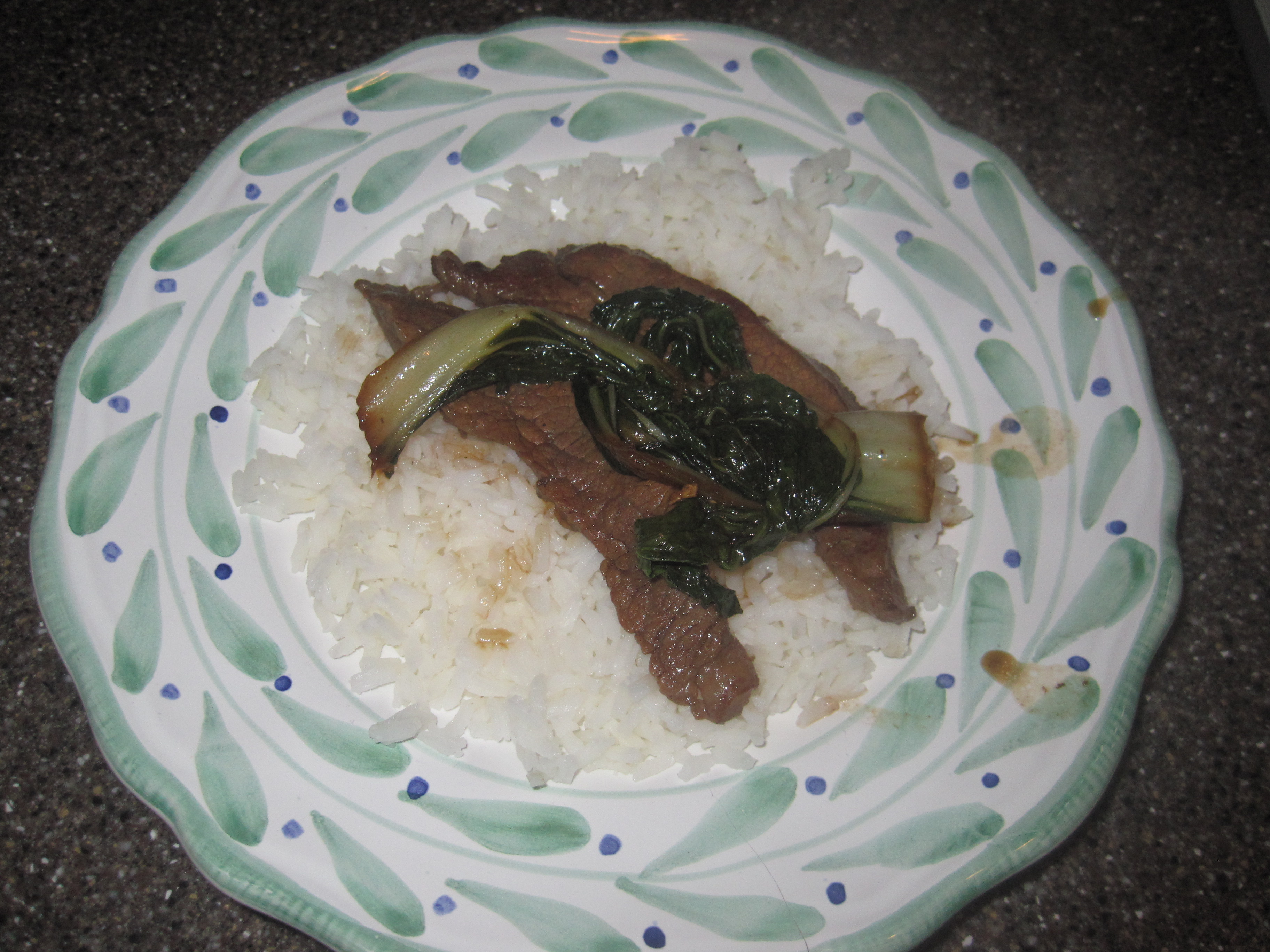 Finding a meal that (a) I can make and (b) the Frumettes will eat is no easy task. Preparing a new food is generally a disappointing experience. I am excited to introduce something new, they hate it, and I spend the rest of the evening trying not to take it personally.
And yet…I keep at it.
So I am thrilled to announce that tonight’s culinary experiment was a complete and total success!
Beef and Bok Choy Stir-Fry
(from Real Simple)
Ingredients
Directions
- Cook the rice according to the package directions. Meanwhile, heat the oil in a large skillet over high heat. Season the steak with 1⁄4 teaspoon each salt and pepper and cook, turning often, until cooked through, 3 to 4 minutes. Transfer the steak to a plate.
- Wipe out the skillet. Add the bok choy and 1⁄4 cup water and simmer, covered, until tender, 2 to 3 minutes.
- Meanwhile, in a bowl, mix the soy sauce, vinegar, ginger, and sugar. Add to the bok choy in the skillet and bring to a boil. Add the steak and any accumulated juices and cook, tossing, until heated through, 1 to 2 minutes. Serve over the rice.
As for the flank steak, we recently made the decision to buy only beef and chicken that is grass-fed. From start to finish. No grass for most of the life of the animal only to have a bait-and-switch during the animal’s final months with the sole purpose of fattening up the “product.” Additionally, the conditions under which the animals are raised are more in keeping with our ethical beliefs. There tends to be less fat in the grass-fed beef so the cooking time is typically shorter.
This meal rated “two-thumbs-up” from ALL THREE Frumettes. B’teavon.
The Avocado Situation
So PC and I thought that we would take advantage of having the sitter at the house and grab a quiet dinner sans children. And it was a good idea…until
the avocado situation.
PC ordered a tri-tip salad and I selected a turkey club (less the bacon, of course). What I really wanted was a Turkey and Avocado sandwich, but they don’t have that on the menu. I typically order the Turkey Club without the bacon, leaving me with…turkey and avocado.
Some time later, our meals are delivered to the table by one of the kitchen guys. Noticing the absence of the avocado, I mention it to the kitchen guy, who says that he will inform our server.
[Sidenote: why is the server called a server when it’s the kitchen guy (not the chef) who serves the food? Shouldn’t we call her the orderer?]
About 6 minutes later, our server comes to the table.
Server: We have an avocado situation.
[I seriously thought she was making a little joke. She wasn’t.]
Server: We’re out of avocado.
FrumeSarah: You’re out of avocado?
Server: Yes, we’re out. We get our deliveries on Mondays and today is Sunday. But we sent someone out and he should be back within 10 minutes. Unless you want something else…
Want something else? The sandwich is sitting right here in front of me. Isn’t it a little late to be asking me that question?!?
FS: Well, since the sandwich has already been made and you’ve already sent someone out, I’m good with this.
Server: My manager just told me otherwise I would have said something sooner.
And off she went. During which time, PC discovered avocado slices in his salad. Guess we know when they ran out.
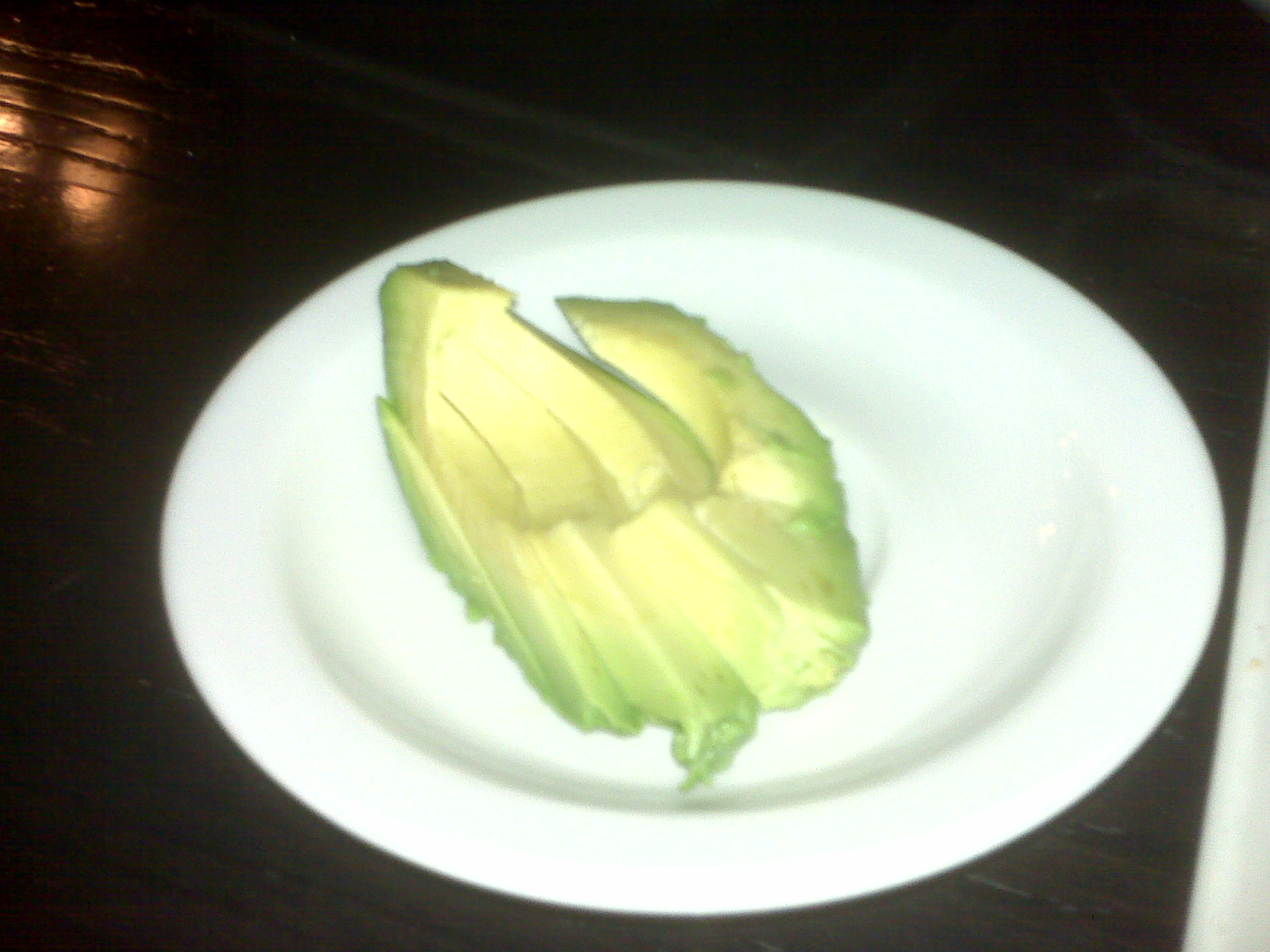
TWENTY-FIVE minutes later, the under-ripe avocado slices (pictured above) were brought to the table. No fanfare. And no apology either.
It was an aggravating experience. Not because the restaurant ran out of avocados. These things happen. However, the kitchen should have forseen that they were running low and made certain that the wait staff was aware of the potential problem.
Once things has unraveled into a “situation,” the server should have done a better job of apologizing. And we were really rather shocked that the manager never approached us. Not even once.
So here is a little tip for the manager and her staff for dealing with a “situation”:
TEAF
- Thank — “Thank you for bringing this to my attention.”
- Empathize — “I can see why this would be frustrating.”
- Apologize — “I am really sorry that this has happened.”
- Fix — “What can I do that would make this better?”
(alternately called LEAF)
If the server had employed this technique, it would have taken an annoyance and turned it into a funny experience. Instead, we grew more and more frustrated. If she had simply let us know from the outset (assuming that the kitchen staff alerted the wait staff about the avocado shortage), I would have changed my order. It would have been no big deal, we would have ordered pie to go, and we would have been on our merry way. Come-to-think-of-it, if we had gotten a simple apology, we still would have ordered the dessert. But now, they not only lost the profit on the dessert, but we are in no hurry to run back there.
Customer service, folks, customer service.
**************************
The latest Haveil Havalim can be found over at Batya’s place!

 Frume Sarah is Shabbos-observant -- in a Reform way, that is. Please note that from Friday afternoons until one hour after sundown on Saturday evenings, Frume Sarah will be unavailable, in observance of the Jewish Sabbath.
Comments made during this time will be held in a queue, to be moderated afterwards.
Thank you for your understanding...and gut Shabbos!!!
Frume Sarah is Shabbos-observant -- in a Reform way, that is. Please note that from Friday afternoons until one hour after sundown on Saturday evenings, Frume Sarah will be unavailable, in observance of the Jewish Sabbath.
Comments made during this time will be held in a queue, to be moderated afterwards.
Thank you for your understanding...and gut Shabbos!!! 


 Frume Sarah's World