Take a trip
over to see my pal, Jack.
Is it fickle to ask readers to link to your blog? Who knows. All I can say is that when I visit other blogs, I find it just as interesting to see who has linked to it.
Enjoy!
Always on my mind
“Climb aboard, get ready to explore, there’s so much to find, Little Einsteins.”
Mooom! Stop singing!
Sorry.
{a few minutes pass…}
“Climb aboard, get ready to explore, there’s so much to find, Little Einsteins.”
Mooom! Cut it out.
Right. Sorry.
{a few minutes pass…}
“Climb aboard, get ready to explore, there’s so much to find, Little Einsteins.”
Mom, I’m serious.
Sorry, Beernut. It’s stuck in my head.
Oh, I know how to fix that. Try thinking about “Chag Purim.”
Wow — I didn’t know that would work!
{a few minutes pass…}
“Chag Purim, Chag Purim, chag gadol hu lay’hudim“
MOM!
Sorry, Beernut. Now that’s stuck.
AARRRRGH!!
As annoying as this might be to Beernut, he should thank his lucky stars that his dear ole’ mom doesn’t suffer from this.
With purpose

One of the **buzz words** in the religious community is “relevant.” And a lot of money is being spent on discovering new ways to make Judaism, in particular, relevant to Gen X and the Millennials.
But here is the problem: what happens when Judaism (or certain aspects of it) simply aren’t deemed relevant? And who decides what is and what is not relevant.
By nature, it seems, we humans take the path of least resistance. Being Jewish? Well, it’s often the other path. The one requiring discipline. Disappointment, sometimes. Confusion. And irrelevance.
That’s right. I mean seriously…what relevance is there in observing shatnes? Certainly a case can be made that taking care not to mix linen and wool in a single garment might make one more aware of the clothing on one’s back. Or that in Biblical times, only pagens wore mixed fabrics. Or….or….or. Let’s face it — we don’t know why God commanded this. All we know is that He did.
So which is better? To infuse the mitzvah with some contemporary meaning in order to make it relevant? To disregard it as an orientalism? To observe it simply because it was commanded some strange night in the desert?
Leah Jones, of Accidentally Jewish,writes of “intentional Judaism” and that sits better with me. It completely sidesteps the issue of relevancy and focuses, instead, on intent. Do what it is you are going to do with intent. Be deliberate. Be serious.
Just. Be.
*****************
And that’s my Torah for today. The Ima is only just back from the Homeland a few hours so her Tuesday Torah banner didn’t get up today but feel free to link with her here.
A Purim Word Problem

If Inspector Clouseau & Queen Esther paid $105.00 to the babysitter, $125.00 for an insured raffle ticket, $262.50 to the IRS, and were left with a total of $257.50, how much money did they win at the Reverse Raffle at last night’s Purim Party???
That’s right! PC and I were the 3rd top winner — $750 samolians. After expenses, we walked out $257.50 richer. Not bad. Top prize?? $5,000. That would have been totally amazing. But since we never win anything (guess I can’t say that anymore!), we were on cloud nine 🙂
After days and days of celebrating, Purim has finally come to an end. And I am left with a combination of post-partum and impending doom. Sad that Purim is over and dreading what is coming next…Pesach!
Why am I sad?
Is it because I find the thought of cleaning out my kitchen overwhelming? Or that I don’t like matzah? Is it that the year is simply flying by too quickly? Or is it that I will miss doughnuts, pizza, and french fries?
All reasonable possibilities. Ones which I will be exploring in the remaining 27 days…
And the party goes on
Wow — I am just totally exhausted today!! Last night’s service, Megillah reading, and shpiel were AMAZING! As soon as I get pictures, I’ll be sure to post them!
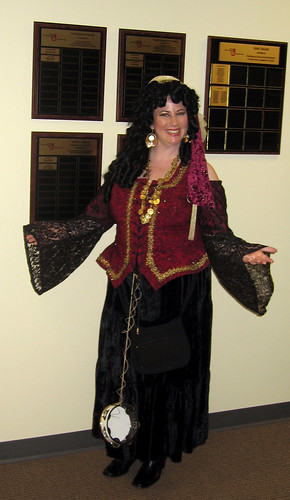
I love Purim. I love the food (it’s cookies…who doesn’t love cookies?). The music is silly. I LOVE to dress up (see here.) The message is profound and important.
We really stretch out the holiday as much as we can at our shul. Carnival last Sunday, service last night, and a HUGE costume party for the grown-ups tomorrow night. So I just couldn’t help myself when putting together the music for this evening. I just had to slip in a few “seasonal” tunes.
Utzu Eitzah
Utzu eitzah v’tufar
dabru davar v’lo yakum
ki imanu Eil.
(Make your plans; they will be annulled.
Scheme against us; it will be to no avail,
for God is with us.)
Chag Purim
Chag Purim, Chag Purim,
chag gadol lay’hudim.
Maseichot, ra’ashanim,
z’mirot, v’rikudim.
Havah narishah, raash, raash, raash,
Baraashanim.
(The holiday of Purim is a great festival for the Jews with masks, noisemakers, songs, and dancing.
Let’s make lots of noise with groggers!)
The juxtoposition of the serious and the silly perfectly captures the tospsy-turvy message of this festival. We Jews are serious most of the time and certainly that has been the case during times of great oppression and darkness. How wise our Sages were to give us one time a year to let go. To break free from the constraints necessary to preserve our lives. To allow the stark realities of our circumstances to fall to the side for just a little while, allowing us to breathe freely and enjoy life.
So laugh, dance, make merry, and enjoy. Remember — it is still Adar!
Chag Purim Samayach…and Shabbat Shalom!
Some Purim Truths
Please enjoy this very informative entry from DadGiraffe:
Very often, materials distributed within the Jewish community around Purim fall into the category of Purimspiels–humorous, and not to be taken seriously.
You may think that what follows, therefore, is such a Purimspiel. It isn’t!I have three “easy” Purim questions for you:
1. How were Esther and Mordecai related?
2. Why wouldn’t Mordecai bow down to Haman?
3. What do Hamantashen represent?
Here are the answers usually given to these questions:
1. Mordecai was Esther’s uncle…WRONG!
2. Mordecai wouldn’t bow down to Haman because Jews bow only to God…WRONG!
3. Hamantashen are three-cornered pastries, reminding us of the three-cornered hat that Haman wore…WRONG!
I guess the questions are not so easy after all!
1. Esther 2:7 tells how Esther was related to Mordecai. She is described there as “the daughter of his uncle.” Hence, they were cousins. Mordecai was an older cousin, and when Esther was orphaned, he functioned as her foster father.
2. If a British subject of the Jewish faith were invited to meet H.M. Queen Elizabeth II, it would be proper protocol–from both British and Jewish viewpoints–for that individual to bow or curtsey. Clearly, Jews can bow before high officials to show respect for their office. The biblical text does not explicitly state why Mordecai refused to bow to Haman. The only information provided (Esther 3: 1-4) is that Mordecai had stated that he was Jew…as if this fact explained his behavior.
Here are a couple of possibilities:
A. Esther 3:1 states that Haman was an Agagite–in other words, a descendent of Agag. In the days of King Saul, Agag was the King of the Amalekites and the two warred against each other. The Amalekites were the group that had–in terrorist fashion–attacked the women, children, and elderly of the Israelites back in Moses’ time. Esther 2:5 tells us that Mordecai was the great grandson of Kish of the tribe of Benjamin. In I Samuel 9:1, we learn that Saul was the son of Kish of the tribe of Benjamin. So…perhaps Mordecai felt it inappropriate to bow before a descendent of his family’s…and our people’s…enemy.
B. An alternate explnation: The Talmud suggests that Haman wore a breastplate and on this breastplate was the image of a deity. If Mordecai bowed before Haman, he would appear to be worshipping the idol. That he would not do.
3. American Jews often say that the 3-cornered Hamantashen are reminiscent of Haman’s 3-cornered hat. I suspect this is because–to the American imagination–a hat from olden times must have had 3 corners (think George Washington!). If these pastries have something to do with hats, why–in Israel–are they called Oznai Haman…Haman’s EARS?
The Yiddish name for the pastries is Hamantashen–Haman’s Pockets. While today, Hamantashen are filled with a variety of good-tasting items, and some old-timers (I include myself in this group) especially recall, and still enjoy, prune filling…yet, the most traditional filling is actually poppy seed. How do you say Poppy Seed in Yiddish? Mohn. Here’s my theory: There were delicious poppy seed pastries known as Mohntashen–poppy seed pockets. As a Purim joke, when prepared for Purim, they were called –not Mohntashen (poppy seed pockets)–but HuMohnTashen (Haman’s pockets).
BONUS QUESTION: What is the relationship between a Kraft Macaroni-and-Cheese Box and a Gragger?
MITZVAH ANSWER: If you bring a Kraft Macaroni-and-Cheese Box (or a Rice-a-Roni Box, etc) with you to our Purim service, you can use it as a Gragger…and then leave it in Shul. We’ll then distribute all these boxes of edibles to hungry people in Orange County. Is that a great idea…or what!
A freilach Purim!
That’s right!!
Just as we are instructed to stamp out Haman’s name with the sound of the grogger, this year we will stamp out hunger at the same time!
We’ve asked everyone to bring a box of a noisy, non-perishable, edible to this evening’s Megillah Reading. We’ll go to town, shaking the noodles (or rice pilaf or cous cous) as our noisemakers. Then, we’ll donate the food to Share Our Selves (SOS).
Look here and here and here for other ways to “do good” this Purim.
Chag Purim Samayach!!!
Unchained Melody
Under Persian law, it was not permissable for one to enter the King’s chambers without first being granted an audience. The text is very clear that this law was known to everyone in the land and was applied equally to all. No exceptions. Not even the Queen. The text goes on to say that Queen Esther fasted for three days in preparation to go before the King without a summons. She asked Mordechai to have the Jews fast and pray on her behalf.
Since that time, the day before Purim (which falls on the 13th of Adar) has been known as Taanit Esther — the Fast of Esther. It is the only day that commemorates the power of a single woman to change the course of Jewish history. Pretty amazing.
In modern times, the observance of this fast day is not so widespread. To be honest, I’m not so sure the observance of Purim proper is so widespread — with the obvious exception of school-aged children. And if the fun part isn’t being observed, you can bet that the hard, mournful aspect is being chucked too!
And so….
Taanit Esther has been designated as International Agunah Day.
An agunah is a woman who is chained to her marriage either because her husband has taken a powder or because he refuses to grant her a divorce.
What more appropriate way to recognize Esther’s heroism than by fighting for the rights and freedoms of other Jewish women.
The International Coalition for Agunah Rights has scheduled a variety of events in order to publicizie this very real violation of human rights. They have published a booklet in Hebrew “Solutions in Halacha to Get recalcitrance – sources to learn together” including a suggested lesson plan. Contact the ICAR offices for a copy. An environmentally friendly tote bags with the slogan “Marriage is not a Life Sentence” were made by people with disabilities in a factory in southern Israel and can be purchased at COMME-IL-FAUT stores. And there is information and resources available at the Jewish Orthodox Feminist Alliance.
Finally, you can add your name to the petition denouncing get recalcitrance

Creator of heaven and earth, may it be Your will to free the captive wives of Israel when love and sanctity have fled the home, but their husbands bind them in the tatters of their ketubot. Remove the bitter burden from these agunot and soften the hearts of their misguided captors. Liberate Your faithful daughters from their anguish. Enable them to establish new homes and raise up children in peace.
Grant wisdom to the judges of Israel; teach them to recognize oppression and rule against it. Infuse our rabbis with the courage to use their power for good alone.
Blessed are you, Creator of heaven and earth, who frees the captives.
English Tefillah by Shelley Frier List. Hebrew Translation by Devorah Ross and Esther Israel. From the Jewish Orthodox Feminist Alliance (JOFA) website.
Amen.
Introducing…Tuesday Torah!
The Ima is starting a new weekly theme-day: Tuesday Torah. This is how she descibes it:
We each have our own Torah*. It may vary from day to day or even from hour to hour.
(*Torah is the Hebrew word that means “doctrine or teaching” and refers to the Five Books of Moses: Genesis, Exodus, Leviticus, Numbers and Deuteronomy. It is often used to refer to the bulk of Jewish teaching in a general sense. Aside from the power that it holds for me as my favorite book, I like to think of “torah with a small-t” as our own personal stories, our own personal truths.)We all hold these ideas inside us that are screaming to get out.
Sometimes they are profound.
Sometimes they are inspiring.
Sometimes they teach us.
Sometimes they are brave or revelatory or interesting or funny or silly or sad.
But they are the truth, and they are ours.
So I invite you to seek truth, to share truth, and to open yourself up to truth…every Tuesday here at Ima on and off the Bima, we will celebrate our own Torah, our own truth.
What’s yours?
Purim. Yesterday, a grown man said to me “Purim? Right…that’s the kids’ holiday.” Except that Purim isn’t really for kids.
Costumes and carnivals aside, there is a very sophisticated and substantive side to Purim. This holiday is a polemic against assimilation.
Consider the protagonists of the story. Mordachai and Esther have completely immersed themselves into Persian culture. The first tip-off? Their names. Mordachai is derived from the Babylonian god Marduk and Esther from the goddess Ishtar. Do those sound like good names for Jewish children? (Quite ironic, if you stop and consider.) The selection of these names was a marked decision by Mordachai’s and Esther’s parents to enable them to blend into the host majority culture.
And blend in they did. When Esther arrives at the palace, she “did not reveal her kindred or her people, for Mordechai instructed her that she not say” (Esther 2:20). She keeps her Jewish identity a secret and as far as the text is concerned, does not observe any Jewish traditions while in the palace.
Our Sages have gone to great lengths to condone Esther’s deliberate concealment. From R. Eleazar of Worms to the Vilna Gaon, commentators have rationalized her behaviour in their rather weak attempts to establish Esther as the heroine of the story.
She does emerge heroic but I think her heroism is strengthened by the reality that she was an assimilated Jew who ultimately came to accept her identity.
This tension — the pull of our Jewish identity as it sometimes clashes with our American culture — exists in a very palpable way for those of us who choose to (a) practice Judaism, (b)embrace modernity, and (c) live outside of Israel. How public we choose to be with our identity can have a significant impact on our daily lives.
Yesterday was St. Patrick’s Day. Did you observe it? Did you know that it is actually a saint day, marked on the Catholic liturgical calendar? Do you even know who St. Patrick was? That he is celebrated for being the one to introduce Christianity to Ireland? Are you so certain that’s something you want to celebrate?
I am not Irish. I am not Catholic. For these two reasons, I do not observe St. Patrick’s Day. What if people suddenly decided to take Purim, strip it of its religiosity, focus solely on the frivolity, joyfulness, and imperative to drink, and say “on Purim, everybody’s Jewish?”
I want to live in an America that allows us to be different and celebrate those differences.
I want the children in our shul to devote as much attention to their Purim costumes (and attend the Megillah reading) as I suspect they devoted to the wearing of green.
I want my people to take their Judaism seriously.
And that’s my Torah this Tuesday.
*********************
What’s yours? Leave a comment linking to your Torah post here as well as see what others regard as their Torah. See you here next Tuesday!
Join the Purim Party! Check out what the Ima has to say today too!
If We Really Ran Hollywood…
it would have been spelled “Jewno” and would have looked like this:
*Brought to you by Makor and Hazon
The Shushan Channel is back for its sixth year. Created by Daily Show writer Rob Kutner and now in collaboration with writers from The Simpsons, Dennis Miller Live and more, The Shushan Channel is a comedic retelling of the story of Esther, as seen through the lens of current TV hits like Lost, American Idol and Ugly Betty. This year don’t miss House-man, MD, DeadVood, Grogger of Love, To Catch a Jewhater and Imperial Gladiators, scripted by professional comedy writers and performed by hilarious comedians and actors, including The Daily Show’s Aasif Mandvi. All this, plus a video monologue rant “The 5 Things I Hate About Purim” by everyone’s favorite “pissed-off optimist”—Lewis Black!
Past performers have included Stephen Colbert, Ed Helms, Rob Corddry and Dan Bakkedahl. Last year, the Shushan Channel sold out two shows at Makor, so bring your friends and get your tickets early!
Doors open 7:30pm – Shows at 8:30 & 10:30pm
92YTribeca – New Makor location 200 Hudson St, at the corner of Canal St
Open beer and wine bar – Costumes are encouraged – DJ party to follow 11:30 – 2am
Tickets: $20 in advance or $25 at the door
Order tickets here or call Makor at (212) 601-1000.
ADVANCED TICKET PURCHASE IS ENCOURAGED
Setting the Purim Mood
Over at the Frummie house, Purim preparations are underway. I decided a couple of years ago that the kids would take annual Purim portraits as a way to reinforce the holiday. Our shul’s carnival was yesterday, we are baking again today, services on Thursday night, and a costume parade and carnival at Poppyseed and Peach’s school on Friday. (And an adult-only costume party on Saturday night!)
It’s my job to create Jewish memories. Here’s to a Purim celebration worth remembering!
Check out Ima’s pix and join our party!


 Frume Sarah is Shabbos-observant -- in a Reform way, that is. Please note that from Friday afternoons until one hour after sundown on Saturday evenings, Frume Sarah will be unavailable, in observance of the Jewish Sabbath.
Comments made during this time will be held in a queue, to be moderated afterwards.
Thank you for your understanding...and gut Shabbos!!!
Frume Sarah is Shabbos-observant -- in a Reform way, that is. Please note that from Friday afternoons until one hour after sundown on Saturday evenings, Frume Sarah will be unavailable, in observance of the Jewish Sabbath.
Comments made during this time will be held in a queue, to be moderated afterwards.
Thank you for your understanding...and gut Shabbos!!! 


 Frume Sarah's World