Whose Rules?
Cancer happens to other people. Right? It doesn’t happen to you. Or me. Or the young. Or the good.
Hogwash.
Cancer does happen to you. And me. And the old. And the young. And the good. And the bad. It crosses socio-economic, racial, religious, and political lines. Cancer does not discriminate.
And this past month, I learned of three pre-menopausal women diagnosed with breast cancer. Two of them under the age of 38.
So guess what? Cancer doesn’t follow our rules. Cancer plays by its own rules. It’s aggressive and lethal.
Our tactic should be equally as aggressive. What are you doing to help in the war against cancer?
Susan Komen Foundation
Retinoblastoma International
Leukemia and Lymphoma Society
American Cancer Society
Important Breast Cancer legislation(Lifetime Channel)
Sharsheret (Linking Young Jewish Women in the Fight Against Breast Cancer)
Y-ME National Breast Cancer Organization
The Breast Cancer Site
Each link will take you to a site that provides patient services, medical information, and ways that you can help. A Google search will yield even more cancer resources. These are just a few of the cancer sites I visit on a regular basis.
Baruch Ata Adonai rofeh hacholim.
Blessed are You, O God, Healer of the sick.
Is this a sign?
So I haven’t run a blessed step since I completed my first (only?) marathon exactly four months ago.
Then, out of nowhere, I receive a package from Nike. To thank me for my “outstanding fundraising accomplishments” in the Nike Women’s Marathon last fall! These are not your average parting gifts either.
Contents:
one Imara Run watch
-
 one Women’s Large Duffel Bag

-
one pair of Shox lightweight socks
 one shoe wallet

 one hydration pack

When PC saw these gifts, he remarked, “too bad you’ve given up running.”
I’ve had a few days to mull this over and now I’m thinking “maybe it’s a sign.”
Knitting Update

So my Grandma was right. [Wasn’t she a pretty little girl? I almost said “cute,” Grandma, but I know how you feel about that description!] Knitting does get easier with a lot of practice. I’ve torn out all of my stiches (3 times!) and finally seem to be getting the movement down smoothly. Even PC remarked how straight and even my stiches seem to be!
Everyone has advice. “You should use bigger needles in the beginning,” one woman suggested. “Working on a project is a better motivation that just practicing stitches,” commented another. “Think loose!” advised yet a third.
I just keep stitching away, nodding, and taking the advice that makes sense and thanking everyone who offers their expertise. And I keep reading. It turns out that there is another way to hold the yarn that works a bit easier than the way I had been doing it. Experimentation and keeping an open mind are going to be valuable tools for me — great life lesson too.
“When I be five, I knit too!” exclaimed Poppyseed. God-willing, my Grandma will share her skills with yet another generation.
Amen!
Lemon Juice
I can still hear his laughter ringing through the theatre.
Other people must have been laughing because the antics of the Marx Brothers are irresistable. But it is my dad’s unmistakable laugh, not to mention the knee-slapping, that resounds in my memory today. This is a guy who really enjoys his comedies.
Duck Soup, I think it was. It wasn’t just the movie that was memorable, but the theatre. Back in the “old days,” there was a private screening room in the old MGM Grand Hotel in Las Vegas. They ran old films all day long and an usher would bring popcorn and soft drinks to the guests who were reclining on divans and sofas.
Anyway, this past Thursday, I saw a screening of Ushpizin 
at the Pacific Jewish Film Festival. What a delightful film. If you have not had the chance to see it, you will be happy to know that it is scheduled to be released on DVD in April. I highly recommend it as well as the critics.
It was interesting, entertaining, and very well acted. Culture warning — you’ll need to enjoy reading your dialogue unless you were paying really close attention in Hebrew school! That’s right — this Israeli film is in Hebrew. Because of the obvious delay, I was about a second or two ahead of the audience and my laughter would ring throughout the theatre well ahead of others. Except that many a time, it was lonely laughter. Apparently no one told the other patrons that this was a dramatic comedy. In fact, several times, the ladies directly behind me would snigger “what is that lady laughing about? This isn’t funny?”
I don’t know about you…but watching a religious man realize that his secular houseguests had sliced open his $1,000 etrog [thinking that it was a lemon] and drizzled the juice on his salad was funny to me.
The Frozen Chosen
Is it just me or are we actually taking over the world? The world of figure skating, that is.
This is amazing.
Of the three ladies who won medals, two are Jewish. 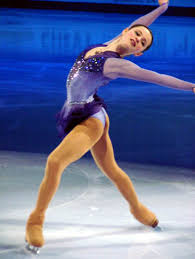 Sasha Cohen (Silver) is an MOT (member-of-the tribe).
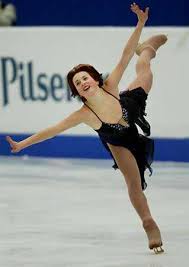
So is Russia’s Irina Slutskaya (Bronze)

Emily Hughes, who replaced Michelle Kwan on the US team, is also Jewish. [That means, of course, that her older sister, Sarah, who is the 2002 Gold medalist, is also Jewish. Sarah was the very first member of the tribe to capture a gold medal in figure skating at the 2002 Winter Olympics.]
In the ice dancing category, all three of the U.S. ice dance couples at the Olympics feature one Jewish partner. 
Melissa Gregory (partnered and married to Denis Petukhov) is Jewish.

So is Jamie Silverstein (partnered with Ryan O’Meara).
 So is Chicago-born Jew, Ben Agosto (partnered with Tanith Belbin, a recently naturalized Canadian) who won a Silver medal — the first for the US in Ice Dancing in 30 years.
For the record: Though he claims to be “a little bit Jewish,” Johnny Weir was was raised Catholic.

Definitely not an MOT.
Are you there Moses? It’s Me, God
Last week was such an exciting week. Remember? We recalled what we would consider the watershed moment of our ancestors. It was in past week’s Torah portion that the Children of Israel came face-to-face with God. It was in that moment that our covenantal relationship was established and sealed for all time. It was our Sinai moment, and it was so powerful that the Israelites instructed Moses to carry on the conversation…without them. So moved were they that they could no longer bear to be in God’s Presence.
In this week’s portion, therefore, God draws Moses near to Him in order to convey the terms of the covenantal agreement…alone. Without us.
God said to Moses, “Come up to Me on the mountain and be there, and I will give you the stone tablets with the teaching and commandments which I have inscribed to instruct them.” (Exodus 24:12)
A very straightforward verse and yet there seems to be a redundancy in the first half when God says. “come up to Me…and be there.” Where else would Moses be but “there?” The Kotzker Rebbe, who had the same question, teaches that “come up to Me” speaks of Moses’ physical location while “be there” is God’s way of telling Moses to be mentally present as well.
How often do we find ourselves just going through the motions? We are certainly physically present but we are not always mentally engaged. We get home from a long day at work and go through the mail or messages while our children try to engage us in conversation. We are there in person, but definitely not in spirit. This week’s portion strives to be our mental check. “Make certain,” God says, “that you are fully involved in My sacred work. It is not enough to just show up!”
May we learn from this to connect on every level in order to achieve God’s imperative to His servant Moses.
Keyn y’hi ra-tzon – May this be God’s Will!
"Maimonides, What Say You?"
I love the Olympics! I am actually one of those crazy people who watch skeleton, biathalon, and luge. For the same reason that I watch badminton, track and field, & archery. The pageantry. The sportsmanship. The artistry. The athleticism. I am in awe. And having trained and completed my first (only?) endurance event this year, I have an even greater appreciation for the athletic pursuit.
Of all the sports, I have always love ice skating the most. My laundry list of reasons are no different from anyone else’s list [poetry in motion, dazzling spins, Ice Castles, etc.]. Except for this — my favourite childhood babysitter was an ice skater. And her teacher, if my memory has not been warped by the passage of time, skated on the Donny & Marie show. And that was just sooooo cool!! We even had a picture of my sitter in a blue skating dress posing in front of a winter background. I loved that picture and I loved that sitter. [For the record, my former sitter’s son will become Bar Mitzvah in six months, and I’ll be on the bimah for it. Who would have thought??]
Whether watching Kristi Yamaguchi skate to gold in Lillehammer from my hotel room in Paris (1992) to watching the 1995 World Championships at Beit HaNasi (Jerusalem) to watching Tara Lipinski skate to gold in Nagano in the Cooks’ family room in Rockville Center. I am enthralled with this sport and secretly dream of taking lessons and learning how to skate.
Thanks to TiVo, I have been able to watch every blessed moment of figure skating from Turino. Some of the moments have been breathtaking. And some, well… Is it just me or does skating sometimes bring out the oddity in people?
I have two words — Johnny Weir. Here’s a third word — excessive. And if you don’t think that owning 40 pieces of Louis Vitton luggage is excessive, just read the rest of the Washington Post article.
The RamBaM said it best:
a wise man will carefully avoid excess, lest he give the impression of haughtiness. (Yad: Deot, 1180, 5.7)
Too late.
Betwixt and Between
Is it an awful thing to admit that I sometimes tire of discussing the Middle East?
I shudder even as I write this, but it is true. Sometimes I just want to talk about something else. And yet, I can’t help but scour the headlines daily for news about our homeland.
I never completely feel at home…in either place. I am a proud and loyal American. My family has been here for three generations, my grandfather served in the Army, and I consider myself American. And yet my Judaism sets me apart from the majority and I am keenly aware of a sense of otherness. When I am in Israel, I am set apart by both my American-ness (that is not really a word, of course.) and my Reform ideology. And still, I feel a sense of belonging there that I cannot describe.
So when I tire of the discussion, I feel guilty. Guilty because in fact I have no right to tire of a discussion that does not directly impact my physical well-being. It is rather chutzpadic of me to arbitrarily decide when I feel like thinking about the political mess in Israel and when I would rather pretend that it does not exist. You can bet that for Israelis, they would love to have the freedom to take a day off from the national tension that has become part and parcel of living in Israel.
And so I once again direct you to Rabbi Daniel Gordis, whose dispatch this week once again elucidates so poignantly what it means to live in Israel. And I am particularly excited to report that Rabbi Gordis’s new book Coming Together, Coming Apart: A Memoir of Heartbreak and Promise in Israel is scheduled to be published this summer. If his earlier writings are any indication, this will be a passionate and insightful look into the soul of our people.
In the meantime, as the Psalmist urges,
Pray for the peace of Jerusalem; May those who love you prosper. May there be peace be within your walls, and prosperity within your palaces. (Psalm 122:6-7)
Amen v’amen.
Knit One, Purl Two?
Ok…well I’m not really up to the purl part yet. After about four hours, I’m still trying to get the knit stitch down pat.
I decided some weeks ago that it was time to learn to knit. PC thinks that I’m crazy for taking on something else. Since I’ve given up running, I figure that I should fill that time with some other worthwhile activity — and knitting seems to fit the bill.
All of the women in my family are accomplished needle workers. Knitting, crocheting, needlepoint, sewing. A few half-hearted attempts as a young girl and I seemed destined not to join their ranks. Lack-of-patience or perhaps a lack-of-talent. Who knows? Luckily for me, I was born into a generation that did not require young ladies to perfect their needle skills.
Or maybe not so lucky. Instead of being tormented in my youth, I struggle with a new skill in my adulthood. And that adage about old canines isn’t so wrong. It is not impossible to acquire a new talent, but it is certainly more difficult to do so as we grow older. So while my childhood was free of the painstaking hours earlier genreations of girl spent knitting rows and then tearing out imperfect stitches, and for that I am thankful, I now wrestle with clumsy hands to create something that might have come much easier to my younger self.
It turns out that you can’t actually learn everything just by reading. That’s not to say that a little advance research won’t help with a new skill. At a certain point, however, one just needs to learn by doing.
I decided to enlist the help of my grandmother. As the matriach of our family, and a most accomplished seamstress, I figured that she would have much to offer in the way of advice and expertise. And even though I have heard many of our family stories from her, I hoped that other information would flow as freely as the knitting needles. [I feel accomplished already for just 10 days ago, I referred to these as “knitting sticks.”]
What did I learn during our first lesson?
I learned that knitting requires an awful lot of concentration and patience in the very beginning.
I learned that my grandmother was taught to knit when she was about 15 by a tenant that lived in one of the buildings owned by my great-grandmother.
I learned that the very first sweater that my grandmother knitted was for her beloved brother Henry and that he was wearing it the day that he died.
I didn’t know any of those things. The first item I would have discovered on my own, but I could have never uncovered the other two facts had we not been sitting together and knitting.
I don’t expect to make great things. If I do, an added benefit. What I am hoping is to to learn great things. Information that will add to my story.
The truth according to whom?
It’s all about perception. Didn’t someone once say that perception is ninety percent reality? Or as Christopher A. Ray wrote, “Perception is merely reality filtered through the prism of your soul.”
Take this week’s Torah portion. After 400 years of Egyptian enslavement and a close escape through the Sea of Reeds, we finally come face-to-face with our God. The details of this experience, as well as our forty years of desert wanderings, will be recorded by Moses. It will be his voice that will reach across the generations, keeping our history alive in every age. Therefore, it will be his perception that will colour our story.
What about the other voices? How can we know a complete story if the other voices are silent? And how would our understanding be altered if we could hear someone else’s perception?
We All Stood Together
My brother and I were at Sinai
He kept a journal
of what he saw
of what he heard
of what it all meant to him
I wish I had such a record
of what happened to me
It seems like every time I want to write
I can’t
I’m always holding a baby
one of my own
or one of my friend’s
always holding a baby
so my hands are never free
to write things down
And then
As time passes
the particulars
the hard data
the who what when where why
slip away from me
and all I’m left with is
the feeling
But feelings are just sounds
The vowel barking of a mute
my brother is so sure of what he heard
after all he’s got a record of it
consonant after consonant after consonant
If we remembered it together
we could recreate holy time
sparks flying
(Merle Feld, A Spiritual Life: A Jewish Feminist Journey Albany: SUNY Press, 1999, p. 205)
When we hear stories from our children, do we stop and take into account that the facts are being presented from their perspective and may not be the whole story? Conversely, when we form an opinion about something, do we heed the fact that our children may have a very different perspective of the same situation? Poppyseed once took a class that I didn’t think was as good as it “should” have been. And yet, Poppyseed loved it! She could not wait to go to class each week and was sad when it was over. Looking through her eyes, I saw a completely different experience and learned to value the class for what she got out of it rather than what I expected.
As we read our people’s story of revelation, may we remember that we are hearing only one side of a multi-faceted story and learn ways to filter stories through the prisms of other souls.
Kol Tuv!

 Frume Sarah is Shabbos-observant -- in a Reform way, that is. Please note that from Friday afternoons until one hour after sundown on Saturday evenings, Frume Sarah will be unavailable, in observance of the Jewish Sabbath.
Comments made during this time will be held in a queue, to be moderated afterwards.
Thank you for your understanding...and gut Shabbos!!!
Frume Sarah is Shabbos-observant -- in a Reform way, that is. Please note that from Friday afternoons until one hour after sundown on Saturday evenings, Frume Sarah will be unavailable, in observance of the Jewish Sabbath.
Comments made during this time will be held in a queue, to be moderated afterwards.
Thank you for your understanding...and gut Shabbos!!! 


 Frume Sarah's World