M.I.A.

Twenty-seven people. Twenty-seven. Including the two rabbis.
- Is it because our Reform folks have never been in the habit of attending shul on the seventh day of Pesach?
- Is it because they don’t know that the seventh day of Pesach is a chag?
- Is it because they’ve been doing so much “Jewish” that the idea of one more thing is just beyond their threshold?
By-and-large, we have good attendance at our services. Our sanctuary is near-capacity most Shabbatot. And it isn’t that I need to have people in the pews.
I believe that our ritual observances have purpose. And that our very lives are enriched by participating in those activities. Passover begins with a great deal of anticipation. The weeks leading up to the holiday are filled with cleaning, shelf-lining, packing up dished, unpacking Pesach dishes, cooking, baking, etc. The search for, and eradication of, chametz. A day of fasting (for first-borns). And then, with great majesty, the weeklong festival commences with an elaborate, scripted feast. Or two. (Or even three!)
A holiday devoted to the retelling of our ancestors’ flight from enslavement. Our flight from enslavement. In order to avoid an anticlimactic dénouement, God instructs us to set aside the final day of Passover as holy. A day to refrain from our normal activities. In addition to the special Festival liturgy, our Sages, in their wisdom, named Passover as one of the four times a year to recite Yizkor. In some ways, it makes the most sense to formally remember those whose absence is keenly felt during this family-oriented holiday.
For twenty-seven of us, Sunday night was a remarkably beautiful and moving experience. As we stood and listened to our Song of Freedom.
The Red Dress Club: Resolution

Courtesy Wikimedia Commons
The phone rang. The clock read 11:23pm. It was the temple president.
As it so happens, I had not been waiting up for news of my contract renewal. I had been assured by the members of my Professional Development Committee, some of whom sat on the Board of Directors of the synagogue, that I would certainly be renewed for another term of service.
What else could I have said? I thanked him again and replaced the phone in its receiver.
***************
The next morning, I went to work as if nothing untoward had happened. Which was a smart move as it appeared as though no one was aware that the associate rabbi had just been canned. The Board, in its infinite wisdom, had determined that sending an official letter to the congregation would do more harm than good. A decision that would be reversed one week later.
It was a strange experience; being at work and knowing that I wasn’t really wanted. At least, not wanted by some. Made all the stranger by the lack of communication to the members of the synagogue. After several days, of course, word had leaked and rumours began to spread. It was then decided that a letter ought to go out. A joint letter. One saying that my departure was a joint decision, shared by the Board and me.
I could not agree to that letter. I could not agree because it had not been a joint decision. In fact, it had not been my decision at all.
Consistent with tradition at Temple ****** that our Associate Rabbis serve our congregation for about five years, the Board of Directors in consultation with our senior Rabbi has determined that Rabbi Frummie’s term will conclude on June 30, 2004.
We thank her for her years of devoted service to our congregation, and wish her well in her future endeavours.
We want the congregation to know that we have begun our search for our new assistant Rabbi and we will keep you posted.
Leaving aside the glaring grammatical mistakes, the terse tone of the letter would later….much later…clarify what the nature of the relationship had been all along.
*************
For the next six months, I remained at the synagogue, fulfilling both my contract to the synagogue as well as the covenental promise I’d made with God on 16 May 1999. In that time, I learned several things:
- Platitudes (e.g. “you’ll see, this is a blessing in disguise” and “it’s meant to be”) are helpful not to the person who is hurting, but clearly make the other person feel a whole lot better. “When the Lord closes a door, somewhere He opens a window” might have been awfully reassuring to Maria, but it made me feel like crap.
- Unanimous doesn’t always mean unanimous.
- Friends don’t abstain from the vote.
- Holding one’s head up and acting with grace, while damn-near impossible at times, is the best way to handle such adversity.
********************
Nearly seven years have passed. I have been gone longer than I was there. It remains one of the most painful experiences of my life.
And I am…now…grateful that it happened. It allowed me to come home.
Remembe(RED) is a memoir meme. This week, we were asked to recall an experience that seemed terrible at the time, but turned out to be something positive. In 600 words or fewer. As always, constructive criticism is welcomed!

Love Shouldn’t Hurt

Just prior to my wedding, one of my younger brothers pulled me aside.
If PC ever does anything to hurt you, you let us know. We’ll take care of you.
I found the exchange particularly endearing as my brother was rather young. The image of him protecting me was just a little funny given that, at the time, he would not even have qualified as a “90-pound weakling,” as ZaydeGiraffe was wont to say.
I don’t know what moved him to make the comment. PC had never shown any violence towards me. Perhaps it was just a natural inclination; to protect one’s sister.
How fortunate I am to have siblings who would protect, defend, shelter me. And how blessed I am to have a life-partner who doesn’t turn to violence as a way of exerting power.
Every day, as I am safe and content in my home and my relationship, there are women whose lives are threatened by acts of violence. Not by strangers, mind you. But by those who purport to love them. Considered a serious public health concern, the Centers for Disease Control & Protection (CDC) defines Intimate Partner Violence (IPV) as the “physical, sexual, or psychological harm by a current or former partner or spouse. This type of violence can occur among heterosexual or same-sex couples and does not require sexual intimacy.”
Two weeks from today, most of us will fete our mothers with brunch, gifts, and homemade cards. We call that day “Mothers’ Day.” Two weeks from today, like any other day, forty-thousand women and children will be in a battered women’s shelter. Safe. But not celebrating. Several years ago, Jewish Women International (JWI) created a program to honour these women. Through the annual Mother’s Day Flower Project, JWI with OPI Products, Inc. and Papyrus will send bouquets of flowers and beauty to 200 shelters across the United States.
“The roses that come to us from Jewish Women International are a beautiful sign that they are cared about, that someone recognizes them as special and that they are not forgotten. For some it may be the first time they have been honored on Mother’s Day. There is something about the beauty of a flower that is so touching to the senses and in its own way helps to revive the spirit. We are grateful to be recipients of this gift of hope.”
-Ann Marie Bartlett, Residential Program Manager at the Cornerstone Shelter in Bloomington, MN, 2010 Flower Project Recipient
By participating in the Mother’s Day Flower project, you can provide hope for these families on this special day, and everyday, through initiatives, supported by Flower Project proceeds, that work to educate communities, empower women and break the cycle of abuse.
Please consider honouring the mothers in your life with this act of tzedakah.
The Red Dress Club: Playlist

Courtesy Microsoft Office
The first time is an occurrence.
The second time is a coincidence.
The third time is a habit. And a superstitious one at that.
Caroline’s Kick-A$$ Playlist.
That’s how it was titled on her iTouch. Caroline’s Kick-A$$ Playlist. A collection of songs meant to get her adrenaline flowing and to put her in the mindset of a warrior. Plus a few songs she just really, really liked.
The titles had been added to over time. A few had been removed. Especially if they were associated with a particularly negative surgical outcome…
She hit “play” as she backed her car out of the garage.
- It’s a Good Day
- I Know This Town
- Perfect Way
- Can’t Fight the Moonlight
- Live it Up
- Dynamite
- Wavin’ Flag
- Get Your Shine On
- Get Up
- Go the Distance
“Hi, Jenna. Do you remember me? I’m Dr. Greenwood.”

Red Writing Hood is a writing meme. This week’s prompt was to take a look at the playlist of one of our fictional characters. (There was a nonfiction option this week, but I was curious to find out what was on Caroline’s iTouch.) As always, constructive criticism is especially welcomed.
Meltdown Guaranteed

Image courtesy of Wikimedia Commons
I never used to feel this way. Though I have spoken freely about my own difficulty with this particular festival, I have always loved the ritual aspects of Passover. From Shabbat HaGadol through Shivi’i Shel Pesach, the structure of the seder, the special reading from Song of Songs, Yizkor — my life is enriched by the carefully selected observances. Like so many Jews, some of my most-cherished childhood memories are of seders from years past. With beloved relatives and friends, now gone, still youthful and full of zest.
No longer. As the mother of a child on the spectrum, this holiday is a nightmare. From start to finish.
Some time ago, PC and I took a class meant to help us better understand Beernut’s behaviours. One of the most lasting take-aways has been the ABCs. Not those ABCs. The ABCs of Behaviour Modification.
- Antecedent
- Behaviour
- Consequence
In other words, as Beernut-specialists, PC and I ought to be able to help Beernut avoid meltdowns by knowing which antededents will set him off. We took this class before Beernut had a diagnosis that placed him on the spectrum. While some of the methods crossover, the ABC approach presents the following problem: Beernut’s antecedents are inconsistent. A hallmark of Asperger’s, as it turns out. What we have learned is that there are some constants as far as Beernut is concerned. While we are not able to accurately predict all the possible antecedents that will cause a meltdown, we know that the following situations are a sure-thing:
- any change in schedule
- late nights (in Beernut’s case, after 7:30pm)
- clothing (he has sensory integration issues)
- doing anything that will draw attention to himself (which seems incongruous for a kid who has major meltdowns in public)
- food
I feel as though we have set Beernut up for failure by placing so many stumbling blocks before him.
If Beernut had to stay up late for just one seder and not three, dayeinu.
If Beernut had to wear a button-down shirt and not also wear nice pants, dayeinu.
If Beernut had to listen to the seder and not read the Four Questions, dayeinu.
If Beernut had to refrain from bread and not refrain from all leavened products, dayeinu.
See what I mean?
Dear God,
As we have removed the chamtez from the crevices, I pray that You help me remove the resentment that sometimes rises within the recesses of my heart.
One at a Time

Courtesy of Wikimedia Commons
Looking back on the journey
that we carry in our hearts.
From the shadow of the Mountain,
to the waters that would part.
On this first day of the Omer, we are at the very beginning of that journey. The one that will take us from enslavement to liberation.
When we started that original trek, we had no true idea of what awaited us. While freedom was something for which we yearned, it was not until we had left behind the shackles of Mitzrayim that we learned what it means to be free. And it is only from our vantage point that we can now truly understand the complete ramifications of slavery on an entire people.
In L’dor VaDor, composer Josh Nelson looks backwards. Viewing the journey from destination to threshold emphasizes the permanent impression the journey continues to have on us. In the safety of the Mountain’s shadow, we revisit the wanderings of our people, from slavery to freedom. From darkness to Revelation. Forty days between Pesach and Shavuot. Forty days to reconnect. To recommit. To reconsecrate.
Today, we take the first step.
The Red Dress Club: Seasonal Goodness
Holiday Closing: Frume Sarah’s World will return after the first day of Pesach has concluded.
**************************
Courtesy of Wikimedia Commons
I have certain rules:
- the toothpaste tube must be capped after use
- pens ought to be stored with the tip-side up
- the closet doors are to be closed before going to sleep
- the peanut butter (in a PB&J) belongs on the top of the sandwich
- fruits and veggies ought to be eaten in their proper seasons
AND
[Sidenote: this is a small sampling of the many rules and regs in Frume Sarah’s World.]
With the advances in agriculture, it is now possible to eat produce out of season. Apples during the summer, squash in the spring, and so on.
Frume Sarah rejects these developments. First of all, produce that is produced in seasons other than those ordained by Mother Nature is not at its best. The flavours are diluted.
Beyond that very practical reason, there is, I believe, a spiritual reason that one ought to consider; eating fruit and vegetable at times other than their proper time moves us one more step away from our awareness of the natural cycle of life. Confining produce to the naturally-occurring seasons connect us to the earth in a physical way. We are taught patience rather than yield to instant gratification because we are forced to wait until the very thing that we desire is at its optimum.
Location plays a big part. Living in Southern California, we are spoiled. We have year-round access to most everything. Gone are the days when our diet revolved around what was readily available. I try to limit our produce choices, but often find it hard to deny the kids when they request berries in February or grapes in November.
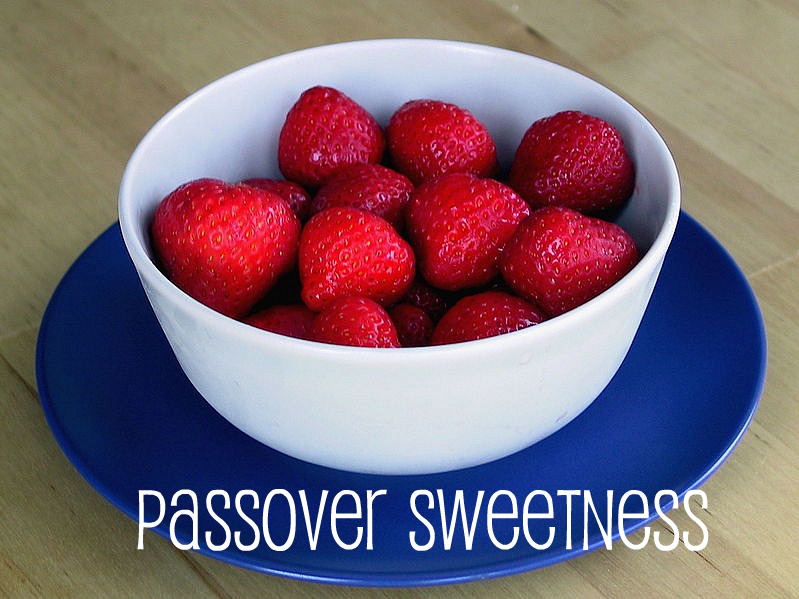
There is, however, one exception; strawberries.
More than any other food, strawberries remind me of Passover. When I was young, I knew that Pesach was coming when the strawberry fields near our home would release their sweet, alluring fragrance. In the days preceding the first seder, ZaydeGiraffe would bring home several flats of locally-grown strawberries. Their juicy goodness put to shame anything the grocery store could hope to offer.
To this very day, I avoid eating strawberries until the beginning of the chag. Impervious to the requests of my children, I preserve this cherished tradition from my childhood. While they do not yet understand, it is my hope that they too will associate the succulence of these berries with our annual festival of deliverance.
Just a few more hours…and those berries are mine.
Chag Pesach Sameyach from Beit Frummie!
“Give me a memory of the color red. Do not write the word ‘red’ but use words that engender the color red when you hear them. For example: a ruby, a tomato, fire, blood.Writing has the elegance of mathematics. Try to write economically. A red cherry is redundant. Cherry is enough unless it’s one of the yellow ones from Washington state. Then it’s a yellow cherry. But, otherwise, cherry immediately wakes up the color red in the mind.”
And, an additional requirement, of no more than 600 words. As always, constructive criticism is welcomed!
Home to Roost

Family. One of the highlights of of Pesach is the annual return of my sibs. Like birds coming home to roost, the Giraffes descend on the family homestead in the days leading up to the chag
With the birth of my niece, Sunflower, a new tradition was started; the annual cousins picture. Some of you might recall last year’s picture and the photographer’s attempt to sell us the Easter package.
This year’s photographer suggested some nice Spring backgrounds (“perfect for Easter”), but dropped the subject when JockBro inquired after some “nice Passover” options.
With the kids a year older, all agreed that this was the easiest photo shoot on record.
A zisn Pesach from the Frummies and Texas Giraffes!
The Red Dress Club: Nomenclature
Courtesy Microsoft Office
Caroline woke with start. Reaching for phone, she wondered if she would ever get used to the middle of the night pages. She entered the call-back number.
“This is Dr. Greenwood.”
The people in Caroline’s life could be divided into two categories; those whom she’d known before she went away to school and those she met after. And she could determine which group a person belonged simply by what name was used.
Carrie. The diminutive form had been used from the very beginning. “Caroline is much too long of a name for such a tiny girl,” said her father. But the name never seemed to fit. Caroline felt as though she was using a pseudonym. On two different occasions, she had tried to make the transition to Caroline. But it never took. “You can be Caroline once you get to college, Sweetie,” consoled Mom. “It’s just too hard for folks who’ve known you all your life.”
The voice on the other end of the phone could be placed into the first category, though it was someone with whom she attended university. She and Tara had met in high school and rather coincidentally ended up at the same university. Determined to be Caroline right from the start, she had shared her plan with Tara during Freshman Orientation. But by the time classes started a month later, Tara had either forgotten or didn’t really care. When Caroline would mention it, Tara would simply respond, “Hard for me to remember. I’ve always thought of you as Carrie.”
There were other things as well. Incidents or behaviours that viewed in isolation seemed of little consequence. When viewed together, and with the gift of hindsight, ought have made it clear that this was a very unhealthy friendship.
Like Tara’s habit of correcting Caroline’s grammar. Which, as it so happened, was pretty good. Or the unrelenting criticism of what Caroline ate. Worst was the one-upmanship. No matter what Caroline had done, was doing, or planned to do, Tara could beat it. SAT scores, position on the Student Council, volunteer work. As if they were rivals in some unnamed competition.
“Yes. I’m still here.”
The voice hadn’t changed since the last time they spoke. Which was three weeks before the end of Fall Semester, Sophomore Year. Caroline had gone to share a disturbing phone call she had just received from home.
“So I need to go home for about a week while my mom is recovering from her surgery.”
“Some kind of brain tumour. They won’t know for sure until they can do a biopsy. It’s close to the surface, though, and she seemed to indicate that was promising.”
Tara seemed annoyed.
“It’s still a brain tumour.”
“I can’t explain it, Tara. My mom said it was fine for me to stay here and that my dad would call as soon as the surgery was over. But I just can’t imagine being here. I’ll be a nervous wreck. I might as well be there, see that she’s OK with my own eyes, get her settled back at home, and then come back to school.”
A frigid vice grabbed hold of Caroline. With a sudden clarity, she turned and walked out of the room. They never spoke again.
It was the right decision. Six weeks later, her mother was dead. From a glioblastoma. On a leave-of-absence for the rest of the year, Caroline returned to school the following August.
“Yes. Tara. How are you?”
“Parietal.”
As Tara’s voice trailed off, Caroline was surprised by the response that rose to her lips.
Red Writing Hood is a writing meme. This week’s prompt was to write a piece of fiction about a phone-call from a long-lost friend. A friend who is in tremendous need of your help. Nomenclature is my initial foray into this genre. So constructive criticism is especially important.
Remember the Fifth Child

Courtesy Wikimedia Commons
One was wise and one was wicked,
One was simple and a bore.And the fourth was sweet and winsome,
he was young and he was small.
While his brothers asked the questions
he could scarcely speak at all.
But what about the fifth child?
At our recent model seder, as the rabbi was exploring possible reasons for the four cups of wine we drink at the seder, a student began to wave frantically, jumping out of her seat with agitation. Typical behaviour for her. For “Z” has Asperger’s Syndrome, a developmental disorder that is on the autistim spectrum. Among other cognitive and social difficulties, “Z” struggles to follow the most basic of social rules such as “raise your hand and wait for the teacher to call on you.”
What was bothering “Z” was this: the rabbi kept talking about four cups of wine. But, as she pointed out, more than four people come to the seder at her cousins’ house. So that makes way more than four cups of wine.
The rabbi came to a complete stop, thought a moment, and thanked “Z” for always looking at things through fresh eyes.
“Z” was right. We talk about the four cups of wine without stopping to think that the words we choose are unclear. The table is not restricted to four cups. Nor is each seder participant given four separate cups. We would remove the confusion by referring to the first drink of wine, second drink, etc.
The wise child.
The wicked child.
The simple child.
The child who is too young to ask.
and
The child who experiences the world differently than his (or her) peers and asks questions based on this unique perspective.
He is the fifth child.

 Frume Sarah is Shabbos-observant -- in a Reform way, that is. Please note that from Friday afternoons until one hour after sundown on Saturday evenings, Frume Sarah will be unavailable, in observance of the Jewish Sabbath.
Comments made during this time will be held in a queue, to be moderated afterwards.
Thank you for your understanding...and gut Shabbos!!!
Frume Sarah is Shabbos-observant -- in a Reform way, that is. Please note that from Friday afternoons until one hour after sundown on Saturday evenings, Frume Sarah will be unavailable, in observance of the Jewish Sabbath.
Comments made during this time will be held in a queue, to be moderated afterwards.
Thank you for your understanding...and gut Shabbos!!! 


 Frume Sarah's World