Haveil Havalim #311 — The Warp and Woof Edition
 Founded by Soccer Dad, Haveil Havalim is a carnival of Jewish blogs — a weekly collection of Jewish & Israeli blog highlights, tidbits and points of interest collected from blogs all around the world. It’s hosted by different bloggers each week and coordinated by Jack. The term ‘Haveil Havalim,’ which means “Vanity of Vanities,” is from Qoheleth, (Ecclesiastes) which was written by King Solomon. King Solomon built the Holy Temple in Jerusalem and later on got all bogged down in materialism and other ‘excesses’ and realized that it was nothing but ‘hevel,’ or in English, ‘vanity.’”
***************************
Strangely enough, both the Conservative and Reform Rabbinic associations held their annual conventions this past week. Here are just a few posts on the RA (Las Vegas) and CCAR (NOLA) gatherings:
Thanks for the Memories, #CCAR!! (Sects and the City)
CCAR Official Convention Blog
The Future’s So Bright: Are Reform Rabbis Ready for the 21st Century? (Rabbi Marci Bellows)
Post-Katrina New Orleans (Walking Humbly. Seeking Justice. Living with Hope>)
The Answer for Conservative Judaism’s Rebound (Rabbi Jason Miller)
And the Tweet streams: #CCAR11 and #RAConvLV
Without further ado…
*******************************
Torah
Though the author had self-categorized her post as “culture,” I am taking the liberty as this week’s host to place it here. As we are taught, in Tractate Sanhedrin 37a, that to save a life, it is as if one has saved a world. Batya sheds light on this imperative in Israel to the Rescue!
NY’s Funniest Rabbi has complied a terrific quiz…all answers from the book of Breisheet!!! Go on…see how well you do.
So, is there any true purpose for the existence of the evil inclination? Take a look at what A Chassidishe Farbrengen has to say.
The Rebbetzin’s Husband offers some excellent advice when it comes to the source of common sense.
And Parshablog wonders why there is no ‘famous’ derasha on Isha Ki Tazria as well as investigates why Rashi seems to be out-of-order.
Israel
There are definitely a few different schools of thought when it comes to seeking peace between Israel and her neighbours. Batya shares her POV over at Shiloh Musings. And watch out for getting news from Amira Hass, warns Yisrael (MyRightWord), who also questions the reporting by Linda Gradstein.
As always, Joel Katz keeps us apprised of all issues of Religion and State here and here. While Truth, Praise, and Help has been Deep in the Desert this week.
Tomer Devorah reminds us about the humanity found in the other. Ruti shares a moving and tender conversation between the old and the young. And Yisroel searingly describes what it is like when all of Israel mourns.
These next two entries show the lighter side of things. I have chosen not to create a separate humour category as I believe an Israel category ought to include both just as life in Israel includes both the serious and the humourous.
Over at Esser Agaroth, Yaakov wonders How Spicy Do You Like It?
Ruti shares a bus ride that truly can only happen in Israel.
Judaism
The Mikvah Lady has Left the Building explores marriage Beyond the Huppah.
This incident, reported over at Tzedek-Tzedek, is troubling for several reasons. What do you think? Tell David Morris if he made the right decision and whether or not he ought to take the matter further.
How do we maintain joy in the midst of suffering? The Jew in the City shares her thoughts.
With Pesach looming approaching, You’re Not Crazy offers this helpful timeline, while The Rebbetzin’s Husband offers an interesting perspective on Pesach and Death..
Wondering how to keep all of our Sages straight? Look at the study guide produced by the Masorti movement (via Blessed Little Bird)
Kashrut/Food
In Israel and in need of some home-style potato salad? Don’t make a move until you read Daniela’s review on a new offering.
With Pesach just a few weeks from now (eek!), we can all use some tips for preparation. Batya has some useful ones…as do the folks who have commented on her post, Simplifying Passover Cleaning.
Mara, over at Kosher on a Budget, has some delicious thoughts when it comes to Pesadik side dishes.
To help with cleaning, Daniela, over at Isreview, takes a careful look at San’s San Foam Dish-Soap
And, speaking of Pesach, let’s take a look at some adorable Pesach prep over at Homeshuling and Five Kid-Friendly Passover Ideas from the Minnesota Mamaleh.
Oh, and the Rebbetzin (of The Rebbetzin Rocks) has a few thoughts for Pesach shoppers.
Politics
News Beyond News has some definite opinions in Love Your Enemy?
Culture
Put on the music and see Batya dance in Lots More Than the Hora.
Racism is such an easy remark to throw around. Ruti asks us to think about it a bit more deeply
NY’s Funniest Rabbi is somewhat less than funny but equally as satisfying over here.
And תודה to Jacob Richman for making Hebrew more accessible with his new online program.
.
Personal
What I love most about The Kvetching Editor is her frank and open exploration of her personal praxis. And Chavi does not disappoint with this week’s offering, A Chasidishe Woman Waxes Frum on Fly-Aways. Pesach is clearly on everyone’s mind as JaneTheWriter gives her take on The 30-Minute Seder. And if you happened to get a strange email from me on Wednesday, here is the sad, sad, explanation.
On Tuesday, I saw the following from A Mother in Israel, regarding the death of her father, ZTz”L. My heart skipped a beat. And then another. Knowing Hannah through the blogosphere, and by her married surname, I had no way of discovering the connection any sooner. For it seems that Hannah’s father was a beloved professor of my father and so many of my colleagues. At the consecration service the night before my father’s ordination from the Hebrew Union College-Jewish Institute of Religion, Dr. Wacholder addressed the group of men. He spoke of the many blessings that they, as rabbis, would bestow on others during their lives. Then he asked, “And who will bless the rabbis? The people will.” Words that hang in my father’s study and have been a guiding principle throughout these nearly forty years. Though he had a significant impact on the lives of his students, no one will feel his absence more than his family, as noted here by one of his granddaughters.
זכר צדיק לברכה — May the memory of the righteous be for blessing.
And may his name always be sweet on the lips of those who loved and respected him.
**********************
And that concludes this week’s edition of Haveil Havalim. I hope that you enjoy reading these posts as much as I did!
Next week will be hosted by Esser Agaroth. You can participate in the next edition of HH by using our carnival submission form. Past posts and future hosts can be found on our blog carnival index page.
Public Service Announcment
Rumours of my recent financial woes have been exaggerated. By the jerks who have hacked all of my accounts. I am working to fix the compromised accounts, but wanted to reassure you that all is fine.
But here’s the real rub; according to the letter that has been sent to any person I have ever emailed, I am currently in London. Which, some might recall, is where I had hoped to be for my fortieth birthday month.
Rewarding Detour
Spontaneity can bring the most wonderful results, as I learned from yesterday’s change in plans. Read about it here: http://nola.ccarnet.org/stories/
Here We Are
New Orleans has always been somewhat of a hazy concept, informed by stories, newspaper articles, and Walt Disney. See my initial impressions of New Orleans here: http://nola.ccarnet.org/bienvenue/
Where is She?
Today’s thoughts can be found over at The Smartly SoCal. Feel free to leave any thoughts there 😉
Starting on Sunday, I’ll be posting from New Orleans, site of the 122nd Annual Convention of the Central Conference of American Rabbis.
Shabbat Shalom!!!
Hello…media…is anyone listening???
Today’s Final Jeopardy question:
An explosion in Jerusalem
Answer:
What is…what does it take for the international media to pay attention?
Nearly one hundred rockets being fired upon the citizens of Sderot just in the past week didn’t do it.
The cold-blooded murder of a young family while they slept didn’t really do it.
It wasn’t until yesterday’s terrorist attack near the Central Bus Station in Jerusalem that the rest of the world seemed to take notice that Israel is under attack.
Only…
Not everyone seems to agree that this was an act of terrorism.
According to Reuters, “a ‘terrorist attack’ (is) Israel’s term for a Palestinian strike.”
Really? Because my dictionary has a very different definition.
terrorism (ˈtɛrəˌrɪzəm)
–noun
1. the use of violence and threats to intimidate or coerce, especially for political purposes.
2. the state of fear and submission produced by terrorism or terrorization.
3. a terroristic method of governing or of resisting a government.
Jeffrey Goldberg, of The Atlantic, had this to say:
Those Israelis and their crazy terms! I mean, referring to a fatal bombing of civilians as a “terrorist attack”? Who are they kidding? Everyone knows that a fatal bombing of Israeli civilians should be referred to as a “teachable moment.” Or as a “venting of certain frustrations.” Or as “an understandable reaction to Jewish perfidy.” Or perhaps as “a very special episode of ‘Cheers.'” Anything but “a terrorist attack.” I suppose Reuters will mark the 10th anniversary of 9/11 by referring to the attacks as “an exercise in urban renewal.”
The mind reels.
Sorry, Reuters. Nails and shrapnel are only placed into a bomb when the intent is to maim and/or kill as many people as possible. Detonating it at a busy bus station is not merely “a Palestinian strike.” This act was meant to inflict pain and terror on the Israeli civillian population.
As was the lethal attack on the Fogel family in Itamar.
As are the missiles that continue to rain upon the southern part of Israel.
Once the sirens are sounded, the countdown begins.
Fifteen Seconds.
*********************************
Pray for the peace of Jerusalem:
they that love you shall prosper.
Peace be within your walls, and prosperity within your palaces.
For my brethren and companions’ sakes, I will say now,
peace be within you.
~Psalm 122
Filling the Void
Well, friends, gone are the days of community. The days when, God-forbid, should you find yourself thrust into a state of mourning, the community would come together and provide. Food, extra chairs, transportation for out-of-town relations from the airport, etc.
Or, perhaps, it isn’t that the community no longer exists, but that most folks have elected not to be a part of it.
הלל אומר, אל תפרוש מן הצבור
Hillel taught: Do not separate yourself from the community
(Avot 2:4)
Fortunately, community can be outsourced, as reported by a recent article in the Los Angeles Times. In need and don’t know where to turn? Enter the Shiva Sisters.
Their services include, but, I imagine, are not limited to:
• Consultation with Family
• Site Visit
• Planning Funeral Arrangements
• Clergy
• Venues for Memorials
• Venues for Gathering/Reception
• Professional Writing of Obituary
• Guest Book
• Funeral Service Program
• Preparation of Photo Reproductions
• Videographers
• Photographers
• Montage for Services or Home
• Courier Services
• Email Distribution of Directions and
Funeral Arrangements
• Personalized Memorial Website
• Minyan Service Leaders
• Bereavement Counselors
• Bereavement Library Resources
• Food/Caterers/Deli/Kosher available
• Rentals/Tables/China/Chairs
• Paper goods/Utensils
• Flowers
• Valet Parking
• Limos
• Bar Service
• Housekeepers
• Cleaning Crew
• Hotel Accommodations
• Meals for Minyan
• Babysitters
• Pet Sitting/Boarding
• Wardrobe Shopping for Family
• Nails/Hair/Make-up
• Handyman
• Organization of Possessions
• Estate Organization
• Unveiling
I don’t blame the owners of Shiva Sisters. Filling an obvious void, they have created something to fill it. And, based on the article, it seems as though they have spent a great deal of time learning about Jewish burial rites and mourning rituals and take their work very seriously.
What saddens me is how far from Judaism so many of our Jews have come. Deli platters, regarded as old school, are cast aside in lieu of passed hors d’oeuvres and beverages. A funeral service that touches on Jewish themes, but devoid of prayer. A lunch rather than a meal of consolation. A celebration rather than a ritual of mourning.
What will remain of all that is precious once it has been watered down beyond recognition?
Is it Still a Seder if Jesus is Invited?

Photo courtesy of FLBL
Frume Sarah likes order. Everything according to its rightful time. So even though this post has been percolating since last week, it would have gone against the natural order to address it until after Purim. But with Pesach looming…
So there I was, driving to shul last week, when I heard an interview on Larry Mantle that nearly caused me to drive off the road. The interviewees were promoting how successfully an interfaith marriage can work, especially when exposing the children to both religions. The couple? Cokie and Steve Roberts. Promoting their new book. Our Haggadah: Uniting Traditions for Interfaith Families.
They are everywhere these days, it seems. The book is getting a lot of press. They are both highly respected journalists and authors and, I believe, their credentials have a great deal to do with the success of the book.
So what’s my problem? Or, shall I say, problems?
Oh where to begin.
First of all, a seder is a religious ritual that is part of the Passover observance. Passover is one of the three pilgrimage festivals and is one of the most important holidays on the Jewish calendar. It is much more than a meal. And each part of the seder has historical and religious significance.
While non-Jewish friends and family members ought to be welcomed to the seder table, the service itself loses its religious potency when mixed with interpretations, practices, and readings that hold theological meaning in other faith traditions. So while it might be an interesting fact, for example, that the historical Jesus observed some type of Passover seder, that point belongs in a world religion class and not during the Jewish ritual.
An interfaith marriage presupposes that it is a union between two individuals who practice differing faiths. In the case of Cokie and Steve Roberts, only one of the two is a practicing member of a religion. Cokie is a committed and knowledgeable Catholic while Steve lightheartedly quips about his family’s Judaism being defined by the non-Jews who treated them badly in Europe. There does not seem to be a great deal of connection between Steve and Judaism. Even with the food that is served. The meal reflects not the Jewish origins of Steve’s family, but of Jews around the world. Again, a wonderful subject for a class on “Jewish Foods Around the World,” but not the right way to go in one’s home. After all, one of the many goals of the seder is to connect us with our past. And food is a very effective vehicle. For example, my children will never know my paternal grandmother, Selma, z”l, for she died when their Tante PepGiraffe, Uncle JockBro, and I were quite young. Though they hear stories about her, it is through her sponge-cake, which we eat only during Pesach, that lends an air of reality to the stories and hazy photographs. If all of the foods that were served came not from family recipes but from other sources, those familial bonds are weakened.
As for rearing their children with both. I submit that their children were, in fact, reared with neither. While the kids were certainly exposed to certain cultural traditions from their Catholic mother and their Jewish father, it does not appear as though they were raised with any theology. Which is often, though not always, the case.
This book is fine for those families who wish to create some type of inclusive seasonal meal. For those who are concerned with the continuity of Judaism, it falls short. I reiterate my earlier statement that non-Jewish friends and family can and should be welcomed to authentic seders. As our guests. Involved guests, if they are so comfortable. But once other theological similarities, viewpoints, meanings are introduced, the authenticity is compromised.
PPLD (Post Purim Let-Down)
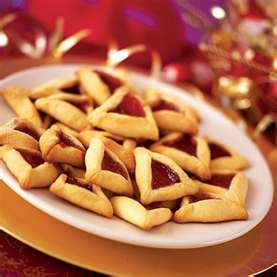
And just like that…it is over. I have been working on Purim since CHESHVAN! And it is not as though I’ll have nothing with which to occupy my time.
The greater the build-up, the greater the fall. I think that I enjoyed thisyear’s shpiel more than any other. Why was this year different from all other years? I’m so glad that you asked. This year, I turned over the director’s chair to someone else. Since this is my final Purim here at Congregation FITB (Fill-in-the-Blank), it seemed like the right time to hand off the responsibility to capable hands. More capable hands, as it turned out. Our director far surpassed what I could have done with the cast. With an added benefit — I got to enjoy the entire process rather than obsess over it. I could focus more on preparing the service, Megillah chanting, and so forth.
The sanctuary was overflowing, as it should be. You wanna know how to get your rabbi in a good mood? Come to shul. Really. BossGiraffe and I could not help but grin at the sight of so many folks. The service was quick and noisy, but we didn’t care. A shul full of Jews, decked out in all sorts of garb, fulfilling the mitzvah of hearing the Story of Esther. And what a Megillah-reading it was! Aided by resounding cries of l’chaim, followed by sips of Slivovitz, the reading was silly, provacative, ridiculous, and appropriately-INappropriate. And then we got to the shpiel!
That was Saturday night. Sunday morning saw the shul strained at its seams. For the first time, I believe in our nearly thirty-five year history, inclement weather forced us inside. The building was bursting with frivolity. And frolicking. And, of course, food.
So that by the time Sunday evening rolled around, I found myself a bit down. The magic carpet ride of Purim pulled out from beneath me. Leaving a new feeling in its place…
PMS — Pre-Matzah Syndrome
One month and counting…
Remember…
(delivered this past Shabbat)
It is on this Shabbat preceding Purim, called Shabbat Zachor, that we are called to remember. Remember…
Remember what Amalek did to you on your journey, after you left Mitzrayim – how, undeterred by fear of God, Amalek surprised you on the march, when you were famished and weary, and cut down all the stragglers in your rear. Therefore, when the Eternal your God grants you safety from all your enemies around you, in the land that the Eternal your God is giving you as a hereditary portion, you shall blot out the memory of Amalek from under heaven. Do not forget! ~Deut. 25:17-19
After fleeing Pharaoh, we began the long journey towards freedom. Tattered and worn, it was our vulnerable who bore the brunt of the violence. It was not the strong who were targeted. No, Amalek plucked out his victims as a vulture chooses the weak.
What is the connection between this passage about Amalek and Purim? The answer is found in the Jerusalem Talmud. Rav says: Why is it necessary for the portion of Zachor to be said before Purim? Because it is written And these days should be remembered and celebrated by every single generation, family, province, and city; and these days of Purim should never cease among the Jews, nor shall their remembrance perish from their descendants. (Esther 9:28).
“Remembered” and “celebrated” are to be understood separately, according to Rashi. I think it is fair to say here at our shul, we know all about “celebrate.” It’s the feasting, shpielling, and merrymaking. But to “remember” is something different.
To remember is to be familiar with the story, to internalize it, and to recognize its historical and contemporary meaning. The text deliberately instructs us first to remember and then to celebrate, understanding that any observance is an empty one without first recalling the meaning behind it. Not just once. But in every generation. As our Sages taught, In every generation, Amalek rises to destroy us. (Me’am Loez, Devarim vol. 3, p. 977)
After Mordechai refuses to bow down to him, Haman persuades King Ahasuerus to turn over to him the fate of the Jews. Whereupon, in the King’s name, Haman issues a royal decree, calling for the death of all Jews. Every man, woman, and child.
In our annual Purim Shpiel, Haman always utters an evil laugh after pronouncing this ominous decree. But this past Sunday, that menacing sound sent shudders through me. For it is indeed in every generation that there are those who rise up to seek our destruction.
One week ago, tonight, in Itamar, a settlement southeast of Nablus, West Bank, a family was executed in cold blood. Udi (36) and Ruthie (35) Fogel, their sons Yoav(11) and Elad (4), and their 3-month-old daughter, Hadas. Palestinian terrorists infiltrated the settlement, broke into the Fogel home, stabbed to death five members of the family, and left. Two sons, Ro’i (8) and Yishai (2) were somehow spared from the attack AND managed to remain asleep, unaware of the horrific reality to which they would awake. It was Udi and Ruthie’s twelve year old daughter, Tamar, who would discover the slain bodies of her family upon arriving home from a youth group activity. Every man, woman, and child…
Amalek was not the first. Throughout history, there have been others. Nor will Amalek be the last. In remembering the story, in remembering our history, we are spurred to action. To remember the past, to overcome the tragedies, and work to bring peace to a broken world, as Ruth Brin captured so eloquently in her poem entitled, Remembrance.
Remember, oh remember Amalek and Haman,
Hitler and Torquemada;
Remember Moses, who lost his temper,
and Esther, who tried to hide her Judaism;
Remember, oh remember that you
were a slave in the land of Mitzrayim.
Do not forget, for memory, fluid, clouded
memory is the beginning of the future.
To remember both the good and the evil,
to love the good and understand the evil,
To uncover them in ourselves and in others,
that is the beginning of wisdom.
With memory clear, with the past understood,
we shall overcome tyranny and hatred.
We shall overcome prejudice and lust for power,
we shall overcome cruelty and fear.
understanding the past, the key to ourselves,
we shall seek courage and wisdom,
We shall seek the hereditary portion
of all peoples, which is peace.
When we overcome the evil that is past and present,
we shall overtake the future of
peace and good for all God’s children.
כן יהי רצון!

 Frume Sarah is Shabbos-observant -- in a Reform way, that is. Please note that from Friday afternoons until one hour after sundown on Saturday evenings, Frume Sarah will be unavailable, in observance of the Jewish Sabbath.
Comments made during this time will be held in a queue, to be moderated afterwards.
Thank you for your understanding...and gut Shabbos!!!
Frume Sarah is Shabbos-observant -- in a Reform way, that is. Please note that from Friday afternoons until one hour after sundown on Saturday evenings, Frume Sarah will be unavailable, in observance of the Jewish Sabbath.
Comments made during this time will be held in a queue, to be moderated afterwards.
Thank you for your understanding...and gut Shabbos!!! 


 Frume Sarah's World