The First Day
 I am twenty-five hundred miles from home. I almost missed my flight. Haven’t had a proper meal all day. And was so tired that I gave up seeing a dear friend AND hanging out with my cousin.
Welcome to BeanTown. Only it appears that I’m not actually going to spend any time in the city.
My plan: Touch down at 7:10am. Arrive at hotel by 8:00am. Check into room, take a quick nap, and head into town. I love Boston. Don’t get here enough. And was hoping to enjoy walking the city before meeting up with folks.
My reality: Touch down at 6:45am. Arrive at hotel around 8:00am. Was told that room would be ready at 9:30am. Sat in lobby until room was ready. Around NOON. By this time, exhausted and rather hungry. VERY limited room service options. Too tired to eat. Cancelled lunch plans in order to take a nap. Woke up, got redressed, and went off in search for food. Found a vending machine and grabbed a Snickers and water before heading over to the mikvah.
What is so amazing is how many people I know here at the conference though I came assuming I wouldn’t know anyone. Some from real life. Some I haven’t seen in nearly twenty years. From rabbinical school. From college. From all over. Some I’ve only met online including Velveteen Rabbi.
And we are all here to talk about ==> mikvah. In our breakout sessions, we shared our motivations for attending a mikvah conference. The reasons are vast; some personal, some professional, all fascinating.
For me, my attendance is two-fold. I hope to gain the language that will accurately and passionately articulate why mikvah has a place in liberal Judaism so that I can educate more girls and women about the role it can play in their ritual lives. Furthermore, as I continue in my own ritual observance, I eagerly anticipate wrestling with the texts that have mandated this practice throughout the generations. Though much of the conversation revolves around the innovative ways in which immersion can be used, I am particularly interested in the traditional role mikvah can, and should, play in the Jewish home.
What struck me tonight, amongst other things, is how much I love to learn and how much pleasure I get when listening to an engaging lecturer. Knowing Dr. Jonathan Sarna only through his writings, I was delighted to discover that he is simply amazing in person. I cannot fathom how compelling a professor he must be or how much I would learn if given the opportunity to study with him for any significant length of time.
As was recounted tonight, for many non-Orthodox Jews, the first introduction to a mikvah is atop Masada. It is time for us to reclaim what is rightfully ours.
**********************************
Haveil Havalim is live over at the Ima’s place. Go see what a great job she did this week and thank her for all of her hard work!
Bitter, Bitter Cheshvan

Artwork: Tom duBois
With the intensity of our Fall Holy Days behind us, we find ourselves in the month of Cheshvan. Known as Mar Cheshvan, or “bitter Cheshvan,” it is the only month on our calendar devoid of festivals or fast days. And it is for that reason that many have assumed it was given its alternate name.
Yet, exploration into the etymology of the word Cheshvan presents a shocking discovery; we have been mispronouncing the name. The names of our Hebrew months were derived from their Babylonian counterparts. Given that we were in Babylonia at the time our calendar was codified, it makes perfect sense. With Nissanbeing the head of the liturgical calendar, the month in question is the eighth month. Because in Akkadian, the language of the day, the “w” (vav) and “m” (mem) sounds can interchange, we see that Marcheshvan which is from the two words “m’rach” and “shvan,” would have been “warh” and “shman,” in Akkadian, corresponding to the Hebrew “yerech shmi- ni,” thus “eighth month.” Ashkenazic tradition incorrectly places a break in the name, “Mar-cheshvan.” Our Yeminite coreligionists have retained greater accuracy in their pronunciation “Marach- sha’wan.” Furthermore, Rashi (11th century, France), the Rambam (12th century, Spain, Egypt), and Ibn Ezra (11th century, Iberian Peninsula) all use the complete name, indicating the longer name as the known name.
And yet historical “truth” ought not invalidate the wisdom that might lurk within the folds of folk etymology. For a certain Cheshvan fifteen years ago turned bitter when the Israeli Prime Minister was murdered at the hands of a fellow Jew.
As my hand reached for the handle, the front door swung open . My father’s face was ashen as he met me at the door to deliver the horrific news, praying that I had not been listening to the radio. Yitzchak Rabin, z”l had been assassinated at a peace rally in Tel Aviv. Moments before his murder, he stood on the dais and, with pop star, Miri Aloni, sang these words:
“…So just sing a song for peace, don’t whisper a prayer; Just sing a song for peace, in a loud shout…”
And then, with seemingly-prophetic words still in his coat pocket, the assassin’s bullet tore through him and stole him from us.
The twelfth of Cheshvan. Set aside to celebrate my engagement to PC with family and friends. What should have been one of the happiest nights of my life was marred by this terrible tragedy. Such an awful, awful night. For me and my family, it was surreal as we numbly maneuvered through a group of oblivious partygoers. The unrequited joy of the evening forever intertwined with a horrific reality.
And though peace seems less possible today than it did fifteen years ago, somehow we must continue to sing and to shout for that peace…
Know Thyself

He’s been clear from the very start. Outdoor Science School is a valuable experience. For other kids.
Beernut: We saw a video today about Outdoor Science School. I’m not going.
FrumeSarah: Why aren’t you going?
Beernut: Mo-om! There’s hiking at Science School. You know I don’t hike. And I don’t like being outdoors.
Now there’s hiking and then there’s hiking. According to the Outdoor Science School website, “our classrooms are outdoors on well-marked trails.” And the schedule does include a lot of hikes. Anywhere from one to THREE hikes each day. So for a self-proclaimed non-hiker, and one who doesn’t like being outside, this might be a problem.
One of the difficulties of having Asperger’s is that there is an illusion of competency. To the outside adult world, Beernut seems like a well-mannered, interesting young man. What the majority don’t see is he completely falls apart as soon as the school day ends. And that is already a vast improvement over last school year when the meltdowns often occurred at school.
Poppyseed: Well if Beernut isn’t going to Science School, then I’m not going when I’m in the fifth grade.
Beernut: No, Poppyseed, you’re going to go. It’s really interesting and you’ll have a lot of fun. It’s just not the right thing for me.
With three summers of camp under his belt, Beernut has a pretty good idea of what to expect while at Science School and while this is only a four day program, it is four, twenty-four hour days. Meaning — no down time from the constant barrage of sounds, expectations, new surroundings, and other external stimuli that can make life overwhelming for those on the Spectrum.
As his mother, I know that part of my job is to pry Beernut loose from his comfort zone and help him expand beyond that very limited place. It is also my job to protect him. And respect his emerging self-awareness. And not get caught up in the never-ending grief process of mourning the “normalcy” that is not to be.
How do I know what is the right decision?
Re-purposing
 I love “Glee.” I love “Glee” because it reminds me of days long past. The hours and hours and hours spent in rehearsal with my school’s equivalent of ‘New Directions.’ I love “Glee” for tackling some real life issues (being unpopular, teen pregnancy, homosexuality, friendships) and using music to move along the story. And I loved last night’s episode because it dealt with the issue of faith.
Using contemporary music to explore issues of faith is not new. In fact, I first used the episode’s final musical offering, “One of Us” by Joan Osborne, back in the mid 1990’s, at the suggestion of one of my classmates.
If God had a name, what would it be
And would you call it to His face
If you were faced with Him in all His glory
What would you ask if you had just one questionAnd yeah yeah God is great yeah yeah God is good
yeah yeah yeah yeah yeahWhat if God was one of us
Just a slob like one of us
Just a stranger on the bus
Trying to make His way homeIf God had a face what would it look like
And would you want to see
If seeing meant that you would have to believe
In things like heaven and in Jesus and the saints and all the prophetsAnd yeah yeah God is great yeah yeah God is good
yeah yeah yeah yeah yeahWhat if God was one of us
Just a slob like one of us
Just a stranger on the bus
Trying to make His way home
He’s trying to make his way home
Back up to heaven all alone
Nobody calling on the phone
Except for the Pope maybe in Rome
Because at the time that I used this song it was one that my students heard regularly, the lyrics were familiar to them. It was contemporary and, therefore, an accessible starting point for a discussion about belief. In last night’s episode, this song helped bring closure to those filled with the angst, questions, struggles, and resolutions that come with spiritual growth.
Belief is a funny thing. Like love, it can wax and wane. Life’s difficulties can challenge our belief in a God Who is intangible. While we can see God’s Imprint, we cannot see God. Though we can sense a Divine melody pulsing through Creation, God’s Voice can be blotted out by the noise of daily life. Adolescence is period ripe with anguish. Reexamining childhood beliefs is an important part of building a sustainable understanding of the Holy One.
What I most appreciated about last night’s episode was the reworking of The Beatles‘ “I Want to Hold Your Hand” from an upbeat pop song to a lyric ballad. With the protagonist’s father lying in a coma, snippets of memories, shot as old home movies, recall times when the hand of the father brought comfort and strength to his son.
Switching out the tinny guitars for the lush, full-bodied strings, what was once a light-hearted love ballad became the gut-wrenching plea of a motherless son, poised to lose his father as well.
I felt like a wrung-out dishrag by the time the song ended…
A Purse is just a…

“I like it on the floor.”
“I like it on the kitchen counter.”
“I like it on the bar stool, nice and high.”
All day, I noticed an odd trend. The Facebook statuses of many of my female friends seemed to suggest their favourite location. For what? Couldn’t quite figure that out.
“I like it on the fur rug.” “…on the floor, under my desk.” “…next to my bed.”
The innuendos were clear; the meaning, however, was not.
The “I Like it On” Facebook Status Update, according to several news sources, is meant to bring attention to breast cancer. October is National Breast Cancer Awareness month. The “it,” for those still in the dark, is a purse. As in, where do you like to put your purse. [Don’t worry, I had to look it up too.]
Several flaws in this ‘viral‘ campaign:
- Purposeful Obfuscation — the statement was worded in such a way as to draw attention while simultaneously leaving men, and anyone else who didn’t get the memo, in the dark. Hint: if you are trying to get folks to join the cause, don’t tick them off.
- Deliberate Titillation — the overt sexual suggestion cheapens the message.
- Inevitable Inaction — once people are told that it has to do with breast cancer, then what??
You want to do something meaningful? Make a donation. Spend time visiting a cancer patient. Urge Congress to ensure prompt and affordable treatment for every woman AND man fighting breast cancer. But don’t play some “game” and think that you’ve made any significant difference.
As for me, I scheduled my first mammogram. That’s how Frume Sarah is marking National Breast Cancer Awareness Month.
What about you?
Where’s the Parapet?

When something is stuck in Frume Sarah’s craw, I try to devote no more than one (two, if necessary) post on the topic as it is boring for you, my dear reader, and wearisome for me. A solid guiding principle that will now have a statute of limitations as it is time to revisit the parking situation at the Frumettes’ school.
Not only has it not improved, but it has actually gotten worse. And with no easy solution in sight.
There is currently only one faculty member willing to serve parking lot duty. “Budget cuts?” you say. A reasonable assumption given that the Golden State is now operating for the ninety-fourth day without a budget. But no, not a victim of the budget.
So if not a money issue, what is preventing the teachers from taking advantage of some additional income?
Fear.
Yes, that’s right. The teachers are afraid of the parents. Having been subjected to the specturm of bad behaviour, ranging from being ignored (at best) to being cursed out, our teachers are no longer willing to start their day in such a horrendous fashion before turning to their priority; teaching our children And I do not blame them. Not one little bit.
The City Engineer reports that the anterior (and smaller) parking lot was not meant for parking and ought to be used for drop-off only while the posterior (and larger) parking lot ought to be reserved for staff parking only. Except that the first parking lot would be a horrific mess with parents who already don’t follow the rules. Furthermore, he noted, he street in front of the school is only two lanes and was never intended to handle the amount of traffic it must now accommodate. Beyond this, he has no other suggestions.
And so, parents continue to drop off their elementary students on the major street around the corner, on the street in front of the school, just about anywhere they please. Creating havoc and, I fear, tempting fate.
כִּי תִבְנֶה בַּיִת חָדָשׁ, וְעָשִׂיתָ מַעֲקֶה לְגַגֶּךָ; וְלֹא-תָשִׂים דָּמִים בְּבֵיתֶךָ, כִּי-יִפֹּל הַנֹּפֵל מִמֶּנּוּ
When you build a new house, you shall make a parapet for your roof so that you do not bring blood-guilt upon your house if anyone should fall from it. (Deuteronomy 22:8)
This verse, as further elucidated in the Shulkhan Arukh (Hoshen Mishpat 427:6,8), if we do not put into place the barriers that will prevent a fatality, we bear the responsibility of the death. In this case, the death of a child.
Besides blaming the parents, and I do blame those who have an utter lack of regard for the traffic rules, what can be done to keep our kids safe?
Haveil Havalim #285 — Back to the Beginning
 Founded by Soccer Dad, Haveil Havalim is a carnival of Jewish blogs — a weekly collection of Jewish & Israeli blog highlights, tidbits and points of interest collected from blogs all around the world. It’s hosted by different bloggers each week and coordinated by Jack. The term ‘Haveil Havalim,’ which means “Vanity of Vanities,” is from Qoheleth, (Ecclesiastes) which was written by King Solomon. King Solomon built the Holy Temple in Jerusalem and later on got all bogged down in materialism and other ‘excesses’ and realized that it was nothing but ‘hevel,’ or in English, ‘vanity.’”
And just like that, the Chagim have come and gone. 5770 is history and the good news is that I have finally stopped accidentally writing 5770 on my checks.
Without further ado…
***************************
Torah
The Rebbetzin’s Husband takes a hard look at the concept of one’s personal relationship with God. I am wondering (aloud) if Buber‘s I-Thou approach might help shed some light on this.
The Edible Torah starts us off on the right foot with a look at the beginning. The Rabbi from the Pacific Jewish Center also has words on B’reisheet as does ThreadzOfBlue.
Rabbi Larry Bach shares a way of understanding the mitzvot of Sukkot and how they work in concert with one another.
Over at the Tablet, Marjorie explores the impact of coming to the end of a story. Our story.
Israel
Reflections on settlers, the Tea Party, family, and compassion from the Velveteen Rabbi.
In addition to the rites and rituals of this season, Risa pays homage to two young men whose lives were stolen at this season in years past.
Batya shares her on-the-ground experience over at Shiloh (literally and figuratively). She also shows how much her grandkids enjoyed the day. (Incidentally, if you are a “local,” Batya cordially invites you to join her at the Tel for Rosh Chodesh Cheshvan Women’s Prayers in one week.)
Stay on top of the religious happenings in Israel (and believe me, there are MANY this time of year), thanks to Joel Katz.
Will the next war be fought using technological warfare? Tzedek-Tzedek wonders if the war with Iran has already began…via computer virus.
Esser Agaroth has some definite opinions about the current dilemmas facing Israel. See here and here.
Newsflash via Lady-Light: Israelis are a resilient people. Not news to us, but Martin Fletcher has now reported it so it must be so. Lady-Light also shares some opinions on Daniel Freedman’s recent piece as well as a recent offering from Latma TV.
Speaking of the media, Simply Jews shows us what the Aussies are saying. And some thoughts over at Israel News about the reports of rape in Palestinian villages.
Want to know if you are raising an Israeli? Treppenwitz tells you how you can tell.
Judaism…with a LOT of Sukkot
I LOVE this post by A Simple Jew and the way he puts Sukkot into context.
And a new perspective (that’s chiddush to most of ya’ll) from NY’s Funniest Rabbi on the happiness of The Chag.
Take a look here and here at the joy in Torah as captured by Jacob Richman. There are Jews who look like me. Jews who look like my Lithuanian and Galician forebearers. Jews who don’t look ANYTHING like me. All rejoicing in God’s Revelation through Torah.
Amy, over at Homeshuling, takes us through her search for local scach in New England.
Speaking of Sukkot, Leora takes us on a virtual Sukkah hop, Chavi gives us her take on Sukkah City, the Minnesota Mamaleh takes us inside her sukkah (and subsequent sukkah conversations with her adorable kids), Truth, Praise and Help takes us along to Yosemite, and the Ima helps us define “to dwell.” Seraphic Secret also weighs in with thoughts on Sukkah City.
Hadassah asks if Simchat Torah is only for the men and I take a critical stance on the public unrolling of the Torah — which invited some serious flaming over at the RJ blog.
Inspired by an old “Ask Shifra” post, Kosher on a Budget shares thoughts on her own experience of dealing with debt here, here, and here.
If we expect our children to be practicing Jews, ought we encourage their talents in activities that will lead them to break mitzvot? I know that this is something with which I struggle. The Rebbetzin’s Husband offers his thoughts here.
Along the lines of being practicing Jews, BOTH of the Rebbetzins (Melissa and Jessica) share their experiences of being Jewish in the workplace. Important explorations.
Two new finds in the realm of modest, yet fashionable, dressing: Nina over at AllTumbleDown and Ally at Modestly Fashioned.
Over at Sects and the City, a look at independent minyanim and their effect on organizational structure.
Humour
Ever wonder how What War Zone observes the Yamim Noraim?
Personal
Sometimes, as Batya has discovered, more choices can solve the problem.
Learning from her own frustrating experience, Sara Layah shares some advice when making gravestone arrangements.
Want to know how to spark your kids’ interest in veggies? Creative Jewish Mom teaches us how to foster an interest.
With the end of the chagim, our prayers turn from acknowledging the Maker of dew to the Maker of rain. How fitting, then, is this post by Elianah-Sharon and the feelings of security and warmth she feels in the rain.
A hearty mazal tov to The Fly Fishing Rabbi on the safe delivery of his twins. May they help build up the House of Israel.
And a very happy double-chai to Benji Lovitt!!!
**********************
And that concludes this week’s edition of Haveil Havalim. I hope that you enjoy reading these posts as much as I did!
Unless someone is willing to step forward and share hosting responsibilities, Haveil Havalim will not appear until Sunday, October 24, 2010, when it will be hosted by Isramom. Please, PLEASE do not submit your blog article prior October 17. You may do so by using our carnival submission form. Past posts and future hosts can be found on our blog carnival index page.
Artwork: Giovannina Colalillo
It is time

The rhythms of this season make so much sense to me. Just as I was hesitant to let go of the sanctity in the immediate conclusion of Yom, I am equally prepared to bid adieu these many, many days of reflection, repentance, and rejoicing. Fifty-three days in all.
At the stroke of midnight, as the story goes, the coach reverts to a pumpkin, the coachman to a horse, the horses to mice, and Cinderella’s gown to rags. The magic is gone.
So too is our backyard. From sacred to ordinary. With just the remnant waiting to go out with the trash. Well-used.
It was a good holiday season. And now we move on…
Rolling, Rolling, Rolling

I don’t know how or when it happened. But somehow, in the not too distant past, the pinnacle of the Simchat Torah celebration moved from the Hakafot and Torah readings to a new, and visually-impressive, presentation — the unrolling of the Torah in its entirety.
More and more congregations have embraced it and I find it both perplexing and troubling.
Traditionally, the Torah is treated as if it is nearly alive. It is NOT alive, but we accord her a great deal of respect. We do not touch the parchment as the oils from our hands will rub away the ink and render it unusable. When we open the scroll for a reading, we open it not more than three columns in order to maintain some semblance of modesty. If we are moving the Torah from one location to another, we would not place her in the trunk. Rather, the scroll would ride inside the car. Nor would we leave the Torah in the car overnight. If a Torah is rendered unusable, we bury her. We stand when the Torah is removed from the ark (Kitzur Shulchan Aruch 28:3). And, God-forbid, should the Torah should be dropped, the one who dropped her is required to fast. As are those who have witnessed the incident (Orech Chayim 3:3).
Unrolling a Torah in its entirety seems to defy our customary ways of handling the scroll.
What is troubling is that there are long-standing rituals associated with Simchat Torah. The Shulkhan Arukh, not to mention a number of Sages, provide clear instructions regarding the ways in which we read the scrolls on this festival. Why toss out the mandated practices only to replace them with something new?
Innovation can be a wonderful thing. It keeps stasis at bay. It seems to me, however, that unrolling the Torah is simply a gimmick to get folks interested in participating. When I read descriptions of this practice as “the highlight of the Simchat Torah experience,” I am saddened. Saddened that we have become so jaded that our traditions are perceived to be both uninspiring and antiquated. Saddened that we seek more thrilling, more “meaningful” rites. Perhaps that is what so compelling about Chabad. They are seen as delivering “the real thing” rather than re-branding it or re-imagining it. How is it, then that instead of seeming outdated, the ways in which they practice their Judaism are seen as “authentic”?
It’s Too Darn Hot
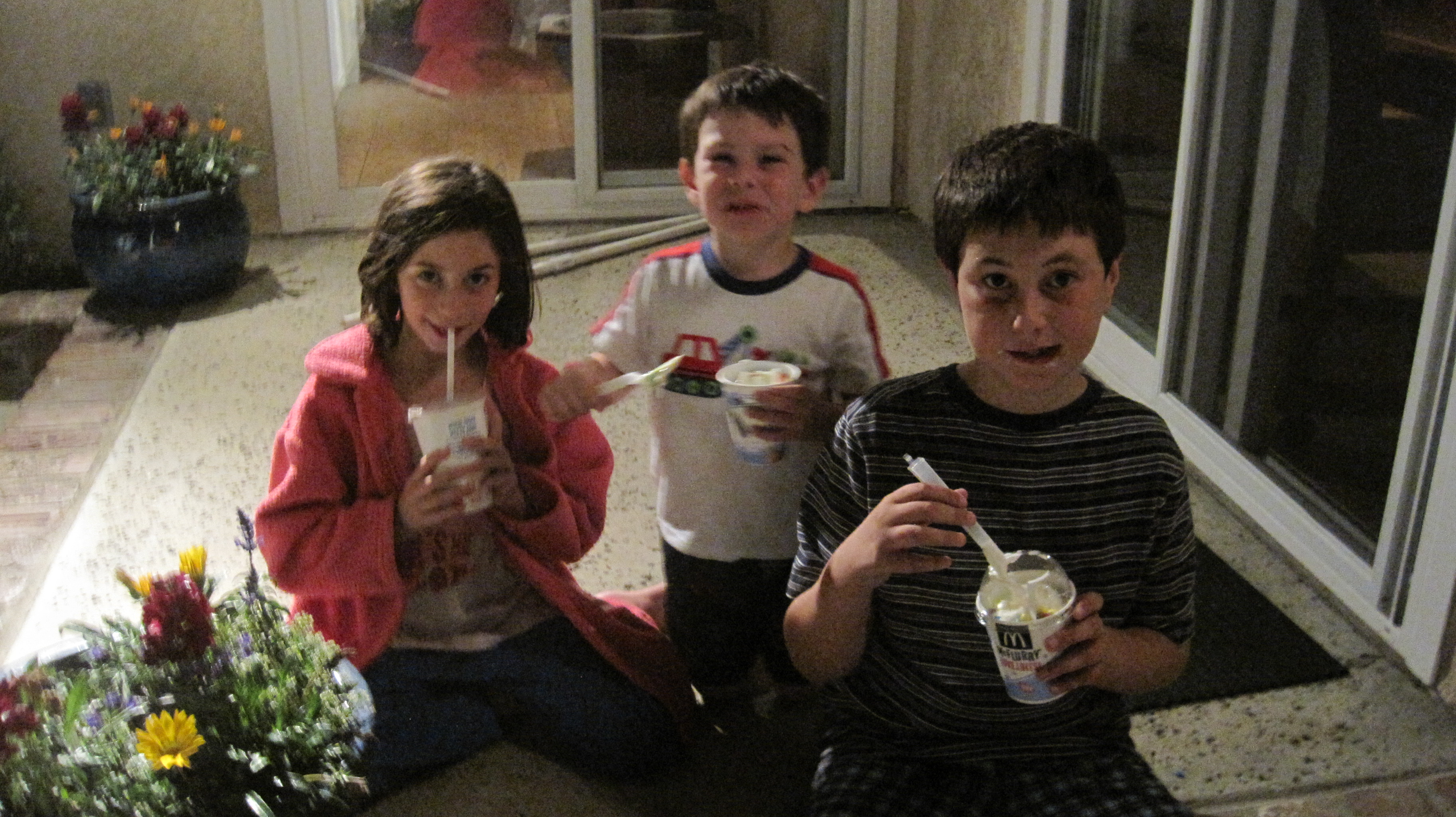
This is why I try not to complain outloud. You see, folks here in SoCal were complaining all summer about the cooler-than-average temps. In fact, the gloomy days of 2010 saw Los Angeles as having the fifth worst summer, according to the experts over at the Weather Channel. Even the typically uncomfortable High Holidays were quite comfortable. And still people insisted on voicing their complaints, comments, etc.
Never, NEVER say such things outloud. Because you’re just tempting the Evil Eye to work some mischief.
Such as…record-breaking heat. Yes, folks, it was 104 today in “A Nice Place to Live.” And no air conditioning in the schools. The school district office, however, has great climate-control and I do hope they enjoyed it. After all, why should everyone suffer?
The Frumettes couldn’t sleep — because Beit Frummie does not have a/c — and at 9:00pm, we took an impromptu tiyul for ice cream.

 Frume Sarah is Shabbos-observant -- in a Reform way, that is. Please note that from Friday afternoons until one hour after sundown on Saturday evenings, Frume Sarah will be unavailable, in observance of the Jewish Sabbath.
Comments made during this time will be held in a queue, to be moderated afterwards.
Thank you for your understanding...and gut Shabbos!!!
Frume Sarah is Shabbos-observant -- in a Reform way, that is. Please note that from Friday afternoons until one hour after sundown on Saturday evenings, Frume Sarah will be unavailable, in observance of the Jewish Sabbath.
Comments made during this time will be held in a queue, to be moderated afterwards.
Thank you for your understanding...and gut Shabbos!!! 


 Frume Sarah's World

