Whose Presence the Celebration Is
 It’s not good to mislead people. It annoys them and then you’ll lose their trust. Which is why, when the D.J. announced that the rabbi would be reciting a very short prayer after the meals, I felt compelled to correct him.
FrumeSarah: It’s not actually short.
D.J.: It really doesn’t take that long. Just a couple of minutes or so.
FrumeSarah: Really…it’s going to take us more than a couple of minutes. I mean, we do the long one and with the wedding inserts…
D.J.: I’m Jewish too. I know how long the Birkat takes.
[===> Ooo — HUGE pet peeve. “The Birkat”? And which one would that be? Birkat HaKohanim? Birkat HaLevana?]
Bubbe: You know, you probably want to trust what she’s saying. She’s also a rabbi.
And so we began…

Though the Wedding Birkat Hamazon starts off exactly like the standard one, it quickly shifts with the following:
Sweep away darkness and anger, then event he dumb will cry out in song. guide us in the paths of righteousness. Accept the blessing of the sons of Aaron.
With consent of all present, let us bless our God in whose presence the celebration is, and whose food we have eaten.

Blessed is our God in whose presence the celebration is and whose food we have eaten, and through whose goodness we live.
At which point, we abruptly go back in the bencher to page 50. And page turns that take us backwards rather than forwards is always concerning to the natives.

Now every family has activities they enjoy together. Some families have family football games after Thanksgiving Dinner. Other families go camping. Our family’s activity? Birkat HaMazon. We like it at a healthy clip and we like it loud. We have to make a concerted effort not to speed up and leave others in our wake.
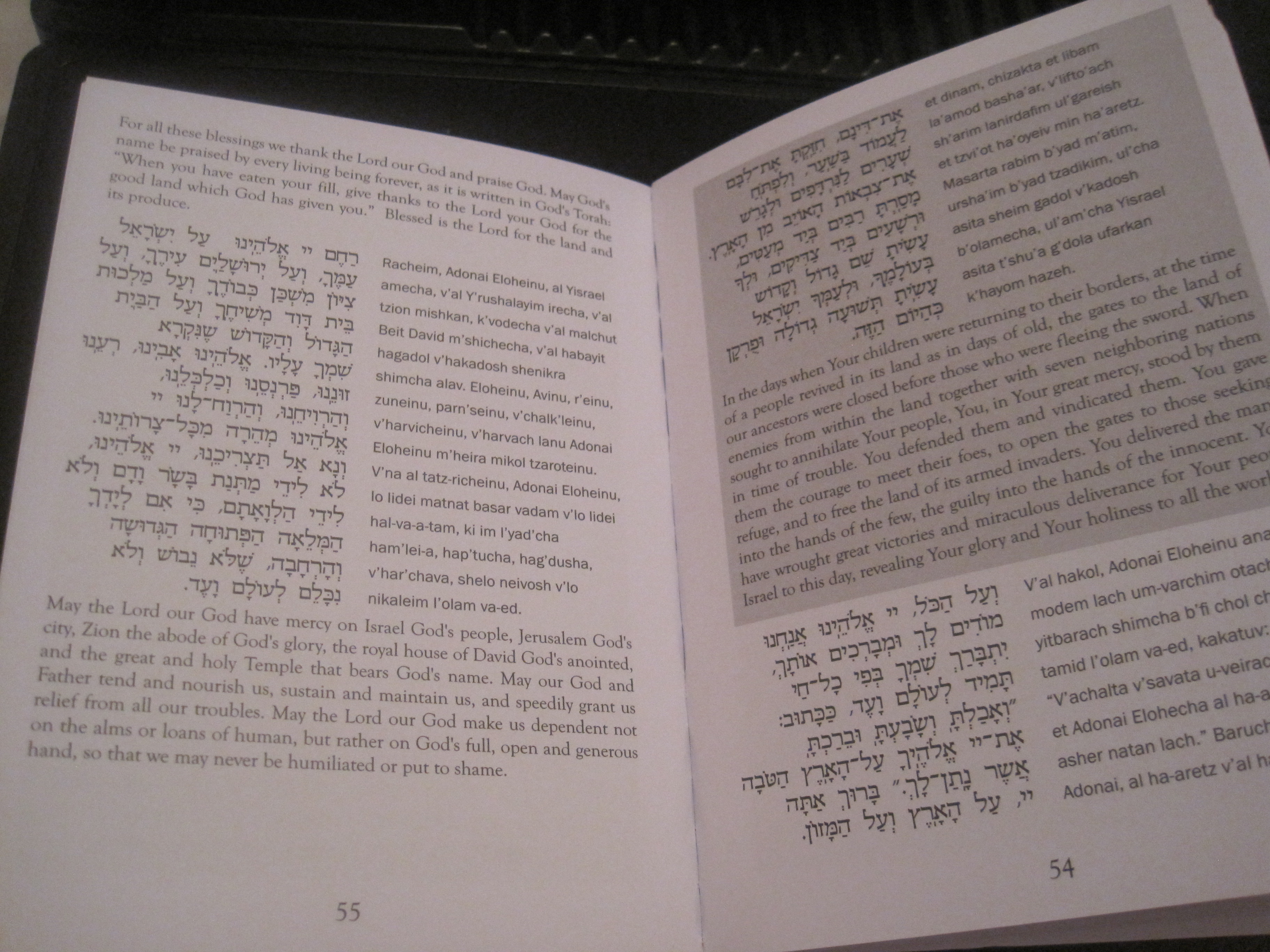
As it was a weekday and not Purim, Chanukah, Rosh Chodesh, Yom HaAtzmaut, or any other special day (other than the wedding, of course), we skipped the special insertions. Which meant page announcements.

And more page announcements.

And more page announcements.

And even more page announcements.

Until finally —
We arrived back on Page 66 for the repetition of the Sheva Brachot.
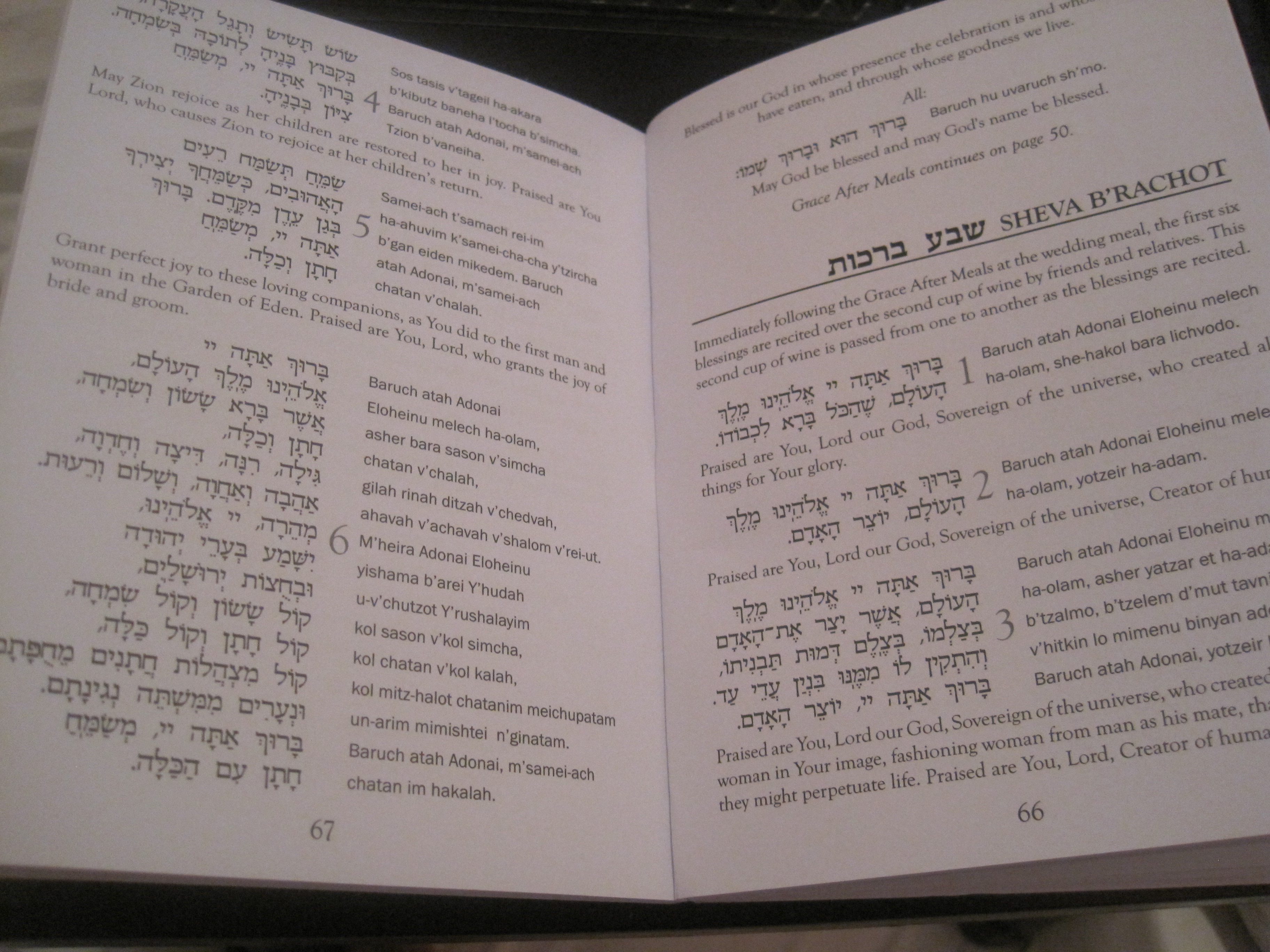
And so, Mr. D.J., you might want to consider that when a family slots fifteen minutes for the Birkat HaMazon, it isn’t a misprint.
Unless you really thought that we were doing some other “Birkat” — in which case, it would have been “a very short prayer.”
Statistics
According to the statistical information, 2.3% of the 808,210 residents of the Lehigh Valley are Asian. Which is drastically lower than the 25.76% in my hometown.
I don’t know where the 2.3% were hiding, but I didn’t see a single Asian resident of the Lehigh Valley.
The one Asian I did see is from out-of-town.

Yo-Yo Ma was giving a concert at Lehigh University on Saturday night. And had the misfortune of attempting to catch an elevator at the same time our entire group was heading out for the out-of-towners’ dinner. Fortunately, he was in no rush and took the next car.
O Come Ye, O Come Ye

And just like that, our family is forced to move from grief to joy. One day after burying my uncle, z”l, the children and I were en route to Bethlehem. No, not that Bethlehem. Bethlehem, PA. (FTR, had I actually meant the Palestinian city, I would have referred to it by its Biblical name of בֵּית לֶחֶם — Beit Lekhem — rather than by the Anglicized version.)
Founded as a Moravian mission on Christmas eve in 1741, Bethlehem, PA was an industrial center during the Industrial Revolution. And it will serve as the site for the seudat mitzvah for my brother, Ace, and his kallah on the first day of the upcoming new week — i.e. this Sunday. (The chuppah, made forty-three years ago by my grandmother, z”l for the wedding of our parents, will be raised at their shul in Allentown.)
The fellas are out carousing. Poppyseed wanted to know what they were doing. Much to the consternation of those within earshot, I responded, “not much. Just going out to drink, play cards, and see naked girls.”
Ma-ma! Be serious!
It really does sound ridiculous, doesn’t it?
Transitions

It hit me during tonight’s minyan; my cousins are their father’s kaddish.
The Mourner’s Kaddish, though never mentioning death or dying, has been recited by primary mourners since the 13th century. Prior to the death of one’s parent, sibling, spouse, or child, the individual does not say kaddish.
The Reform movement broke with this tradition for two extremely sound reasons. In a time when fewer and fewer people are comfortable with liturgy, it can be painful to listen to a sole mourner stumble through the Aramaic. By having the entire congregation rise and recite Kaddish alongside the mourner, the community is able to provide emotional and linguistic support. Additionally, we are keenly aware of the horrific murder of six million of our people at the hands of the Nazis. With entire families vanished from this earth, there is no one for whom the obligation of saying Kaddish falls. And so the entire community takes on the obligation to remember those whose lives were cut short.
But Judaism makes a point of marking transitions. With ritual, we distinguish between night and day, between tamei (ritually unclean) and tahor (ritually clean), between holy and the not-yet-holy. Moving from not saying Kaddish to being obligated to say it marks the shift from one whose soul is intact to one who has someone ripped from his or her life. A tearing actualized by the act of k’riah. If one has always said Kaddish, as is the Reform practice, this shift is ritually more subtle.
Watching my cousins say the words hallowed by our Tradition, I saw the shift. No longer carefree, they are now paternal orphans. Relegated forever to a status that will change how they see the world. A world where their contemporaries still have both parents. A world in which their mother is a widow at far too young an age. A world without their father.
Will this define them? Will they mark life’s experiences as moments their father missed? Or will there come a time when life’s experiences are more than missed opportunities?
You Say Tomato…

On the left, one very loved, very used Nintendo DS Lite. It is, as Beernut is frequently mentioning, one of his most precious possessions.
On the right? Depends on whom you ask. If you ask Frume Sarah, she would say that it is a luggage tag purchased in advance of upcoming travels. To Peach, it is his DS. When he saw it tonight, his eye were all aglow.
Look, I can play LegoBatman on it. Just. Like. Beernut.
Just like Beernut. Just like his big brother. Because as annoying as siblings can be, the younger ones really do look up to the older ones. And Peach wants so much to be just like his big brother.
The said big brother, of course, continued to insist that it was a luggage tag. Peach just laughed…and “plugged” it in. Just. Like. Beernut.
Here We Are Again
 I was so angry with you. Like an interloper, you appeared and whisked her away. My vivacious, regal, beautiful aunt. It was one thing when you just came by the house. And I loved wearing such a beautiful dress and being a flower girl in your wedding. And I even understood that the two of you were going away on a special wedding trip to Mexico.
But she didn’t come home after that. “She has a new home now,” they told me, “with your new Uncle.”
“I don’t need a new Uncle. I’m fine with my other Uncles.”
But it was clear, even to a young girl of six, that you made my sweet aunt so happy. And, in time, it was hard to remember when you weren’t a part of the family.
I still remember the last time that we played “Hearts.” It was the Summr of ’81. It was the last time because I shot the moon and those twenty-six penalty points were enough to send you right over the edge, into “Hearts” oblivion. You were always a very serious game player and being soundly whooped by a ten-year-old was a serious afront. It was Beginner’s Luck…it really was.
I was wrong. It turns out that I did need another Uncle.
Baruch dayan HaEmet — Blessed is the Eternal Judge.
#FollowFriday

I waited anxiously, knowing that pretty soon I would be called up to light a candle. That all eyes would be on me. The Bat Mitzvah’s best friend. Everyone knows that the Best Friend gets to light one of the candles during the requisite “Candle Lighting Ceremony.”
Except at the conclusion of the rhyming ditty, it wasn’t my name that was called. It was some other girl’s. And suddenly I realized that I was not my best friend’s best friend.
That devastating moment has most certainly affected the way in which I guide students in regard to the thank you section of the D’var Torah they will deliver towards the end of the Bar or Bat Mitzvah service.
Which brings me to #FollowFriday (sometimes shortened to #FF). Leaving aside the logistical issue of Friday being the busiest day of my entire week, I rarely participate in #FF unless it is to thank others for listing me as one of the people to follow. Because no matter who I include, there are so many who are excluded.
Like with the candle ceremony…
Oh There You Are, Perry
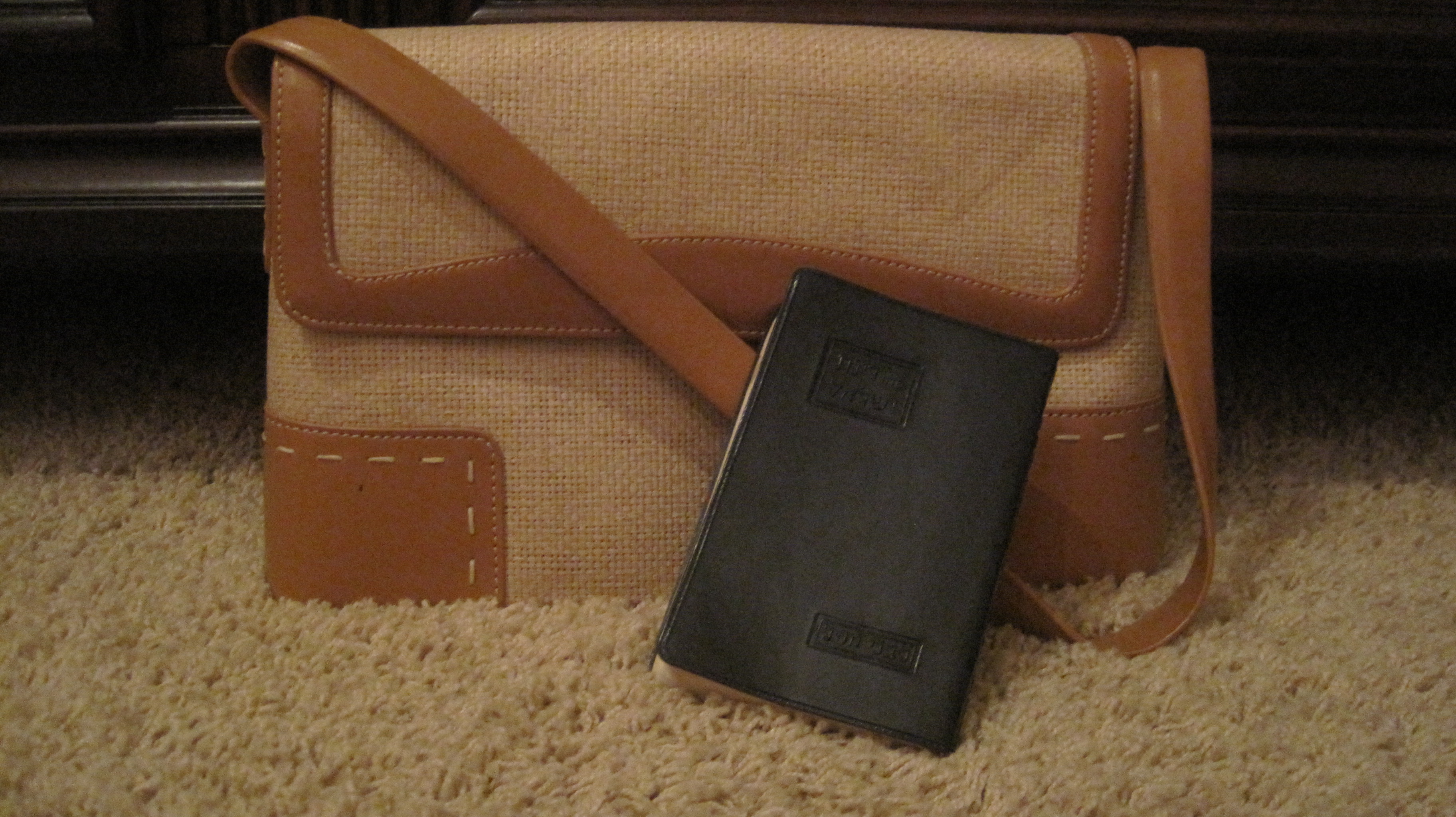
Some of you may recall a siddur dilemma I had last December as I was preparing to attend the Hazon Food Conference.
As for a siddur, I just don’t know. Am I making a public statement by which siddur I use? The Mishkan is bulky. Plus, I don’t really use it for my personal davening. But I am a Reform rabbi and that is our Movement’s siddur. And I do, generally speaking, believe that there is a great deal of strength in having a Movement siddur. On the other hand (as my friend, Tevye, is fond of saying) I enjoy a more traditional prayerbook for my own praying. I was given a copy of Rinat Yisrael 16 years ago by a mentor and it is very dear to me.
I had firmly decided on Rinat Yisrael as my prayerbook of choice when I realized that it had gone missing. {{Poof}} Just like that. Into thin air. DadGiraffe was gracious enough to let me borrow his brand-new Koren siddur. And it was love at first sight.
Shortly thereafter, after returning the Koren to its rightful owner, I ordered my own copy. And, discovering how much I loved it, purchased a second, and more compact, copy. With one in my study and one at home, my personal prayer needs were covered.
And then…just as suddenly as it had vanished, the Rinat Yisrael reappeared. It seems that I had tucked it inside a handbag and forgotten to remove it when I swapped out the bag for a different one. Whatever compelled me to carry that bag two weeks ago, I cannot say. But this is what I know: Had it not gone missing, I would not have needed to borrow the Koren from DadGiraffe. Who knows when, and under what circumstances, the Koren and I would have become fast and furious friends. It was, I suppose, meant to be.
In an unusual turn of events, which happens to be a somewhat regular occurrence here in Frume Sarah’s World, the Koren went missing last week. As I was packing for my trip to the Mayyim Hayyim “Gathering the Waters” Conference, my little Koren was nowhere to be found. As if jealous of the attention being paid in the wake of Rinat‘s homecoming. And so, it was my Rinat Yisrael that accompanied me to Boston.
You wanna guess who showed up tonight???
Finding Meaning

I am not from the poetry-lovers. I think it’s because I typically don’t get it. And had many, MANY classes where I was made to feel stupid for not getting it.
And yet…
Sometimes I run across words, usually prose but sometimes poetry, that grab hold me of me. Words that if I didn’t know better I would believe to have written myself because they so accurately verbalize how I feel.
As You taught Torah to those whose names I bear,
teach me Torah, too.
Its mystery beckons, yet I struggle with its truth.
You meant Torah for me: Did You mean the struggle for me, too?
Don’t let me struggle alone;
help me
to understand,
to be wise, to listen, to know…
Lead me into the mystery.
~Rabbi Richard Levy
The first time I saw these words, I inhaled sharply as they articulated what I’d long felt. The struggle. The tension between what I know, what I do not yet know, what I feel, who I am, who I hope to be, and how I live as a Jew.
But as with much in Jewish ritual life, there is struggle and it is in the struggle that we find meaning. If it was all easy, I suppose, it would be all too easy to take it for granted. To view the behaviours as rote.
Earlier today, one of the rabbis challenged me with “isn’t there meaning in all of the mitzvot?” I found the manner in which the question was phrased to be argumentative and just a little bit insulting. As if I should know that there is meaning in the obligations. Because it was a group setting, and I frankly didn’t feel like engaging in a conversation that would have been exclusionary to the rest of the participants, I did not explain my sense that while each mitzvah has an inherent meaning, I am not convinced that we will come to understand the meaning. Nor should performance of mitzvot be solely determined by whether or not we can discern said meaning. Instead, I just said, “And shatnez? have you found meaning in shatnez?”
And that was the end of that.
I don’t know where this will lead. And that might very well be the most frightening part of the struggle. It isn’t the struggle itself. It is not knowing who or what I’ll be when I come out on the other side. And so I take comfort in the knowledge that You are with me, giving me the space and time needed, but always a Presence.
By the Waters

My head is swirling. Three panels, two keynotes, and a story in song. An aliyah at Shacharit, making new friends, and reconnecting with a classmate. Had the opportunity to hear Rabbi Maya Leibovic, to learn from Rabbi Miriam Berkowitz, whose teshuvah on mikveh I have long admired, and Rabba Sara Hurwitz, who was every bit amazing as I’d imagined.
It has been, in a word, amazing.
But it has also contributed to a heaviness in my heart as I realize that there is no place for me. At least not yet. For although the Reform movement has embraced the use of the mikveh to mark transitional moments, our leadership is largely silent on the monthly use of the mikveh. Seeing a woman as niddah, and the subsequent immersion in the mikveh, was among the numerous “orientalisms” that were discarded by the early Reformers.
I am troubled, as I have noted in prior posts, about the rush toward innovation at the expense of tradition. Why can’t the laws concerning a woman, her menstrual cycle, and immersion in a ritual bath be a meaningful part of liberal Jewish life. At the very least, it ought to be a part of our conversation.
And so, it is by these living waters that I have wept. Wept that I seem to belong everywhere and yet nowhere. Wept because I yearn for a community who struggles with what it means to be an observant, liberal Jews.

 Frume Sarah is Shabbos-observant -- in a Reform way, that is. Please note that from Friday afternoons until one hour after sundown on Saturday evenings, Frume Sarah will be unavailable, in observance of the Jewish Sabbath.
Comments made during this time will be held in a queue, to be moderated afterwards.
Thank you for your understanding...and gut Shabbos!!!
Frume Sarah is Shabbos-observant -- in a Reform way, that is. Please note that from Friday afternoons until one hour after sundown on Saturday evenings, Frume Sarah will be unavailable, in observance of the Jewish Sabbath.
Comments made during this time will be held in a queue, to be moderated afterwards.
Thank you for your understanding...and gut Shabbos!!! 


 Frume Sarah's World